


Learn how to stop escaping your weekly schedule, leverage functional illusions as fuel, and replace chaotic calendars with deterministic routines that protect your energy.
A veteran corporate consultant sits at her desk on a Friday afternoon, her shoulders tight and her eyes burning from a week of endless client demands. She has spent the last five days saying yes to misaligned projects, chasing leads that feel hollow, and surviving on a dwindling runway. Yet, instead of planning a weekend of deep rest, she is preparing to spend the next three days dressed as a clown, performing for hundreds of people in a local community theater production at a nearby medieval castle. She insists this is "fun" and a necessary escape from her heavy professional load. But her body is signaling a deeper truth: she is not resting; she is compensating for a week of self-inflicted imprisonment.
When your business feels like a series of forced chores, your energy reserves deplete rapidly, forcing you to seek extreme counter-measures just to feel alive. This is the silent tax of the independent practice. We escape corporate cubicles to build our own sovereignty, only to become the most demanding, unforgiving bosses we have ever had.
The Compensation Trap: Why Your Weekend is an Escape Hatch
We often treat our energy like a simple bank account: we spend it on painful obligations during the week, and we try to deposit fun on the weekend to balance the ledger. But human biology does not work in neat accounting columns. When you spend your weekdays grit-toothing through work that does not align with your emerging identity, your allostatic load—the wear and tear on your brain and body from chronic stress—skyrockets. The sudden urge to throw yourself into intense, high-energy weekend hobbies is not a sign of vitality; it is an emergency escape hatch.
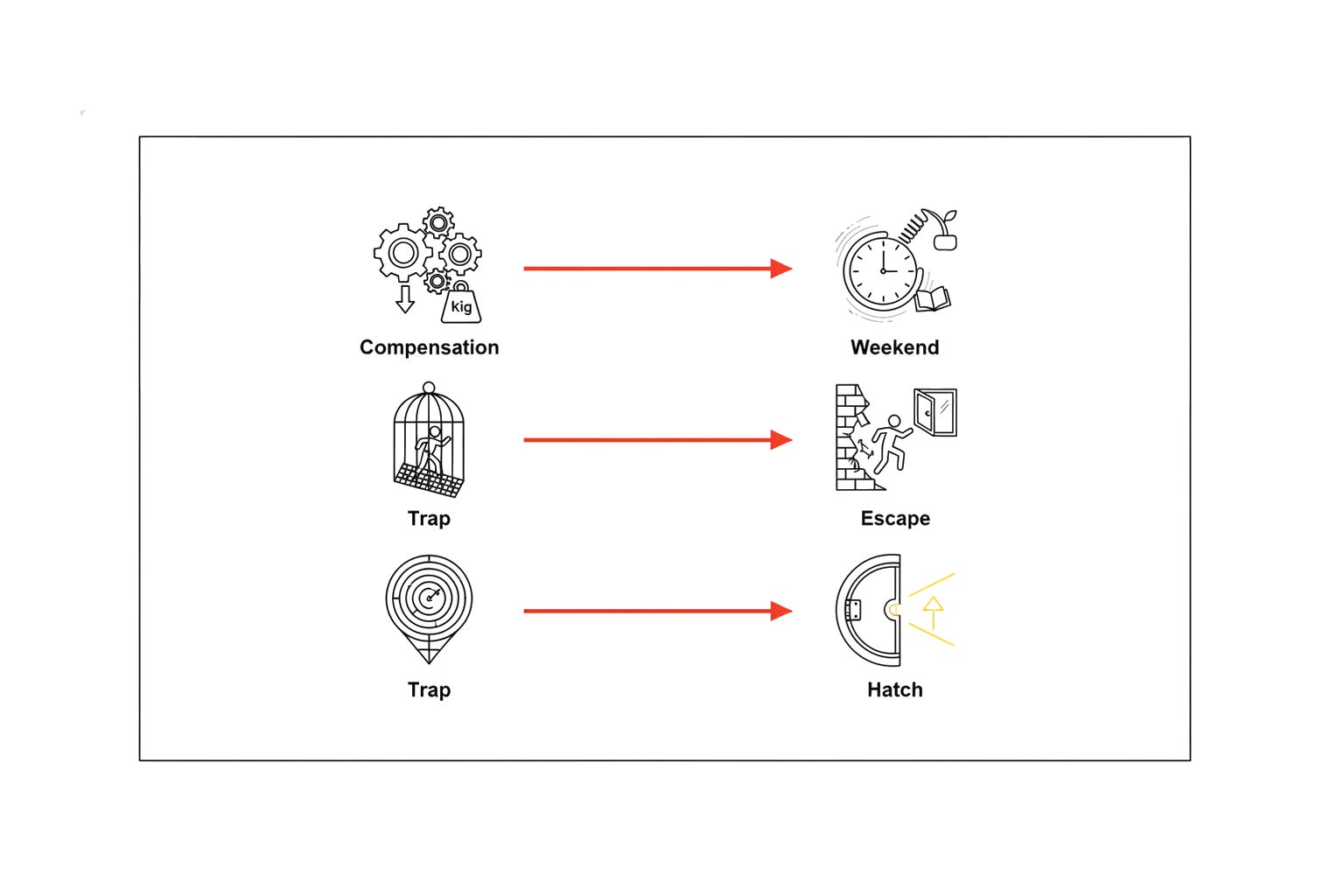
The solution is not to seek a life free of friction, but to choose the right kind of discomfort. Humans are wired to solve problems, and we actually crave the cognitive engagement that comes with overcoming obstacles. When you choose problems that match your core values and business direction, the boundary between effort and pleasure begins to dissolve. You no longer need to escape your weekdays because the work itself, despite its challenges, feeds you.
"If you design the real friction that matches you, pleasure and adversity travel together. Compensation is simply the receipt showing that your weekday problems are still not truly yours."
When you find yourself saying "I must" or "I am obliged to" regarding your daily tasks, it is time to look at who is holding the pen. Often, we carry invisible contracts with past versions of ourselves or external markets that we never agreed to maintain. By engaging in micro-negotiations with your schedule, you can begin to reclaim your sovereignty, ensuring that the adversity you face on a Tuesday is the exact adversity that will grow your business on a Friday.
Useful Illusions: Recruiting Your Brain's Scaffolding
When transitioning your practice toward a more aligned model, you will inevitably face a gap between who you are today and the leader you need to become. This gap often triggers profound resistance and imposter feelings. Rather than waiting for perfect confidence to strike, you can strategically leverage what cognitive scientists call instrumental emotion regulation. Research by Maya Tamir (2009) demonstrates that our brains do not merely seek pleasant states; they can purposefully recruit uncomfortable or even illusory emotional states—like engineered pressure, controlled anger, or artificial constraints—to achieve functional utility.
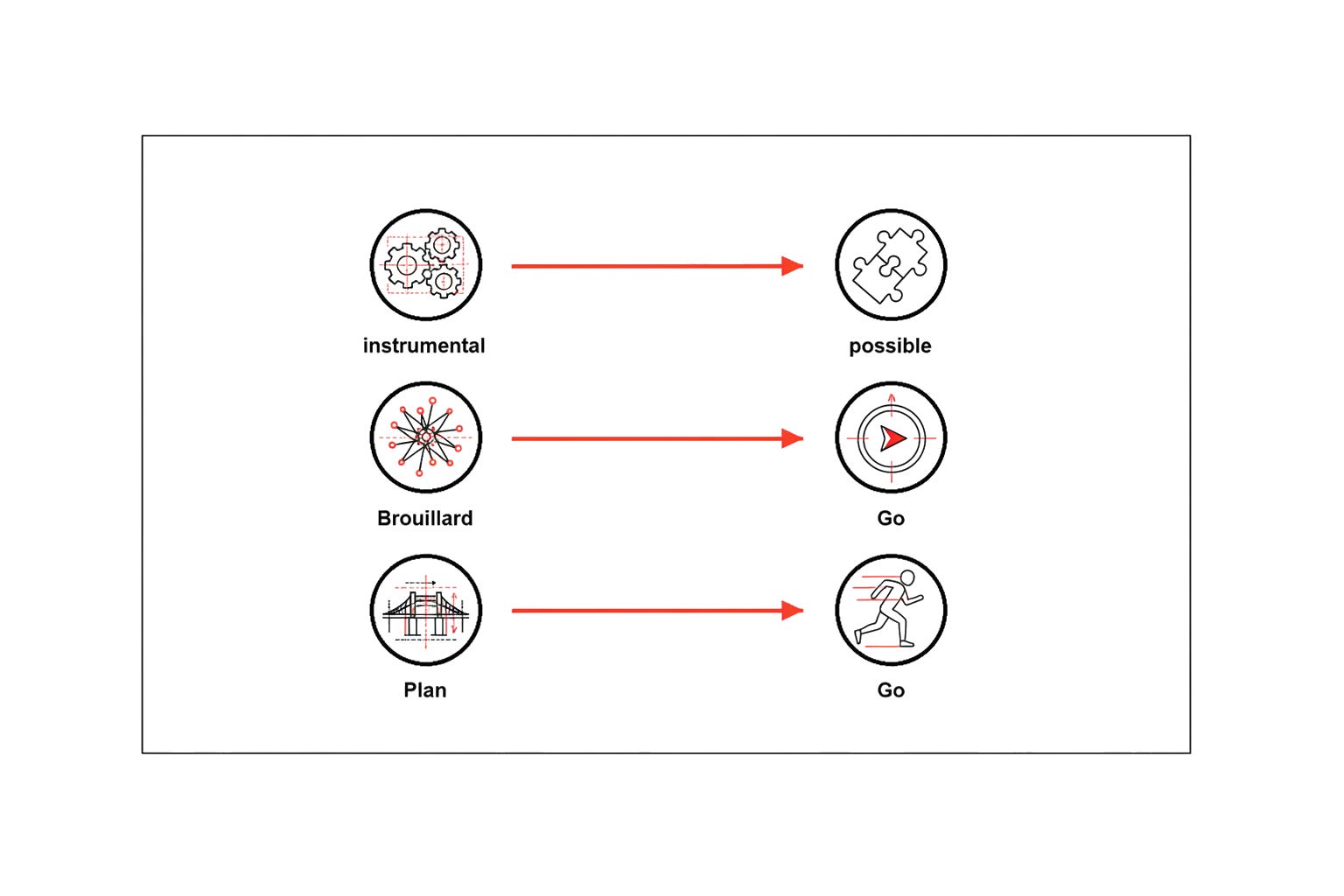
Similarly, psychologist Hazel Markus (1986) introduced the concept of possible selves—cognitive representations of who we might become, who we would like to become, and who we are afraid of becoming. These possible selves act as temporary "identity scaffolding." Just as construction workers use metal scaffolds to support a building while its permanent walls are set, you can adopt temporary professional identities and structured illusions to hold yourself up while you build new operational habits.
I experience this dynamic daily during my own morning routine. Every morning, my journal names my early-morning writing block as my primary friction of the day. The temptation is to focus on my inadequacy—on every awkward sentence and slow paragraph. But instead of suffering that gap, I treat it as Deliberate Play, gamifying the challenge so that the discomfort builds me up rather than tearing me down.
"You do not need to fully become your future self before you act. You need the scaffold—the temporary identity and designed habits—that produces the results while you build the foundation."
By consciously choosing which illusions to use rather than passively suffering them, you turn potential anxiety into kinetic fuel. If you are dependent on being seen as an expert, do not condemn the need; use it to scaffold your next high-value writing piece. If you feel unprepared, build a tight, 45-minute operational box that forces rapid execution before your inner critic can wake up.
Go deeper 👉 : How to Move Beyond Wounds and Humiliation
The Deterministic Day: Building Recipes, Not Fate
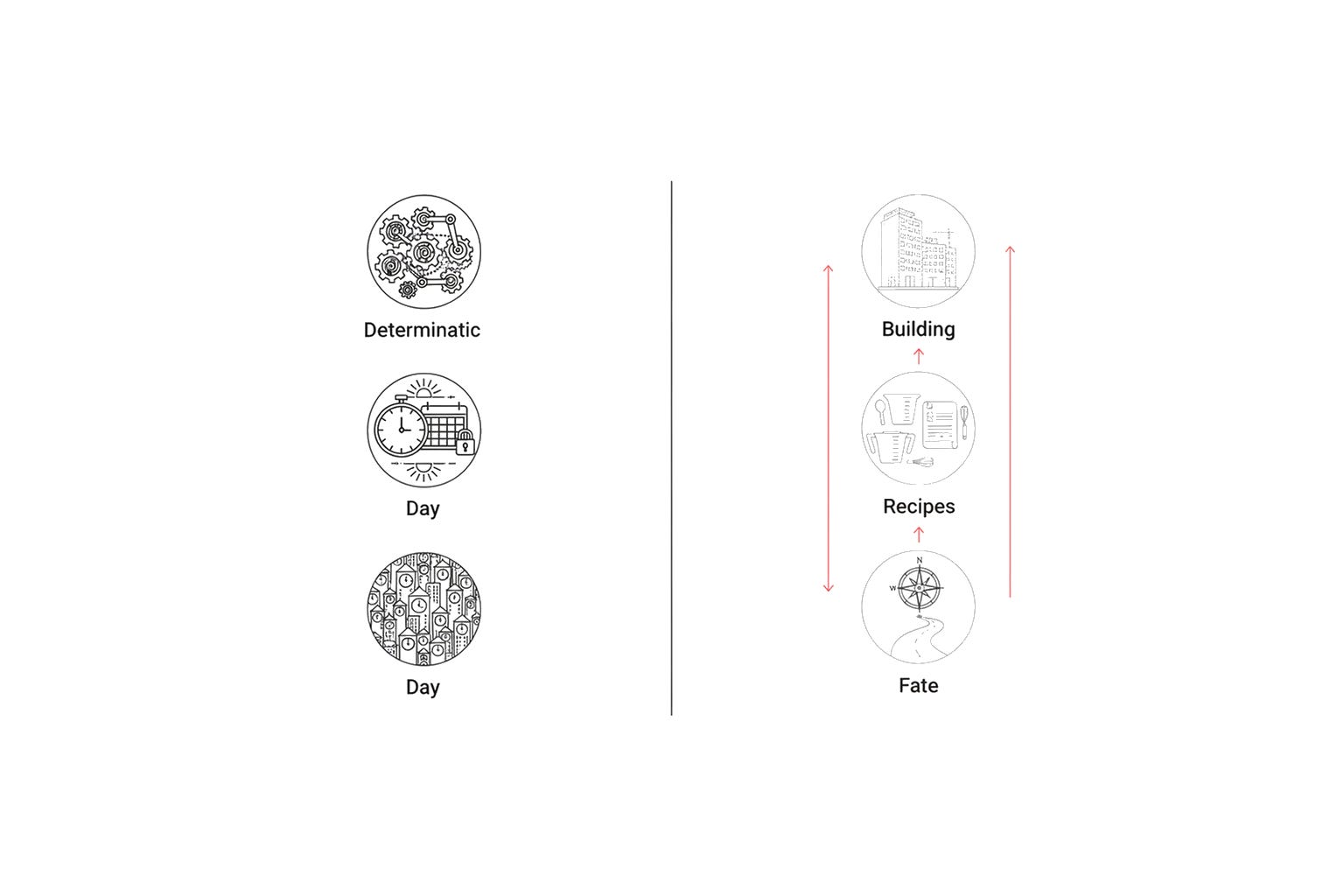
Most independent consultants design their calendars around a lottery. They write down a massive, idealistic to-do list for Monday morning, cross their fingers, and hope they will have the heroic willpower to complete it. When evening arrives and half the list remains untouched, they feel defeated and exhausted. This is a probabilistic approach to work—one that relies on luck, mood, and uninterrupted circumstances.
Go deeper 👉 : Stop Voting on Your Morning
To regain operational sovereignty, you must transition to a deterministic model. A deterministic day is built like a precise culinary recipe. A master sushi chef does not hope the rice turns out well; they follow a highly controlled sequence of temperature, water, and timing that makes a perfect result mathematically probable.
To build your own deterministic day, you must identify your critical operational links and protect them fiercely. This does not mean scheduling every minute of your week until you choke your own creativity. Rather, it means isolating one or two high-impact cells—such as a protected morning block dedicated to deep offer design or client outreach—and designing the exact environmental inputs, time constraints, and recovery markers required to make execution automatic. By treating these blocks as repeatable recipes rather than heroic battles, you preserve your cognitive energy and ensure consistent progress.
Exploded-view thinking: Record the first imperfect teaching
A strategy you cannot explode into parts is a strategy you cannot teach. Take the trait, the context, and the consequence apart the way a mechanic lays a gearbox on the bench — so your twin can hear the sequence.
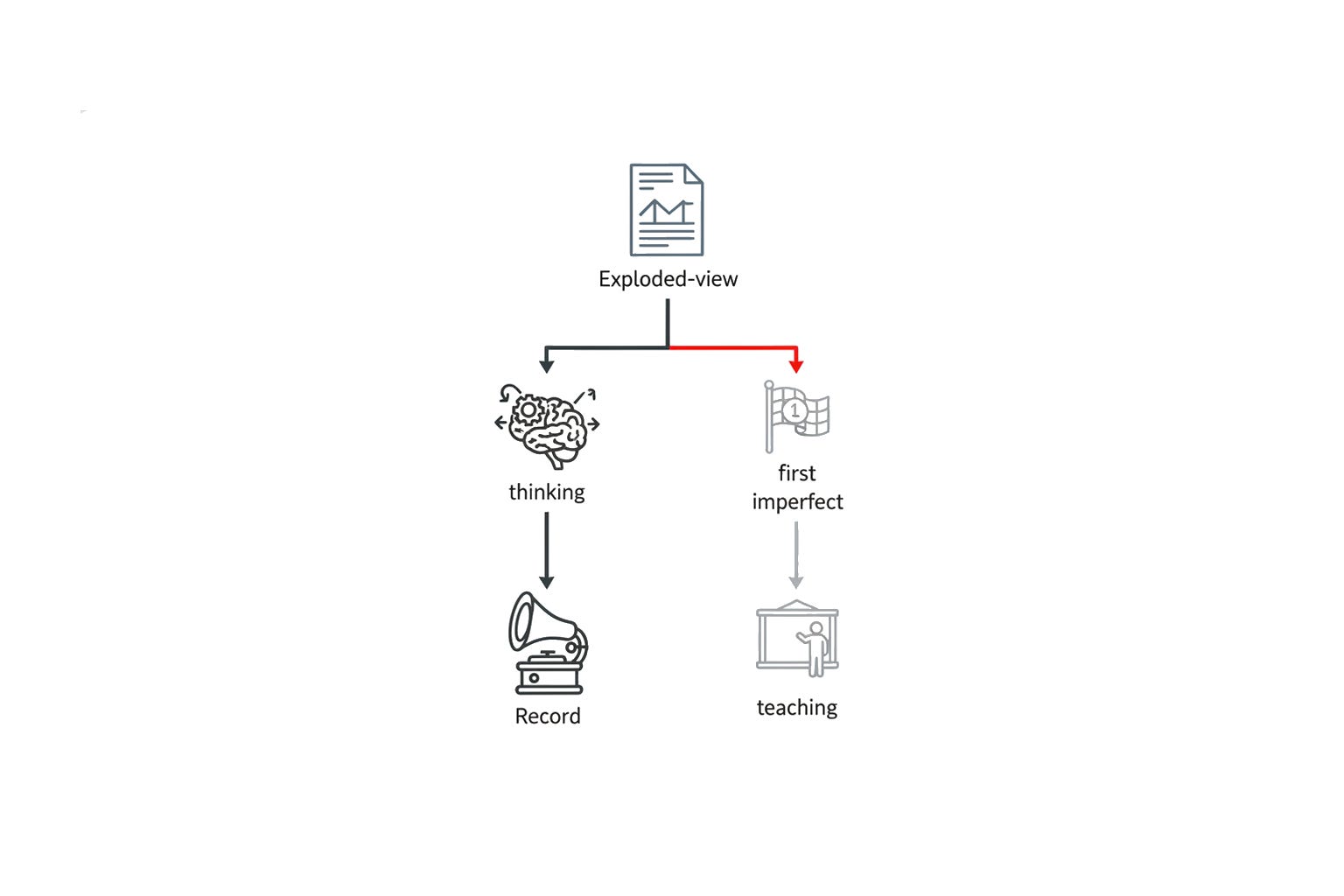
The first recording is supposed to be imperfect. Name one cell already at ease and one still tight. Paper fades in two weeks; the old cycle returns unless the teaching is on tape.

Your Move This Week
Copy the YAML block into Claude, ChatGPT, or your preferred AI.
Replace each placeholder with your situation this week.
Paste the three numbered returns into your notes.
### INSTALLS
1. Audit your weekday obligations to identify where you are compensating.
2. Scaffold a functional identity or useful illusion to fuel your immediate tasks.
3. Build one deterministic morning cell to protect your energy from the daily lottery.
### YOU ARE
An independent coach or consultant who is feeling exhausted by daily business demands,
struggling with fuzzy offers, and trapped in a cycle of surviving the week only to crash
or overcompensate on the weekend.
### MY SITUATION
[ROLE]
[LOAD]
[RUNWAY_MONTHS]
[ENERGY_SCORE]
### ASK 1
Analyze my current weekly schedule to find the "I must" tasks that cause the Friday crash.
- Identify the specific business obligations that feel like punishments.
- Pinpoint my primary compensation behavior (e.g., extreme hobbies, total collapse).
- Propose one designed discomfort that I actually want to solve instead.
### ASK 2
Help me build an identity scaffold for my high-friction business tasks.
- Identify a useful illusion or "possible self" I can adopt to face these tasks.
- Apply the principle of instrumental emotion regulation to turn my anxiety or resistance
into kinetic fuel.
- Define a micro-negotiation to lower the barrier to entry for this task.
### ASK 3
Design one deterministic morning cell for my upcoming week.
- Specify a 45-to-90-minute block that operates like a rigid recipe, not a lottery.
- Detail the exact inputs, environmental constraints, and recovery markers for this block.
- Explain how this cell replaces heroic effort with predictable execution.
### RETURN ONLY
1. Your audit of my weekday obligations, highlighting the compensation receipt and the
proposed designed discomfort.
2. Your identity scaffolding plan, detailing the useful illusion, its functional utility,
and the micro-negotiation to initiate it.
3. Your deterministic morning cell design, structured as a repeatable recipe with clear
boundaries and recovery markers.