

Assets/event-plus-response-substack-hero.png
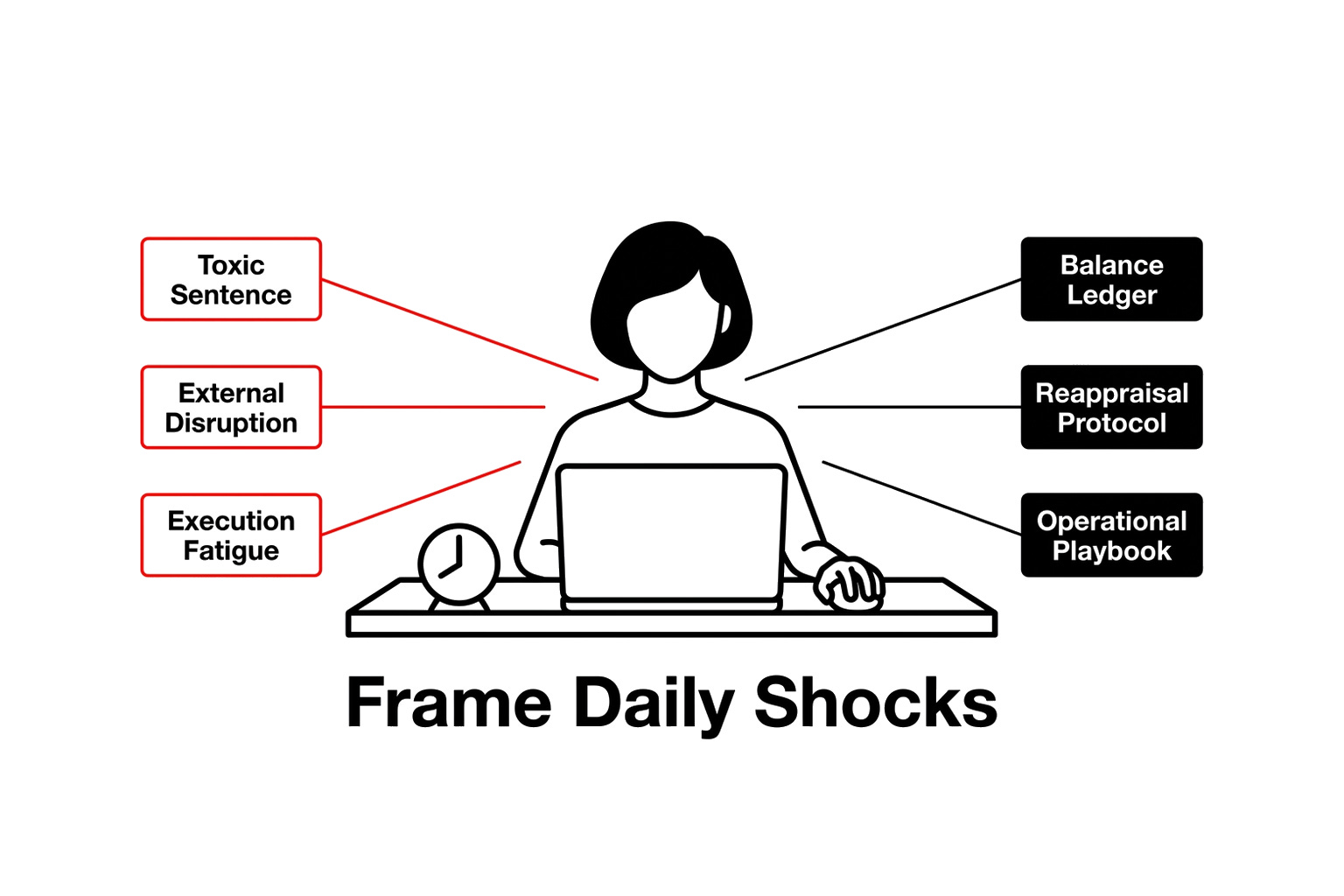
This article installs three operational shifts: neutralizing the internal sentence that cancels focus, running event-plus-response arithmetic on daily shocks, and separating your revenue machinery from personal validation needs.
You sit down at your desk at 8:00 AM to execute a high-value focus block—refining a premium consulting proposal or launching outreach to prospective enterprise clients. Within twenty minutes, a familiar heaviness lands in your chest, accompanied by a quiet sentence: Why bother, you are not advancing fast enough anyway. You look at the blank screen, feel your jaw tighten, and instantly rationalize closing the tab to clear your inbox or check pipeline stats instead. The moment you yield, a second sentence fires: You are not serious, you never hold the line.

The toxic sentence that cancels the working hour
The breakdown of focus rarely stems from raw physical exhaustion or lack of strategic clarity. It begins when an unexamined internal state generates a single toxic sentence, which your executive function immediately misinterprets as an objective evaluation of your business reality.
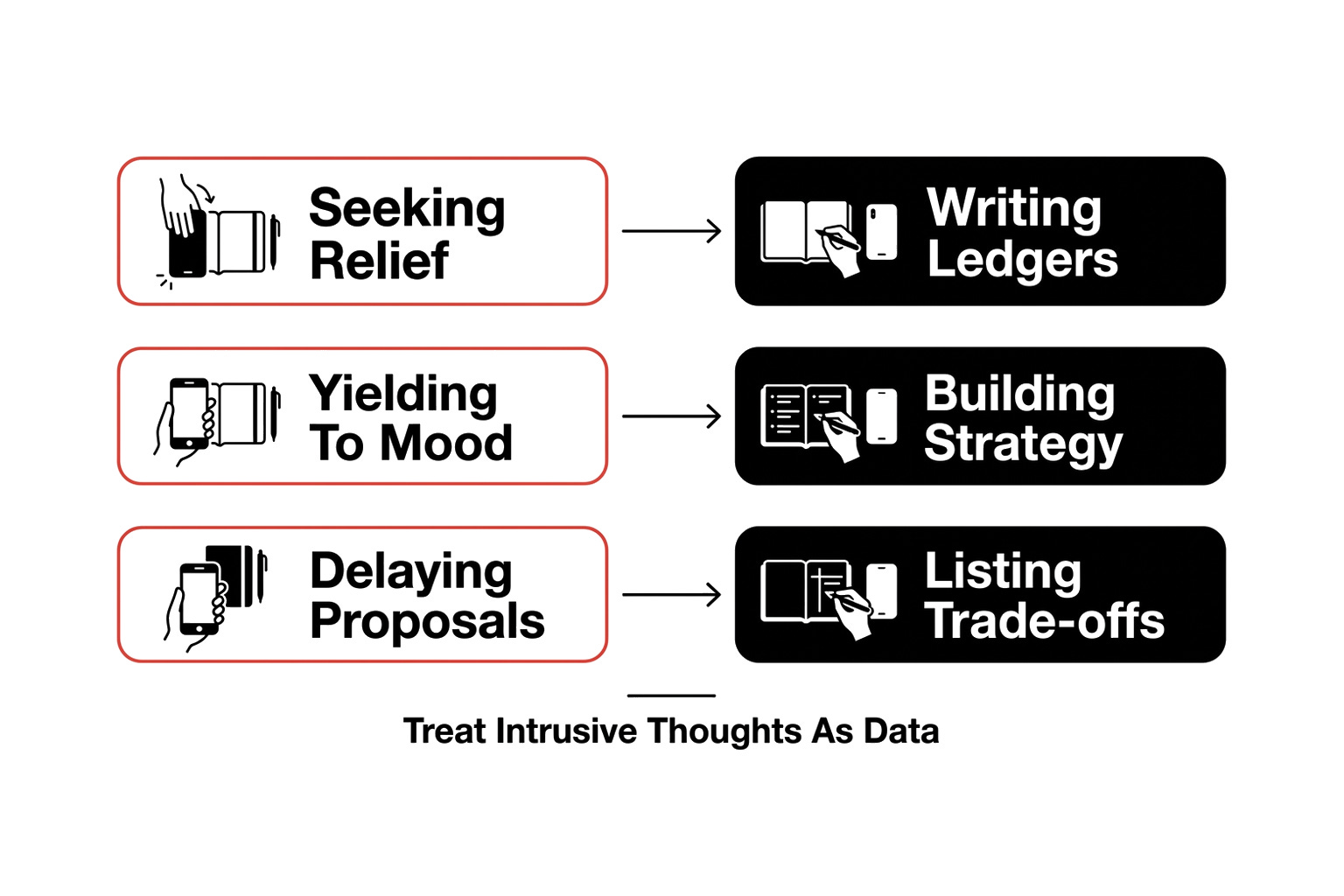
When doubt arises during deep training or high-stakes business execution, the default temptation is to seek immediate relief by abandoning the task. You cancel the session, put down the phone, or delay the proposal, telling yourself that you need better alignment or more energy before proceeding. Yet the instant you yield, your cognitive standard penalizes you for breaking discipline, locking you into a paralyzing loop where both staying and quitting feel untenable.
To break this loop, you must treat the intrusive thought not as a verdict, but as raw data to be evaluated through a structured decisional balance ledger.
Assets/event-plus-response-the-toxic-sentence-that-cancels-the-working-hour-inline.png
"When a toxic thought tells you to stop, do not make a dramatic decision on the spot. Write down every short, medium, and long-term benefit of continuing, alongside the precise price of stopping. The list is not the decision—it is the evidence stack you build so your next wave of doubt meets a strategy instead of a mood."
Before altering your schedule or abandoning a critical focus block, force yourself to write down the exact parameters of the trade-off. List three immediate gains of pushing through the discomfort, alongside the cumulative business costs of stopping. This intervention intervenes in the cognitive cascade, shifting processing from automatic stress reactivity back to prefrontal executive control before autonomic fatigue sets in.
Go deeper 👉 : How to Move Beyond Wounds and Humiliation
Event plus response: selecting the useful frame
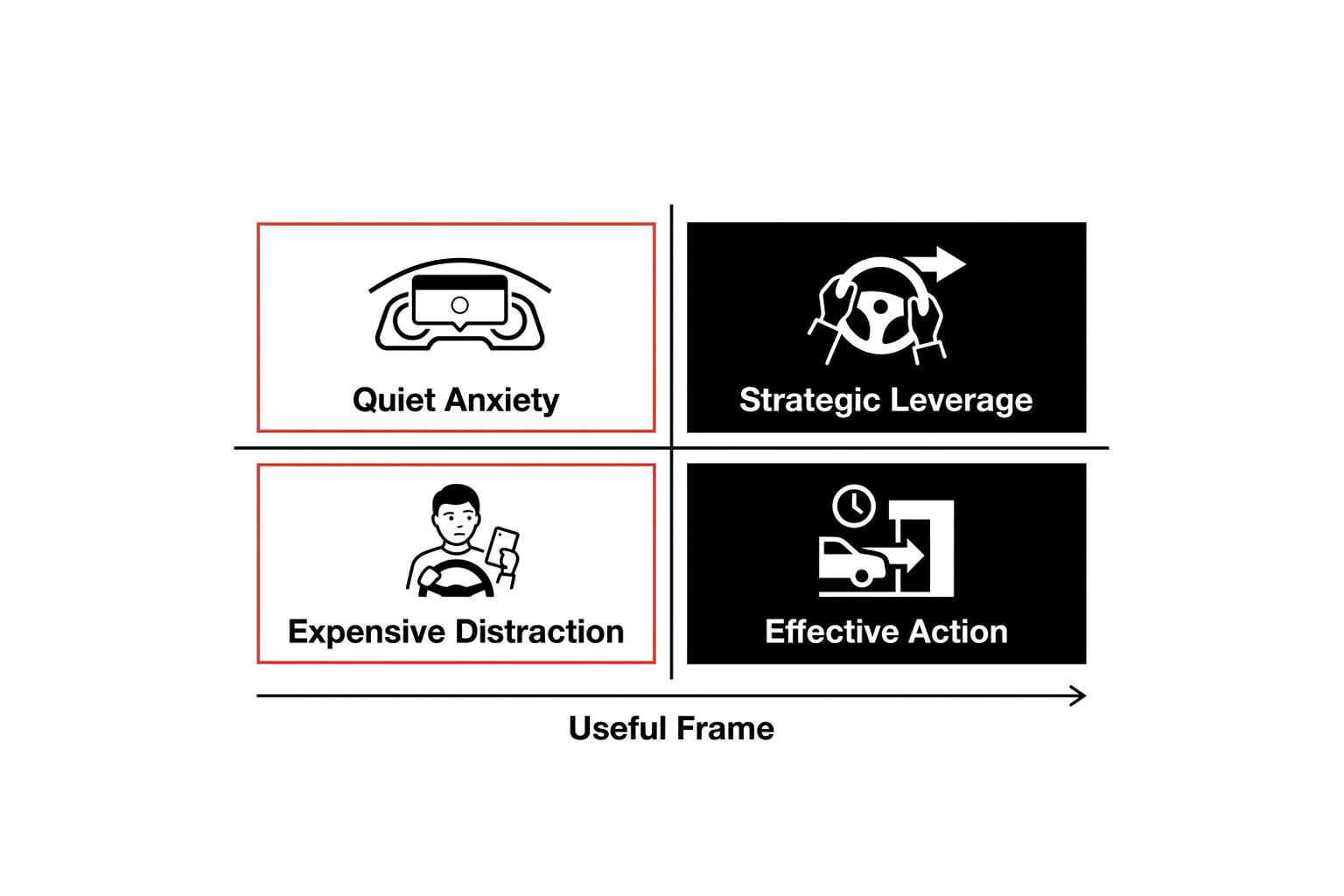
Imagine driving to a strategic meeting when a message arrives on your dashboard: your key sub-contractor or delivery partner is abruptly resigning for a corporate role. If you are already carrying quiet anxiety about your consulting revenue, your immediate reflex might be to interpret this as a sign that your business model is collapsing. Alternatively, you might frame it as a cosmic test of your endurance.
Go deeper 👉 : The Professionalism Trap
Both interpretations can be spun into coherent stories inside your mind, but pursuing whether an event is inherently "good" or "bad" is an expensive distraction. What dictates your market trajectory is a rigorous equation: Event + Response = Outcome.
The external event is a fixed variable that carries zero inherent operational meaning until you process it through a cognitive reappraisal protocol.
Assets/event-plus-response-event-plus-response-selecting-the-useful-frame-inline.png
When an external disruption lands—a lost client pitch, a delayed contract, an unexpected key partner departure—you possess the immediate authority to select the cognitive frame that yields the highest leverage response. The skill is not in proving your narrative right, but in choosing the frame that mobilizes effective action.
"Whatever story you choose to tell yourself about an unexpected event, you will be right inside your own head. The only question that matters for an operator is: which thought is actually useful to run?"
When I look back at how I constructed my own advisory space, I realized I built it primarily as the environment I personally required to refine my operational clarity, test mental mechanics, and sharpen my command over growth systems. The moment I briefly allowed an arbitrary external goal—like needing thousands of passive members—to overwrite that core purpose, operational friction surged and energy drained. Returning the room to its original purpose instantly restored strategic leverage and clarity.
Build the cognitive strategy before you hit the wall
Independent consultants frequently operate under the fantasy that a well-designed advisory practice should run smoothly without severe friction points. When they inevitably encounter an enterprise client pushback, a dry deal pipeline, or intense execution fatigue, they experience the friction as evidence of personal failure rather than a predictable feature of high ambition.
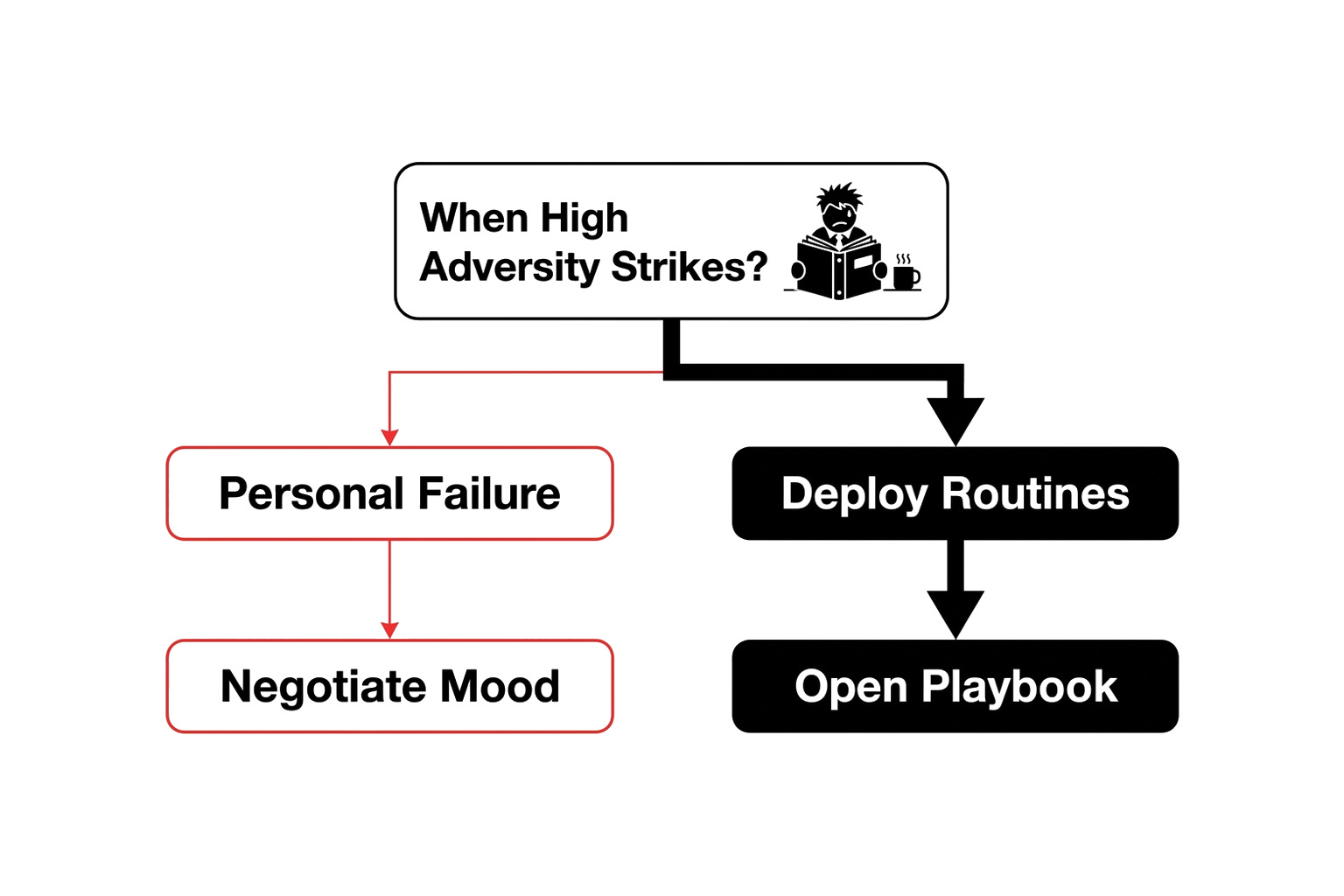
Relying on real-time willpower when you hit a high-stress wall is an operational flaw. Under acute pressure, your brain naturally defaults to immediate discomfort avoidance.
You must institute pre-built coping planning before you encounter the wall.
Assets/event-plus-response-build-the-cognitive-strategy-before-you-hit-the-wall-inline.png
"You do not build a victory log or a strategy stack to display on a shelf for motivation. You build it so that when you hit an inevitable wall, you have an operational playbook ready to open that does not depend on how you happen to feel that morning."
Go deeper 👉 : The Anatomy of High Performance Discipline
High-performing operators construct an institutional memory of past execution victories, client transformations, and systemic problem-solving frameworks during calm periods. When high adversity strikes, they do not negotiate with their mood; they deploy pre-committed routines that maintain forward momentum pebble by pebble, step by step.
By exercising instrumental emotional regulation, you decouple daily progress from transient emotional states, treating friction simply as the tax required to operate at the height of your commercial ambition.
Separating the role from the underlying need
A subtle systemic trap for senior advisors is conflating a professional business vehicle with their personal identity and emotional needs. A consultant might spend four years struggling to make a specific offering profitable, enduring constant strategic drag without realizing that they are asking that business offer to deliver something it was never designed to provide.
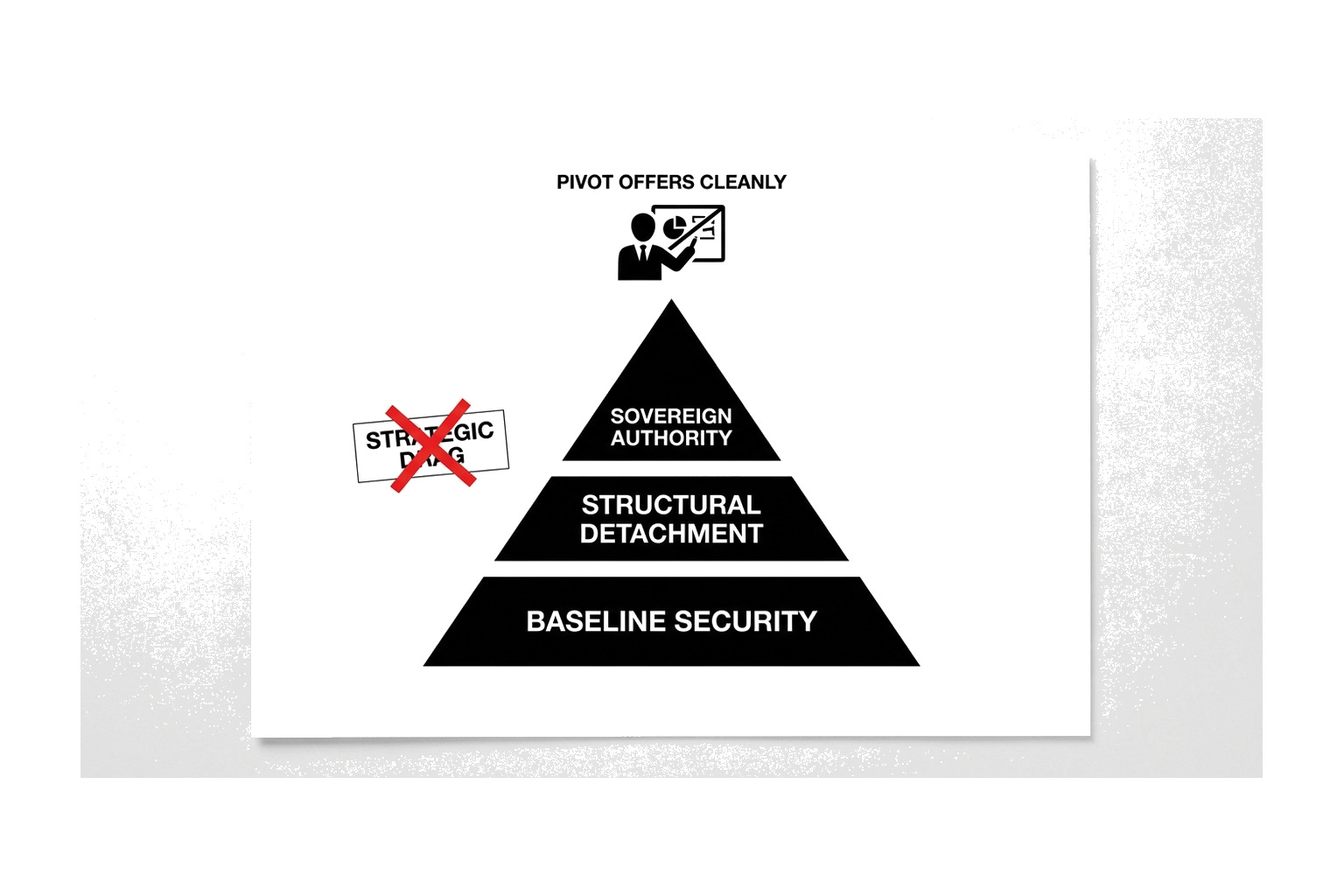
When you demand that your consulting practice deliver total existential validation, creative complete freedom, and total financial ease all at once, you overload the business vehicle.
Resolving this requires executing a clean structural role detachment.
Assets/event-plus-response-separating-the-role-from-the-underlying-need-inline.png
"Many professionals hold onto an underperforming offer or high-friction client dynamic far too long because they confuse the operational vehicle with their personal worth. When you separate the economic role from your inner need, you can finally make sovereign business decisions without lingering grief or drama."
Examine where you are exerting obstinate persistence in your current practice. Are you holding onto a client segment or an offer structure long after it has proven inefficient simply because you believe making this specific offer work will prove your competence?
When you systematically separate the vehicle (the commercial offer engineered to solve a client problem) from the underlying need (your financial runway or baseline security), you regain complete sovereign authority over your business architecture. You can adjust prices, pivot offers, or terminate toxic accounts cleanly, without taking daily operational friction as a personal verdict.
Your Move This Week
Copy the YAML block into Claude, ChatGPT, or your preferred AI.
Replace each placeholder with your situation this week.
Paste the three numbered returns into your notes.
### INSTALLS — 1) Neutralize the toxic sentence cancelling focus 2) Run event-plus-response arithmetic on external shocks 3) Separate structural offer roles from internal validation needs
### YOU ARE — An independent coach or consultant experiencing revenue pressure, offer doubt, or execution fatigue
### MY SITUATION — [ROLE: Independent Consultant / Executive Coach] · [LOAD: High friction, fluctuating revenue, execution drag]
### ASK 1 — When an internal narrative threatens to cancel a deep-work focus block, log the decisional balance costs and benefits before altering your schedule.
Return:
- Log 3 specific short, medium, and long-term gains of continuing the session or task.
- Log 3 concrete costs of stopping or abandoning the commitment.
### ASK 2 — Upon receiving an unexpected external disruption, write out two contrasting interpretations and select the operational frame.
Return:
- Frame A (passive reaction / sign to yield) vs. Frame B (testing ground / mechanical
data).
- The exact response action attached to Frame B.
### ASK 3 — Audit your core business offers to decouple structural revenue delivery from underlying psychological validation needs.
Return:
- Identify the primary business vehicle generating or requiring revenue.
- Name the exact need previously loaded onto that vehicle and assign it a cleaner,
dedicated channel.
### RETURN ONLY — 1) Decisional balance log for the current friction point 2) Dual-frame interpretation + chosen action 3) Decoupled offer profile and reallocated validation channel