

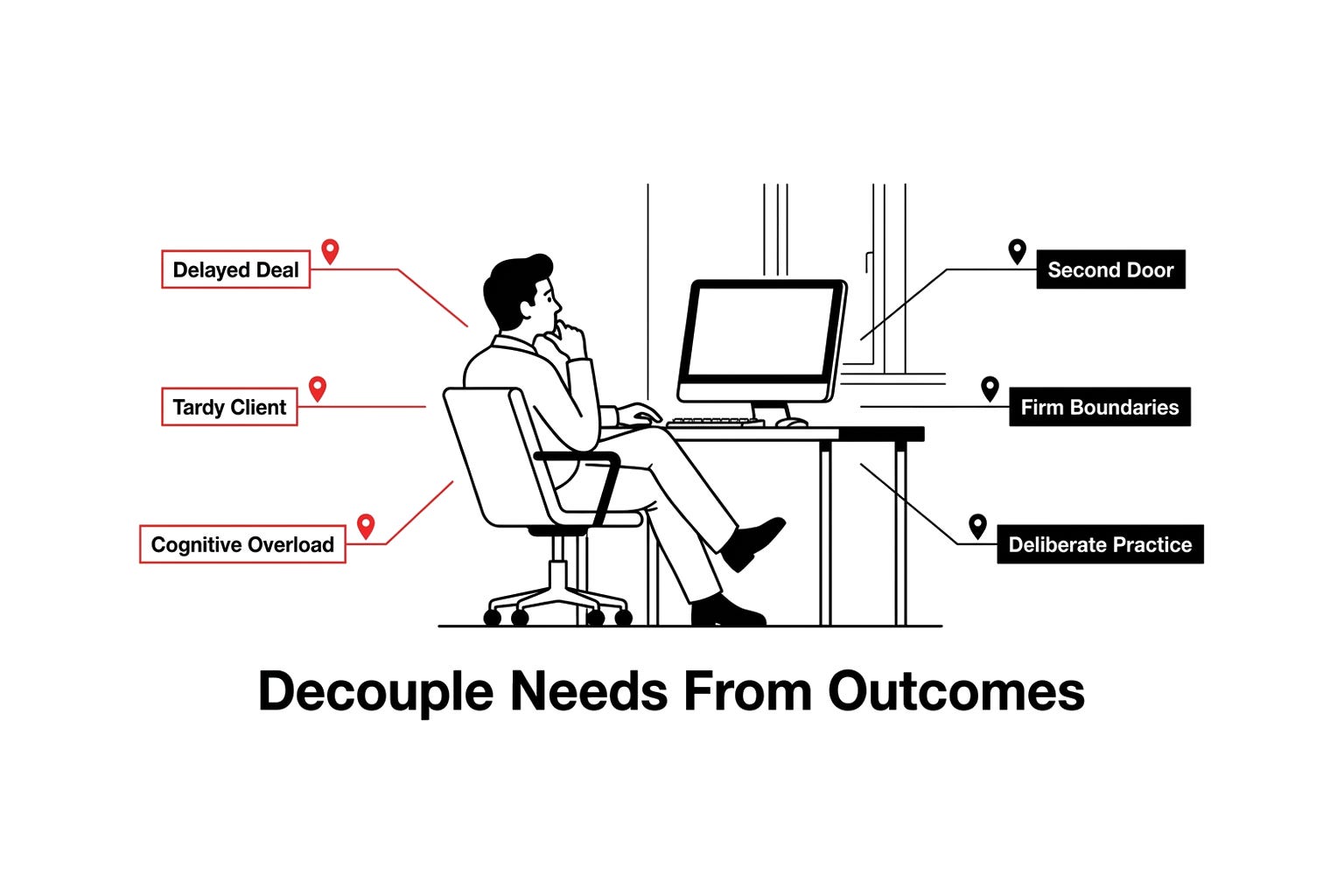
This article installs three operational mechanisms: decoupling core human needs from client outcomes, converting implicit operational obligations into explicit rights, and maintaining strategic decisions across time through distributed micro-calibration.
The consultant sat back in his chair, staring at a proposal draft that had been sitting open on his screen for forty-eight hours. Three days earlier, an exploratory conversation with a prospective corporate client had set his chest on fire; he had spent the entire evening sketching a custom intervention, convinced that this single account would validate his independent practice and secure his runway for the year. By Thursday morning, when the client asked to reschedule the closing call, the excitement vanished, replaced by an acute heaviness in his shoulders and a sudden urge to clean his desk or update his website. His revenue line looked like a mountain range, and after two years on his own, the idea of returning to a corporate salary felt less like a defeat and more like a quiet relief from the constant exhaustion.
You know this internal landscape if you have ever run an independent practice. You do not suffer from a lack of talent or market opportunity; you suffer from an architecture that forces a single commercial event to carry your biological need for vitality, progress, and validation. When the outcome hangs in the air, your body interprets the delay as an existential drop, pulling your focus away from critical outbound work precisely when consistency is required.

The saw starts where a need has only one door
When an independent operator experiences violent swings between hyper-focus and complete inertia, the problem is rarely laziness. It is a structural defect in how core needs are routed through business activities. If your need for raw vital energy or professional significance can only be satisfied by a client signing a contract, every stalled negotiation triggers a neurochemical collapse.
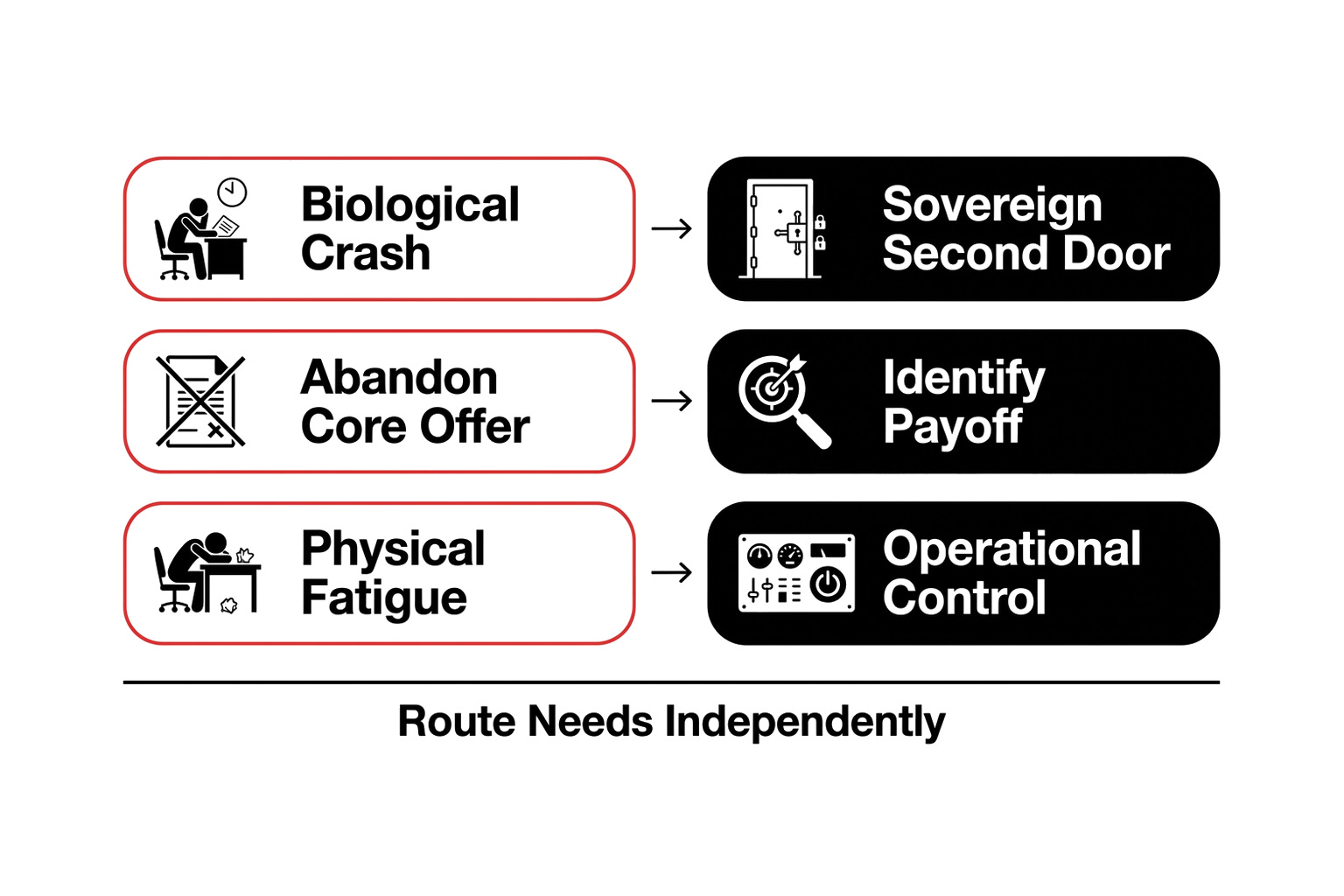
When a promised opportunity evaporates, your brain registers a sharp reward prediction error. Dopamine plummets below baseline, activating an autonomic flight response that manifests as physical fatigue, procrastination, or an urgent impulse to abandon your core offer and build something new. The fatigue you feel on Thursday afternoon is not a character flaw; it is a predictable biological crash caused by placing a single point of failure at the center of your emotional system.
"There is no fruit on this tree, and I am going to stay anyway. A need with only one door turns every delayed outcome into a saw."
To break this cycle, you must identify the exact psychological payoff your current expansion projects are secretly hired to provide. If a new venture is actually being hired to satisfy a need for novelty or social immersion, you must construct a sovereign second door that feeds that need without requiring a prospect’s signature. Once the underlying biological need is secured independently, a lost deal becomes merely data rather than a personal crash, restoring calm operational control over your pipeline.
Go deeper 👉 : How to Move Beyond Wounds and Humiliation
Surprise is an uncollected permission
Consider an operator who routinely waits forty-five minutes in a virtual room for a tardy executive client, fuming quietly while staring at her calendar. On paper, she calls this exceptional client service and professional patience. In reality, her body is under chronic stress, characterized by shallow breathing and a locked jaw, because she believes that enforcing her time will destroy the relationship.
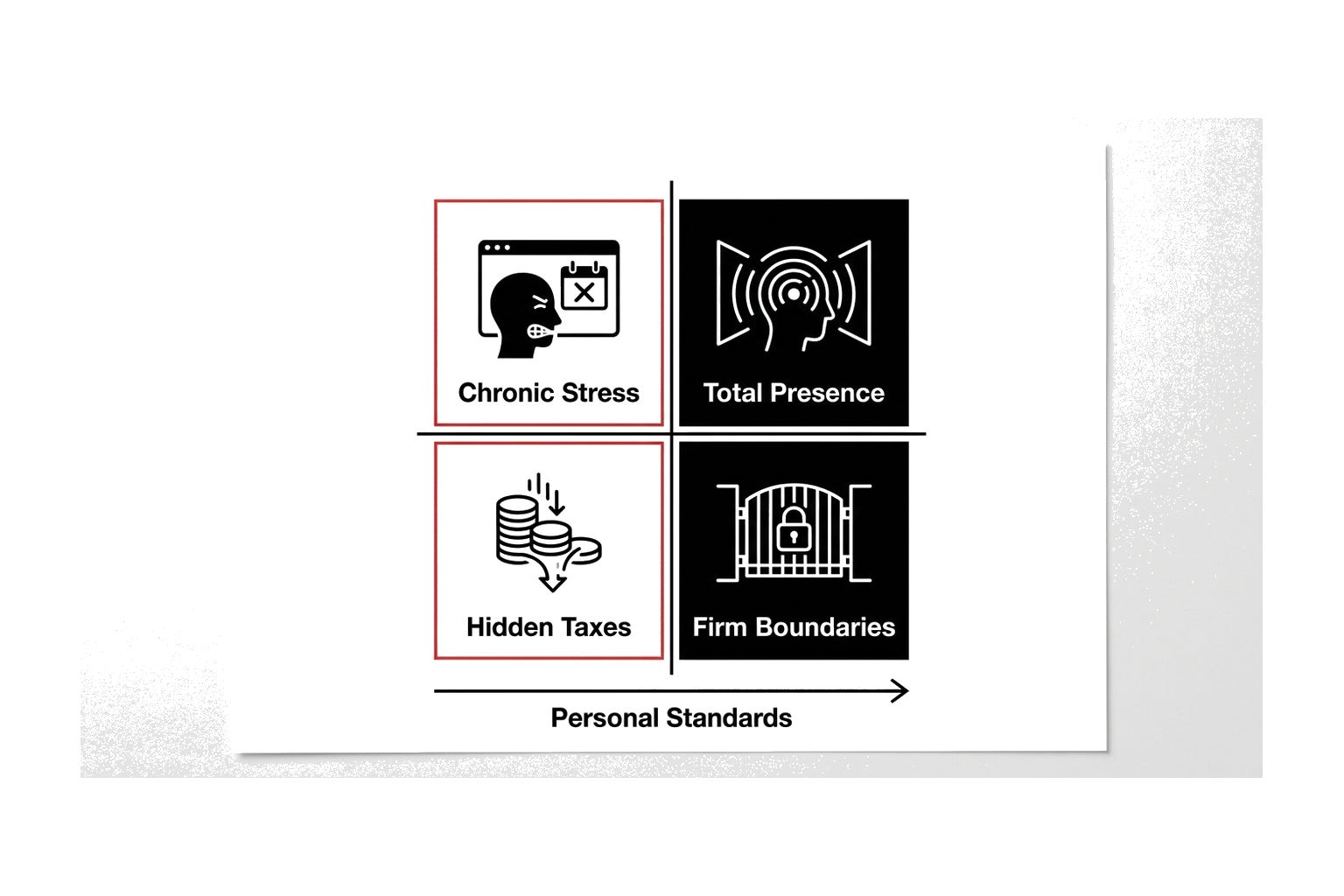
The friction endures because of an unexamined operational rule: I must accommodate every client demand to remain valuable. The turning point arrives when the operator realizes that professional respect cannot exist without firm temporal boundaries. The shift from "I must tolerate this wait" to "I have the right to leave after ten minutes" is not a aggressive stance; it is the collection of an operational permission that was always available.
When you clarify your personal standards, you remove the hidden emotional taxes that bleed your daily capacity. A clear rule frees executive attention from continuous micro-negotiations, allowing you to execute high-stakes work with total presence. When you stop spending your self-respect in hallways and waiting rooms, your offers naturally regain their authority and precision.
Go deeper 👉 : How to Stop Negotiating With Your Calendar
Splitting practice into two distinct postures
In my own daily protocol, when I refine complex analytical frameworks or practice high-friction communications, I never mix live execution with self-critique. I set up dedicated artificial environments where an AI interface is assigned two explicit roles in sequence: first, acting as a rigorous sparring partner, and second, operating as a cold, objective coach analyzing sentence structure, logical coherence, and hidden evasions.
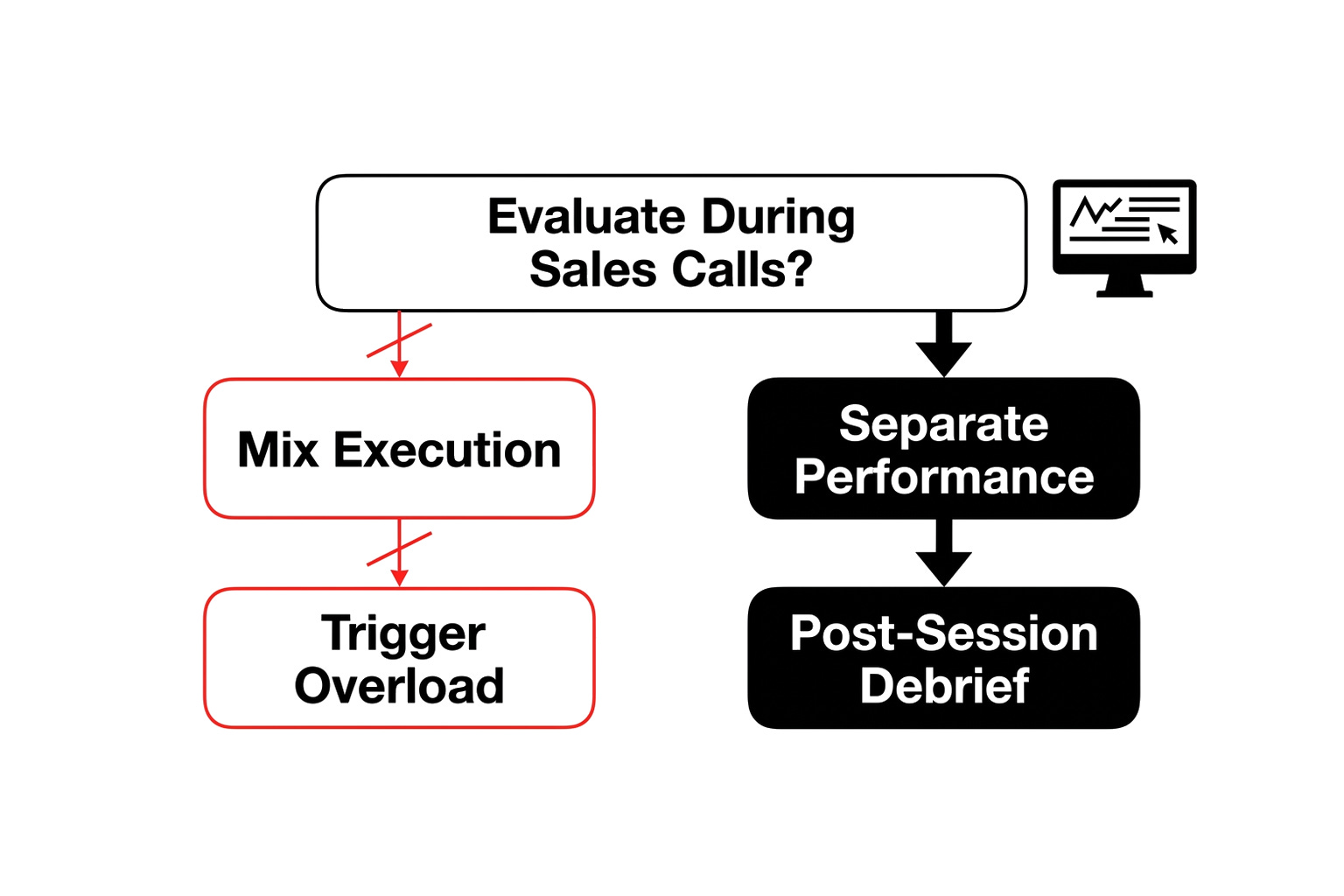
Most coaches fail to build steady revenue because they attempt to evaluate their sales calls or program design while actively performing them. This cognitive overload triggers anxiety and defensive maneuvers during client interactions. By separating performance from deliberate practice, you create an environment where failure carries zero operational cost, allowing you to refine your pitch until your delivery carries an unquestionable transfer of certainty.
Copy the YAML block into Claude, ChatGPT, or your preferred AI.
Replace each placeholder with your situation this week.
Paste the three numbered returns into your notes.
[LIVE PERFORMANCE POSTURE]  --->  Executes without internal commentary
                                           |
                                           v
[DIAGNOSTIC POSTURE]        --->  Analyzes structural breakdowns after the call
When you enter a client meeting, your sole focus must be reading the room and guiding the prospect through their own resistance. Diagnostic review belongs strictly to the post-session debrief. This discipline isolates fear, accelerates skill acquisition, and prevents live commercial conversations from turning into emotional trials.
Maintaining the decision past the bargain
A decision made during a high-energy Monday strategy session is easy to honor when energy is high. The true friction appears on Wednesday afternoon when the initial enthusiasm has faded, and you are left with cold outbound actions or difficult administrative tasks. This is where the internal saboteur mechanics sequence takes hold, offering comfortable excuses to adjust your scope or renegotiate your standards.
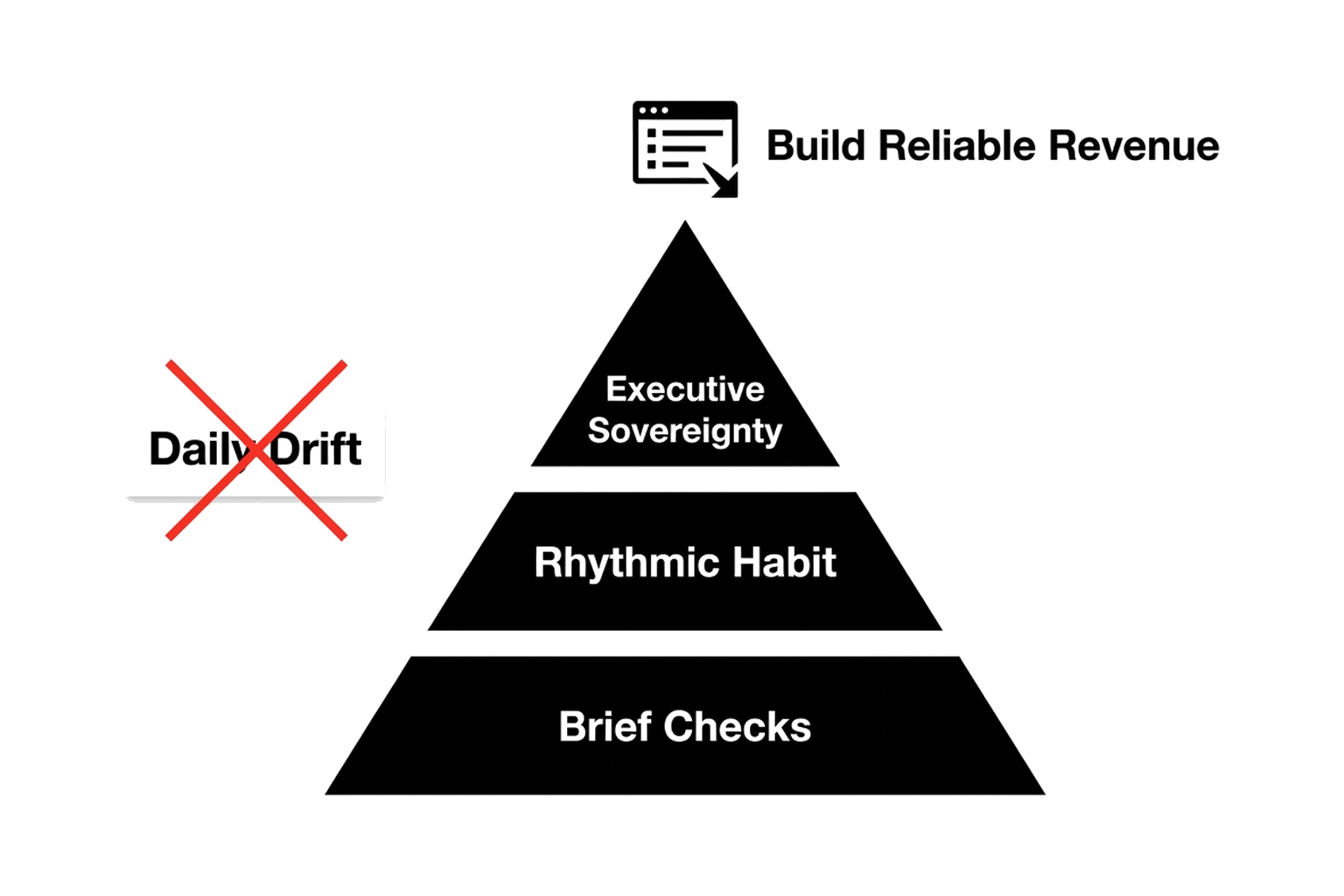
"A decision is not a single emotional moment at sunrise. A decision that is not actively maintained past the morning bargain is merely a mood."
To prevent your strategic choices from dissolving into daily drift, you must leverage the spacing effect mechanism. Rather than attempting to hold a decision through sheer willpower in one massive weekly review, you distribute brief, ten-minute calibration checks across your schedule. These short, spaced check-ins act as structural reinforcement, keeping your primary objective active in working memory and preventing silent compromise.
Copy the YAML block into Claude, ChatGPT, or your preferred AI.
Replace each placeholder with your situation this week.
Paste the three numbered returns into your notes.
+-----------------------------------------------------------------------+
| MON: Decision Defined  -->  WED: 10m Calibrate  -->  FRI: 10m Review  |
+-----------------------------------------------------------------------+
| Result: Decision maintained across time without high-friction fatigue  |
+-----------------------------------------------------------------------+
When decision maintenance becomes a lightweight, rhythmic habit, your business operations stabilize. You cease to react to temporary energetic slumps or client delays, operating instead from a steady baseline of executive sovereignty that builds reliable, long-term revenue.
Your Move This Week
Copy the YAML block into Claude, ChatGPT, or your preferred AI.
Replace each placeholder with your situation this week.
Paste the three numbered returns into your notes.
### INSTALLS — 1. Core need decoupling · 2. Permission taxonomy · 3. Distributed decision cadence
### YOU ARE — An independent coach or consultant experiencing revenue volatility, fuzzy offer execution, and the exhausting cycle of high-energy pitches followed by deep operational fatigue.
### MY SITUATION
- [ROLE]
- [LOAD]
- Core tension: Coupling business outcomes to basic psychological needs (energy,
significance, movement).
- Risk score: 8/10 (Threat of returning to salaried employment due to operational
exhaustion).
### ASK 1 — Need Decoupling Protocol
- Identify the exact core need currently attached to your next client closing or new
venture pitch.
- Write one sentence defining this need without using business terminology or client
outcomes.
- Return:
  * The single need defined in precise human terms.
  * The current single point of failure (door #1).
  * A second non-commercial door created to feed this need directly this week.
### ASK 2 — Implicit Permission Audit
- Locate one operational friction where you wait, over-accommodate, or hesitate to enforce
boundaries with clients or partners.
- Uncover the underlying hidden rule ( "I must..." ) and rewrite it as an explicit
operational boundary ( "I have the right to..." ).
- Return:
  * The original implicit constraint.
  * The friction cost in lost hours or depleted focus.
  * The precise new operational standard enacted.
### ASK 3 — Decision Maintenance Cadence
- Isolate one key decision made this week that tends to dissolve by Thursday afternoon.
- Replace a single heavy planning block with three 10-minute calibration checkpoints
across three distinct days using spaced repetition principles.
- Return:
  * The core decision being maintained.
  * The three scheduled micro-calibration times.
  * The exact metric measured during each 10-minute check.
### RETURN ONLY
1. Decoupling map: core need, single point of failure, and the sovereign second door.
2. Boundary standard: implicit rule vs. explicit operational right.
3. Spacing schedule: core decision and the three 10-minute calibration checkpoints.