

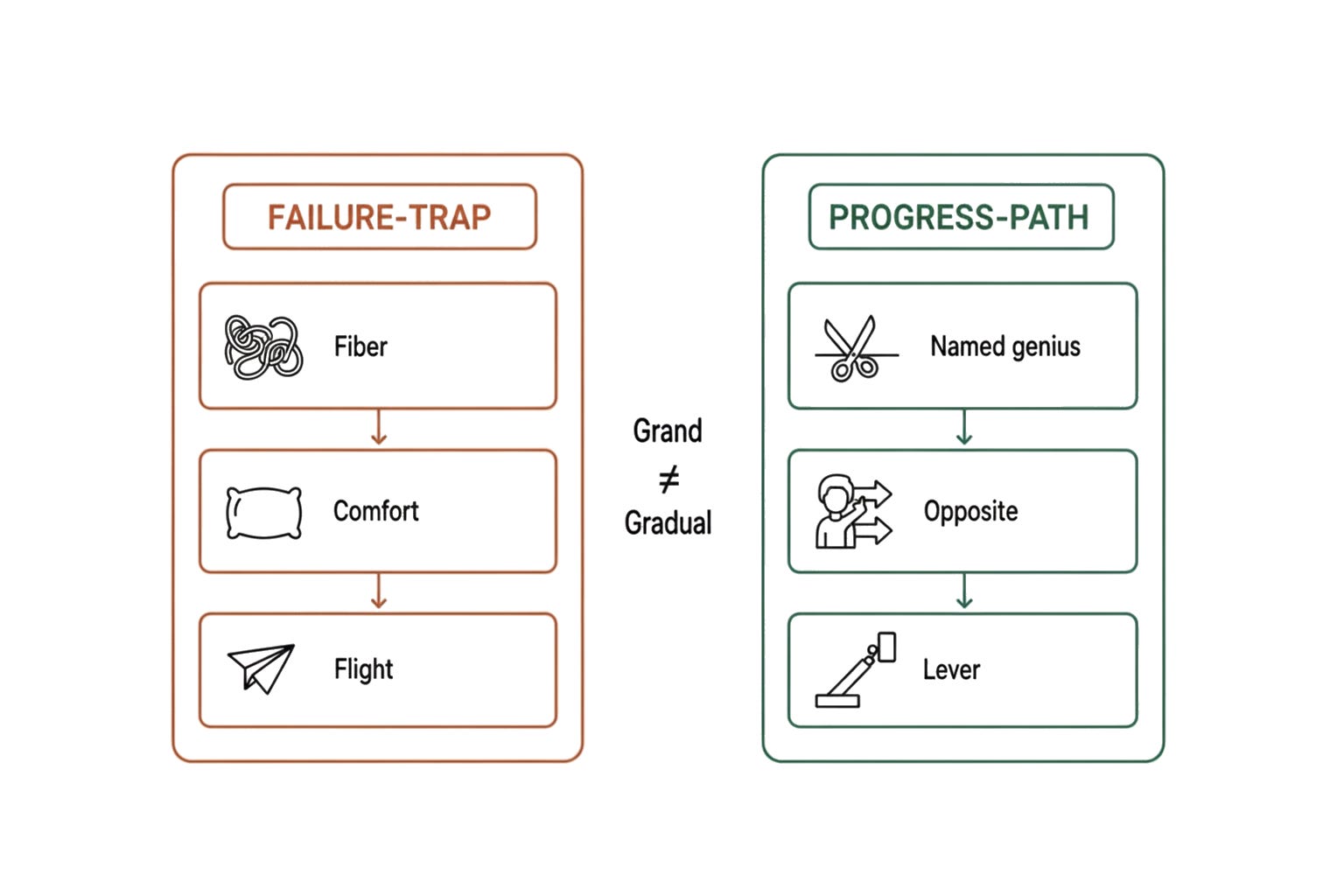
To break the cycle of constant delay, you must learn to identify the hidden payoffs of your oversized goals, design hard constraints that bypass your willpower, and test your systems using deliberate operational pauses.
The clock on your desk reads 4:15 PM on a Thursday, and the silence in your home office is starting to feel heavy. Your financial runway is shrinking, your client pipeline is dry, and the offer you have been "refining" for three months still feels fuzzy and untested. Instead of picking up the phone to make three direct outreach calls to past colleagues, you find yourself deep in a browser tab, drafting a massive, multi-year content strategy and mapping out a complete website overhaul. Your shoulders are tight, your stomach is knotted with a quiet anxiety, and though you feel a fleeting surge of heroic ambition, nothing on your desk is actually getting finished.

The Grand Task is an Escape Strategy
When you find yourself constantly setting massive, unfinishable assignments for your afternoon, your brain is not suffering from a lack of ambition. It is executing a highly sophisticated defense mechanism designed to protect your self-esteem from the vulnerability of real-world feedback. By targeting an impossibly high mountain—like rewriting your entire business model in a single sitting—your cognitive system clever avoids the risk of failing at a smaller, highly visible hill. If you fail to climb the mountain, you can blame the sheer scale of the peak; if you fail to make three simple sales calls, you have to face the uncomfortable verdict of your own current skill level.
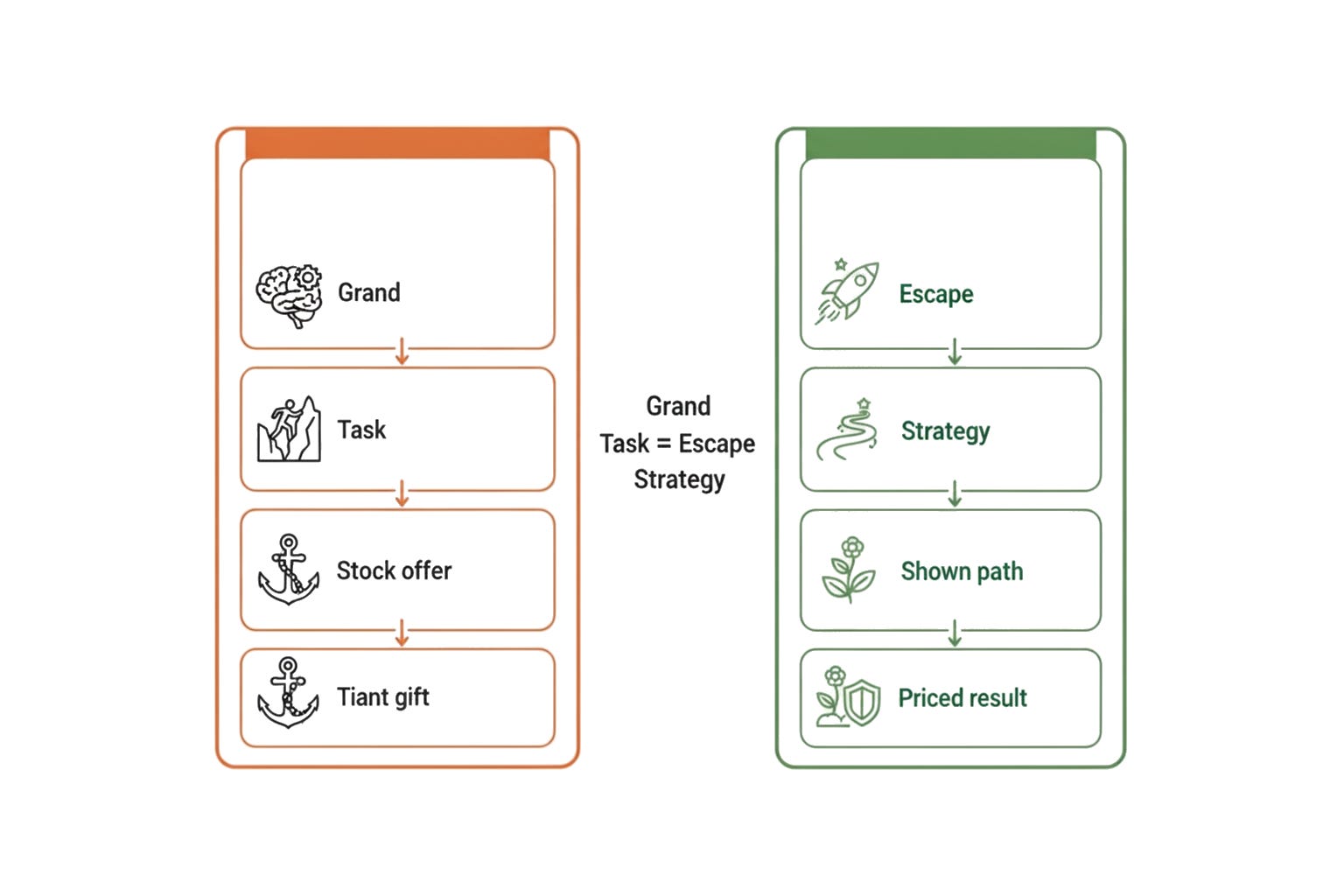
This loop operates on a deeply rational internal ledger where the immediate psychological payoff of feeling grand and ambitious far outweighs the delayed cost of disappointment. From a cognitive perspective, when the prefrontal cortex is subjected to high stress and financial anxiety, it frequently defaults to abstract, long-term planning as a threat-coping mechanism. This mental flight into complexity temporarily lowers your immediate distress, but it leaves your daily execution completely bankrupt. You remain in constant, unproductive motion, treating your business as a series of grand gestures rather than a sequence of completed operations.
Go deeper 👉 : How to Move Beyond Wounds and Humiliation
During a recent session, we dissected this exact pattern with a consultant who realized she was intentionally inflating her daily goals to guarantee she would never have to finish them. The moment a task is small enough to be completed today, it becomes real, and once it is real, it can be judged by the market. To break this cycle, you must learn to design the smallest finishable dose of your craziest challenges, keeping the grandeur of your ambition intact while forcing the daily unit of work to close before the sun goes down.
"The size of the task is your strategy to avoid the verdict of completion. You are not failing because you lack discipline; you are setting the task so huge because it guarantees you never have to stand behind a finished piece of work."
The Single Point of Failure in Your Chain
When your daily execution falls apart, the solution is rarely to search for more motivation or buy another productivity planner. Your operational day does not disintegrate because of a general character flaw; it breaks down at one specific, physical bottleneck that determines whether your momentum begins or stalls. In behavioral science, managing these bottlenecks requires the installation of physical commitment devices—hard, external limits that remove your ability to negotiate with yourself when your energy is low.
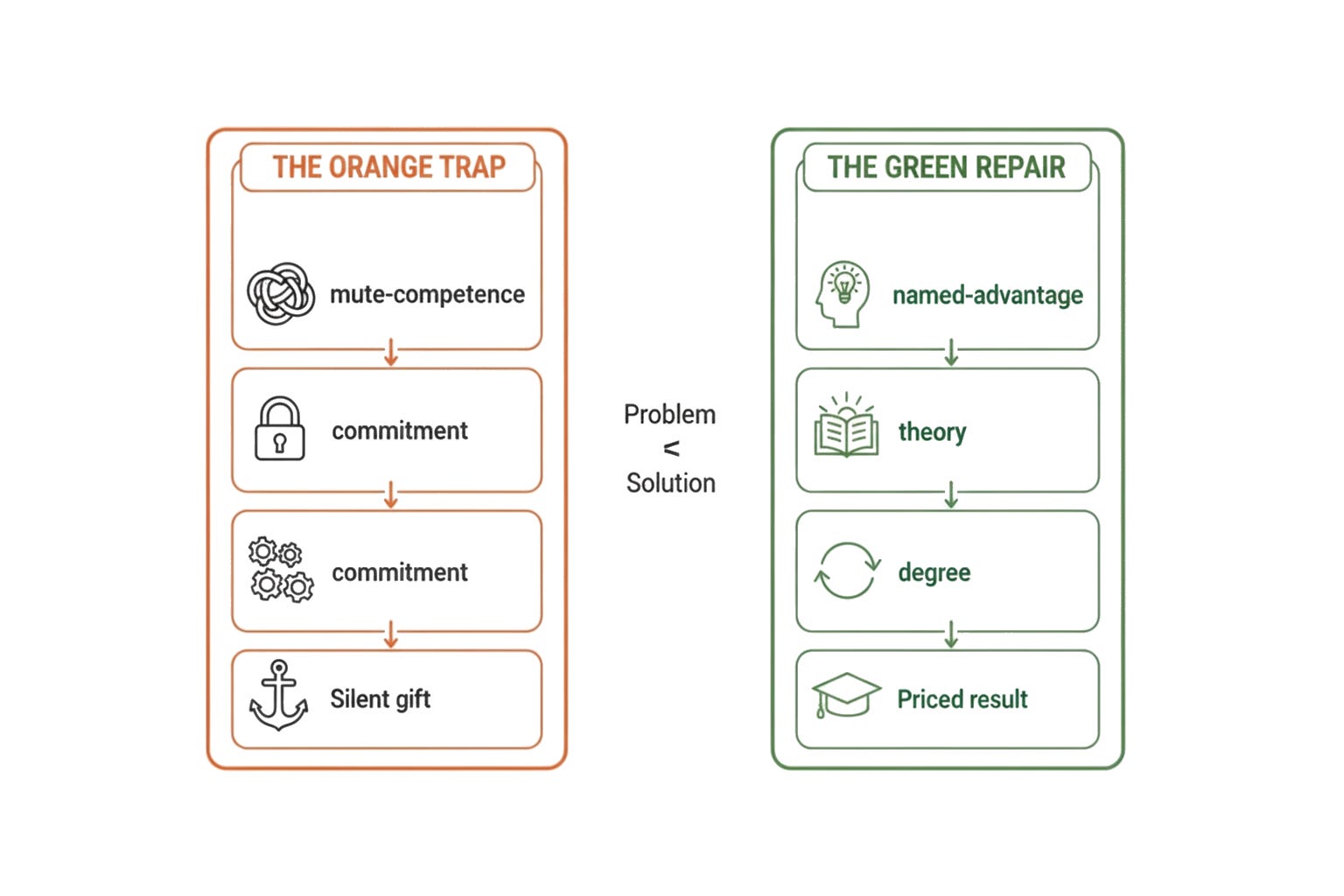
This approach is grounded in the theory of constraints, which dictates that any system's output is limited by its single weakest link, rather than its average performance. If your daily workflow fails because you spend your first two waking hours scrolling through emails on your phone, polishing your afternoon writing process will yield absolutely zero operational return. You must identify the exact physical point of failure in your morning sequence and apply a rigid, uncompromising degree of constraint to that single link.
For years, my own morning routine relied on a completely analog trigger: a physical toothbrush case wrapped in heavy tape with my morning principles written directly onto it. If my phone was not physically placed face-down on the bathroom tile the night before, the entire sequence of my morning simply did not happen. By securing that single, physical constraint, I eliminated the need for early-morning decision-making and protected my executive function for the deep creative work that followed.
"You do not need a better productivity system; you need a harder fence. When your starting constraint is soft, you spend your most valuable hours running micro-negotiations with your own fatigue."
Reclaiming Sovereignty Through Voluntary Contrast
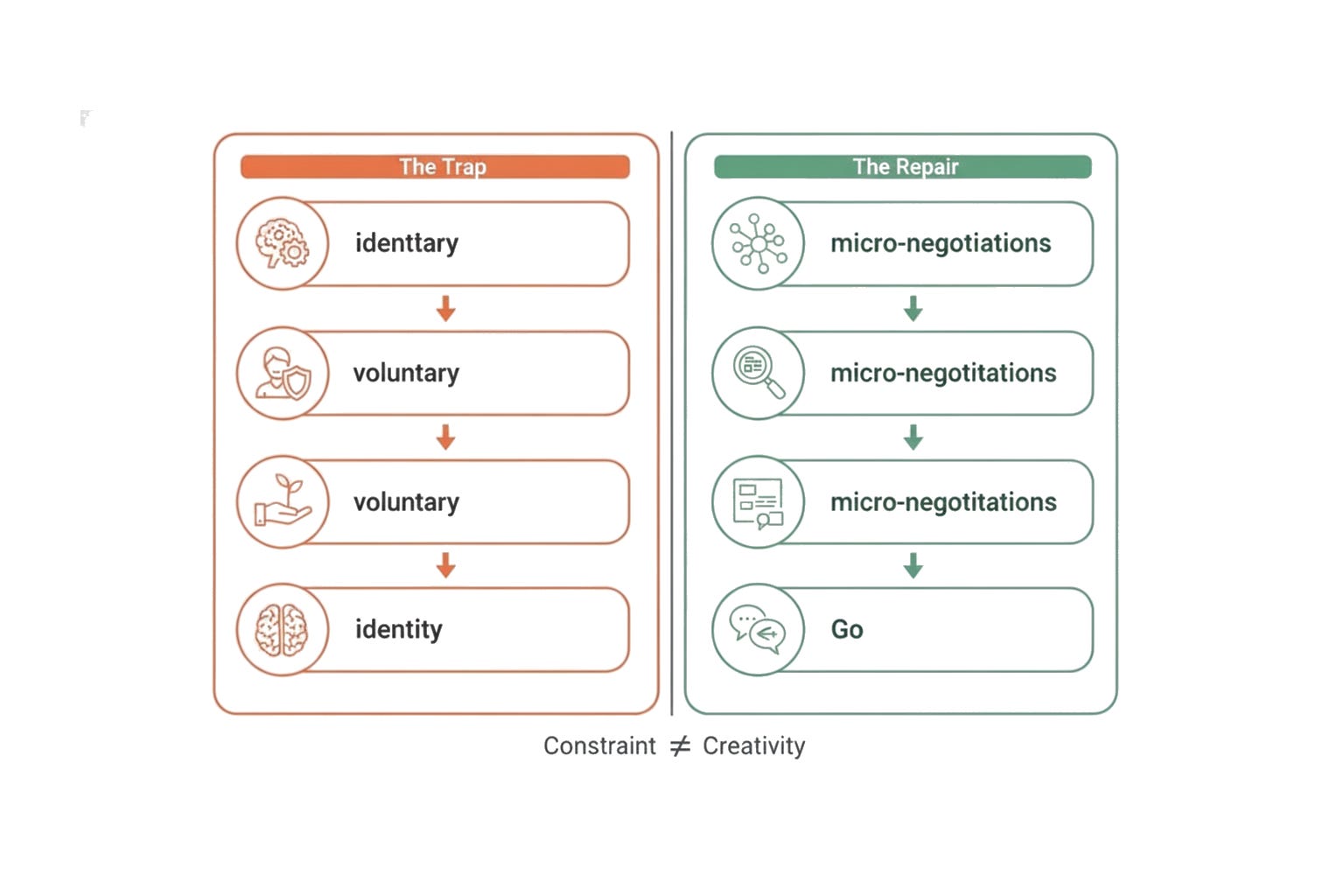
To truly govern your business as a sovereign leader, you must avoid becoming a prisoner to your own productive habits. When a daily routine becomes so rigid that you perform it out of pure muscle memory, you lose the ability to perceive its actual operational value. By introducing a deliberate pause—an intentional break in a system that is otherwise working perfectly—you can run an experiment in voluntary contrast to measure exactly what that routine was buying you.
Go deeper 👉 : Why I created my own adversity
When you consciously skip a core habit for a single day, you create an immediate vacuum that allows you to observe which destructive behaviors rush in to fill the space. You will quickly witness the return of subtle micro-negotiations, those quiet internal dialogues that whisper that you can afford to delay your most important work just this once. This intentional disruption is not a failure of discipline; it is an active diagnostic tool that reveals the hidden structural pillars supporting your highest-performing days.
I recently ran this exact test myself, choosing to skip my cold bath and morning journaling session on a random Tuesday just to observe the downstream effects. Within three hours, my focus was scattered, my decision-making felt sluggish, and my morning vocabulary cards remained completely untouched. This brief, controlled descent into friction reminded me of the precise operational price of my habits, transforming my routine from a chore I had to do into a strategic advantage I actively chose to maintain.
"The bath is never just the bath. It is the physical anchor that prevents the first micro-negotiations of the morning from ever taking root in your mind."
Exploded-view thinking: Record the first imperfect teaching
A strategy you cannot explode into parts is a strategy you cannot teach. Take the trait, the context, and the consequence apart the way a mechanic lays a gearbox on the bench — so your twin can hear the sequence.
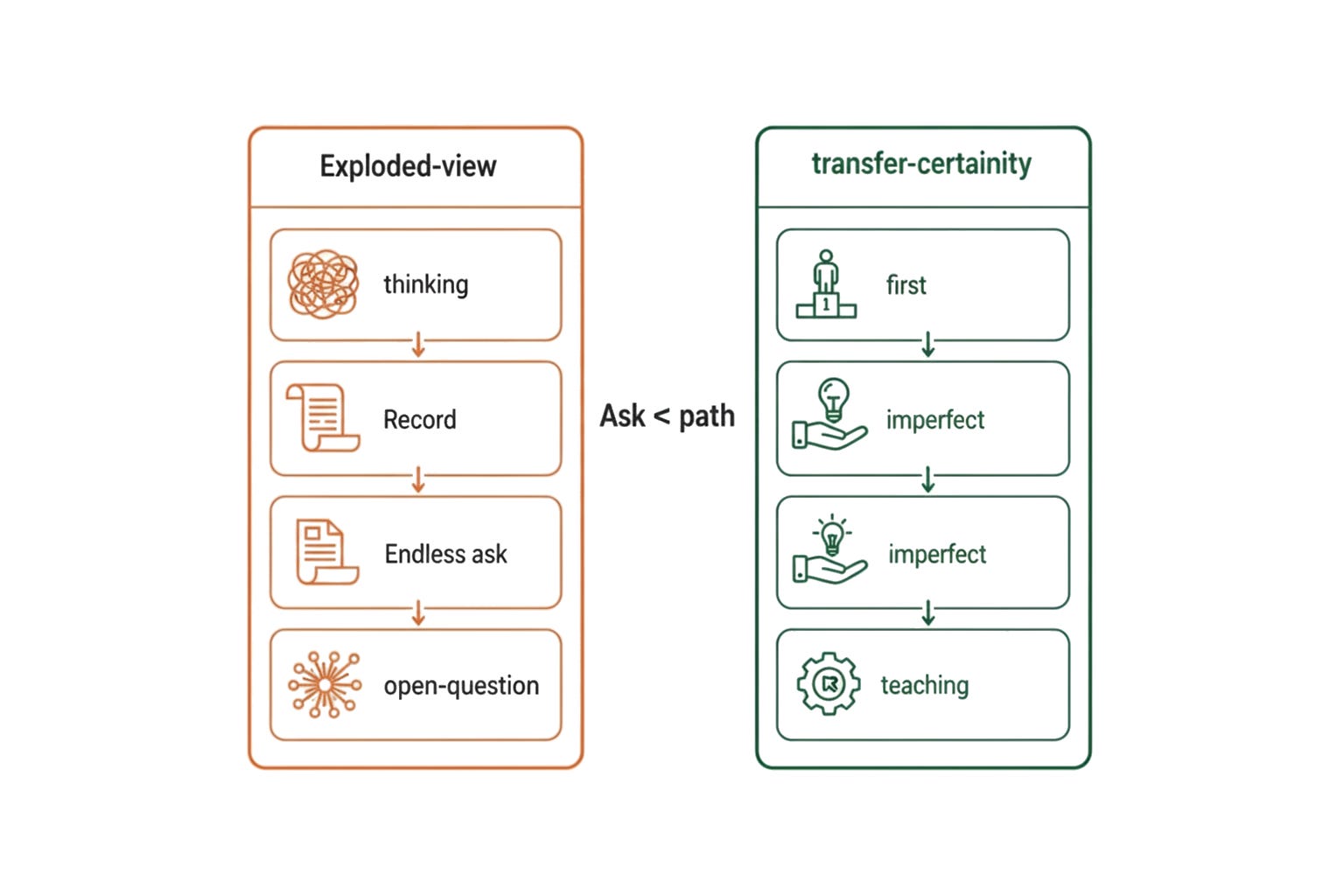
The first recording is supposed to be imperfect. Name one cell already at ease and one still tight. Paper fades in two weeks; the old cycle returns unless the teaching is on tape.
Your Move This Week
Copy the YAML block into Claude, ChatGPT, or your preferred AI.
Replace each placeholder with your situation this week.
Paste the three numbered returns into your notes.
### INSTALLS
1. Identify the hidden psychological payoff of your impossibly huge tasks to reclaim your
operational sovereignty.
2. Install a high-friction physical commitment device at your workflow's single point of
failure.
3. Run a voluntary contrast experiment by skipping a core routine for one day to measure
its true baseline value.
### YOU ARE
An independent coach or consultant who is struggling to sign clients, watching their
runway shrink, and constantly escaping into complex, unfinishable projects to avoid the
vulnerability of real market feedback.
### MY SITUATION
[ROLE]
[LOAD]
[SPOF]
### ASK 1
What is the exact hidden payoff your brain gets by setting an impossibly grand task today
instead of a small, finishable one?
- Return: Name the grand task, the hidden payoff (e.g., avoiding judgment), and the
self-esteem cost you are currently paying.
### ASK 2
Where is the single point of failure in your morning or daily workflow where execution
breaks down?
- Return: Identify the exact physical cue or constraint that determines whether your chain
starts or fails.
### ASK 3
Which working routine will you intentionally skip for one day to observe what behaviors
rush in to fill the void?
- Return: Name the routine, the day you will skip it, and the micro-negotiations you
predict will surface.
### RETURN ONLY
1. The grand task, its hidden payoff, and the self-esteem cost.
2. The single physical point of failure and its new constraint.
3. The routine to skip, the test day, and the predicted negotiations.