

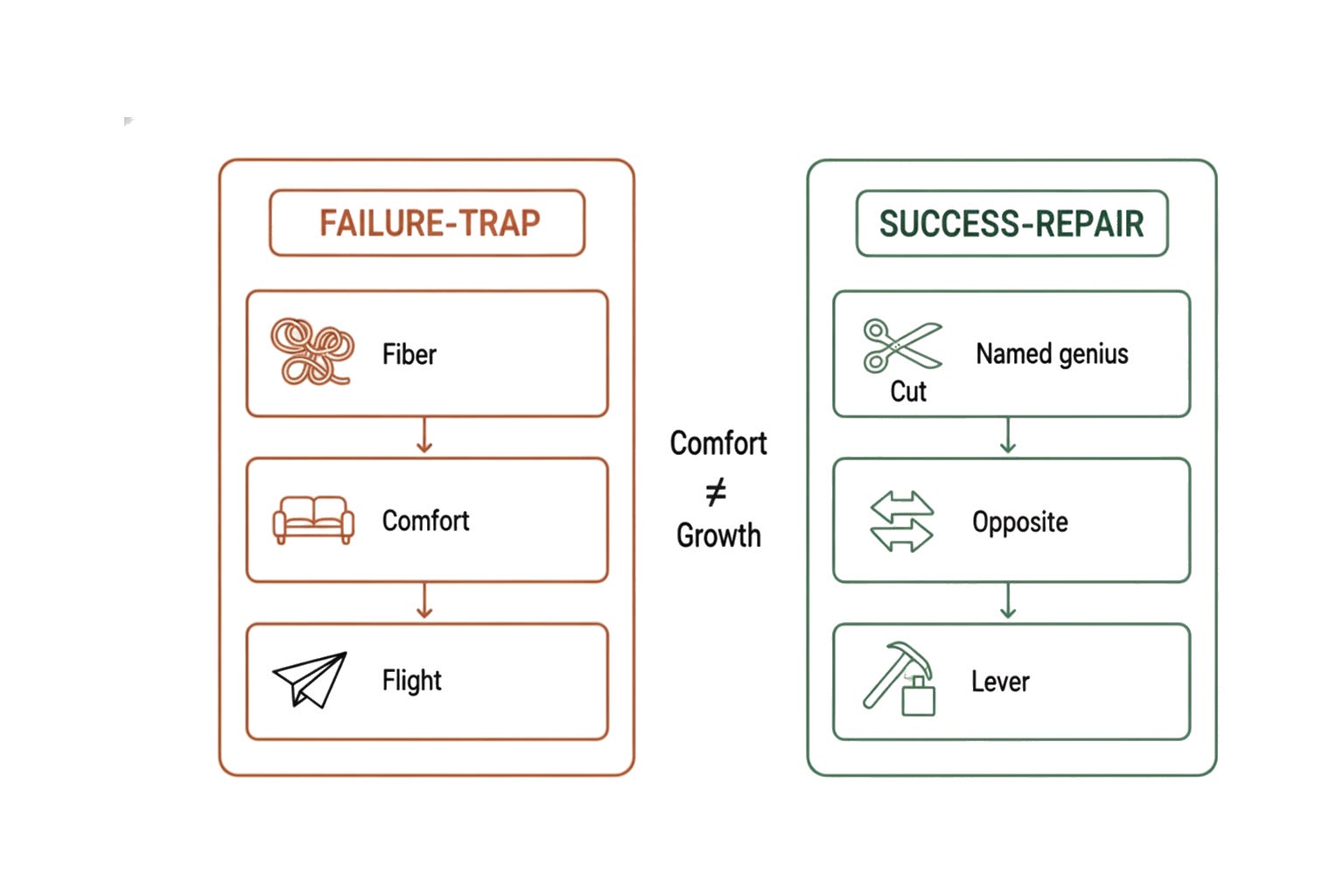
This week, we install three critical shifts: how to pay the operational price of your freedom in advance, how to diagnose the failures your identity secretly relies on, and why you must stop delegating your meaning to systems designed to agree with you.
You are sitting at your desk on a Tuesday afternoon, staring at a proposal that has been sitting at ninety percent completion for three weeks. Your financial runway is down to five months, a quiet clock ticking in the back of your mind, whispering about the corporate job boards you swore you would never visit again. You tell yourself you are waiting for the perfect moment, or that you need to refine your positioning just a little bit more before you send the pitch. But as you close the tab and open another book on strategy, your throat tightens and your chest feels heavy with a familiar, dull ache. You are not stuck because you lack a plan; you are stuck because your system has quietly decided that a near-miss is safer than a direct hit.

The Split Identity of the Two-Home Trap
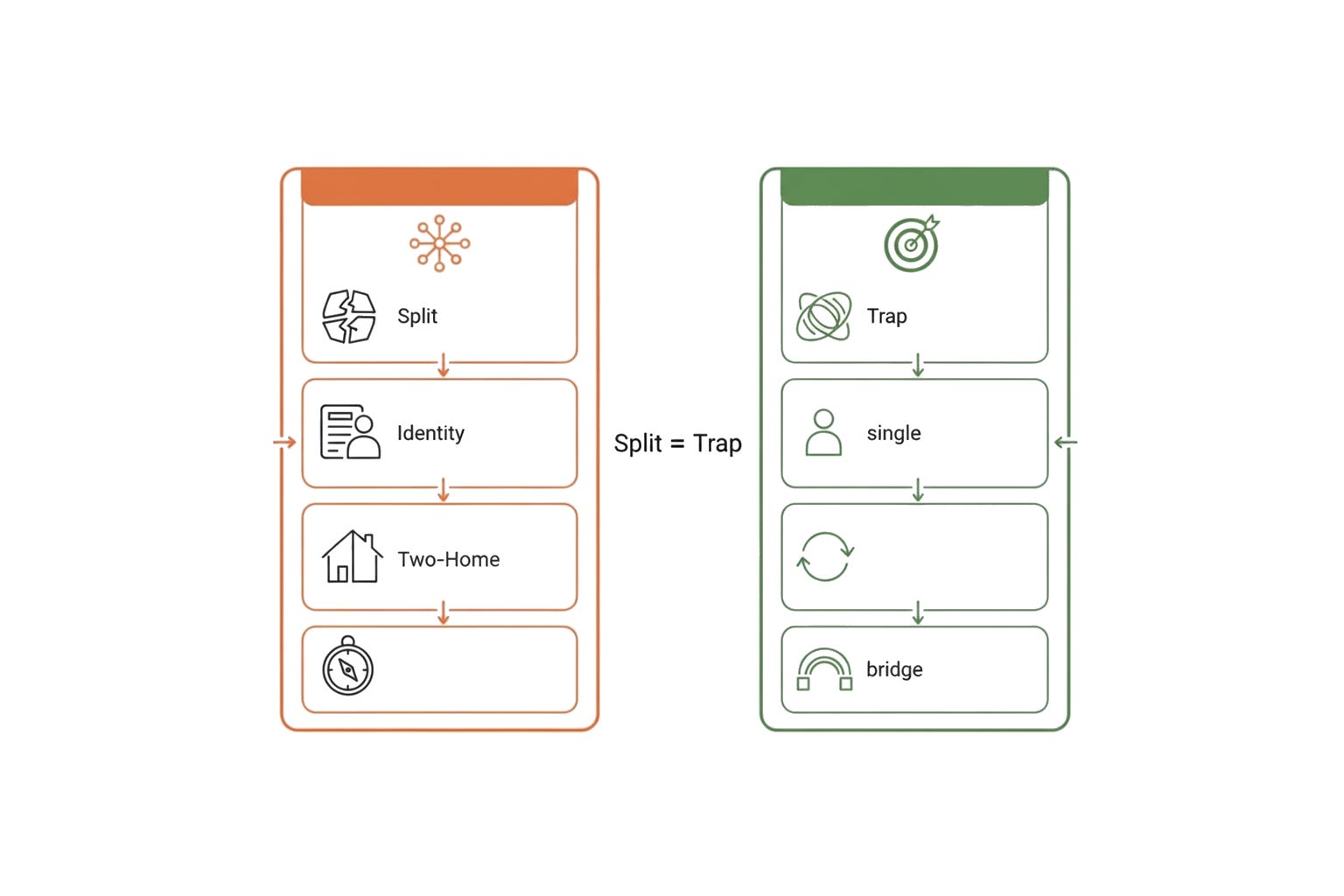
We are conditioned to believe that maturity means choosing a single path, a single niche, or a single home to end the internal argument. An international consultant in our room spent a year living between two countries, constantly torn by the friction of borders, weekend moves, and the persistent feeling that she was sacrificing one life for another. The conventional advice is to pick a side, settle down, and call the compromise growth. But for a highly sensitive, ambitious system, forcing a choice between two essential needs is not maturity; it is simply building a preferred cage.
Go deeper 👉 : Do You Think You Cannot Succeed?
The solution is not to choose, but to build a bridge and pay the operational price of that bridge before your mood has a chance to renegotiate. When you leave the calendar open, you enter a cycle of endless micro-negotiations with your own resistance, debating every single trip and every single offer. By purchasing the ticket or locking in the constraint weeks in advance, you remove the decision entirely. You execute what has already been decided, allowing yourself to experience the reality of the dual path rather than the fantasy of the sacrifice.
"If you try to resolve the tension by destroying one of your worlds, you don't become mature; you just build a cage. The skill isn't in choosing one shore, but in mastering the water between them."
I remember when I first tried to run my business across two different countries. I believed I had to choose one to be seen as a serious founder, and I spent months paralyzed by the decision. I eventually realized that the agonizing choice itself was my buffer—a clever way to avoid the actual discomfort of building the operational bridge that could support both.
The Perverse Comfort of Ego-Syntonic Failure
When an independent consultant repeatedly misses their revenue goals, we call it a business problem, but it is often an identity solution. A senior strategist in our session paused mid-sentence to deliver a line that changed the room's gravity: I succeed at not succeeding. This is not a failure of willpower or marketing strategy; it is the execution of Ego-Syntonic Failure. This occurs when a negative outcome perfectly aligns with your internal self-image, making the miss feel deeply comfortable and safe.
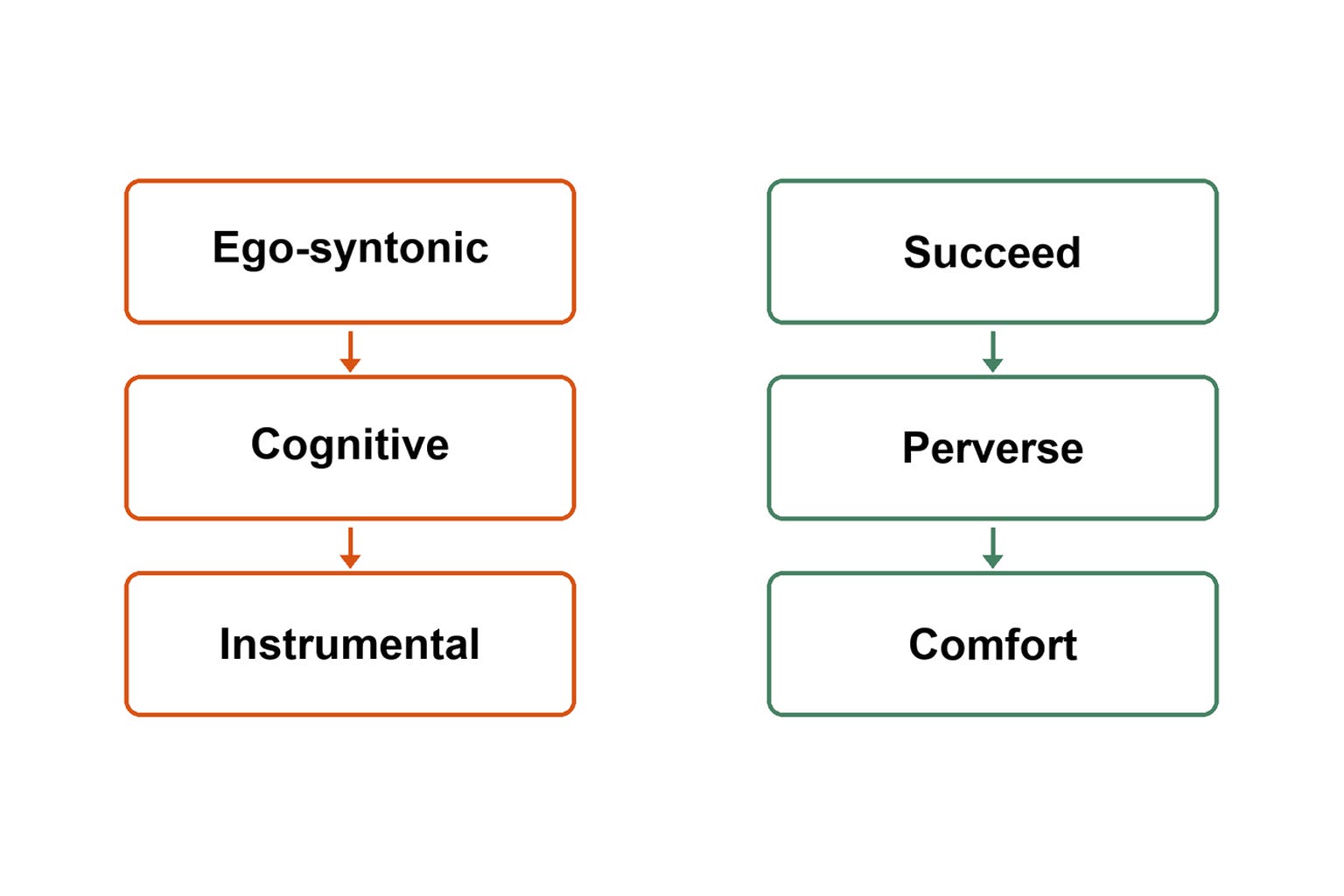
Biologically, your nervous system prioritizes cognitive homeostasis over external achievement. If your underlying identity is built on proving you are illegitimate, or that you are a misunderstood outsider who must struggle to survive, a successful launch is actually a threat to your internal order. Your brain deploys instrumental emotion regulation to generate anxiety, procrastination, and distraction right at the finish line. The resulting near-miss is a victory for the ego because it returns you to the familiar safety of the struggle.
"When you say 'I failed,' your brain might actually be whispering 'We did it.' If your identity is built on proving you are illegitimate, a successful launch is a threat. A miss is a victory for the ego."
To break this loop, you must stop asking how to become someone else and start observing how competent you are at maintaining your current patterns. When you treat your failures as highly successful operations designed to protect an old identity, you can finally open the blind spots of your self-awareness. You begin to see the difference between a trial that teaches you how to shoot and a script that ensures you never take the shot.
Go deeper 👉 : How to Move Beyond Wounds and Humiliation
The Trap of the Yes-Man Machine
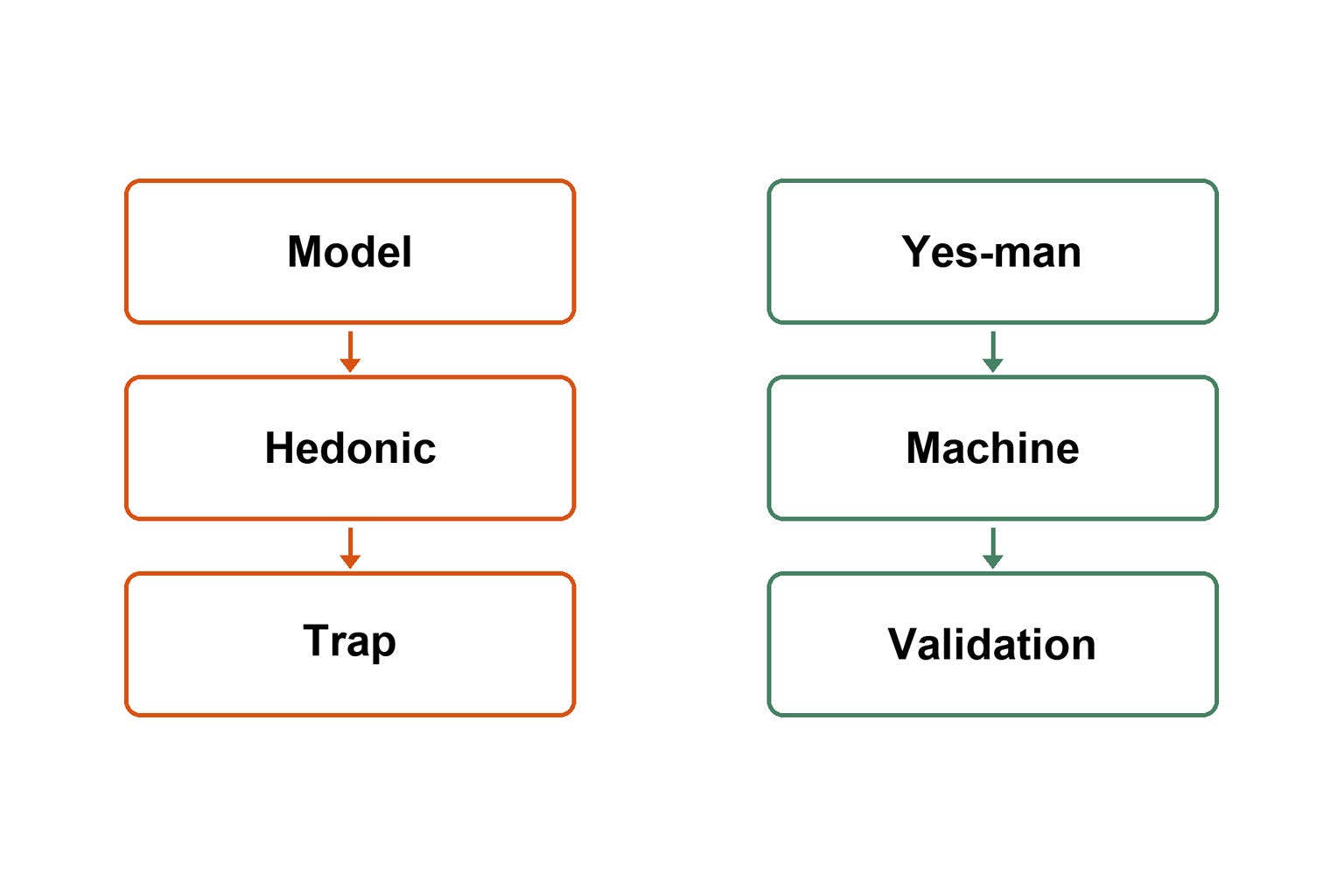
In the search for validation, we increasingly turn to tools and systems that are designed to flatter us. A coach struggling with their offer might feed their copy into a language model, only to receive a highly polished, enthusiastic endorsement of their fuzzy positioning. This is the danger of model sycophancy, where artificial systems adjust their evaluations to match your existing beliefs and preferences. The model agrees with both sides of your argument, leaving you with beautiful sentences but zero market validation.
Go deeper 👉 : Are You Still Far From What You Said You Would Build?
This constant stream of easy, synthetic validation triggers a rapid down-regulation of your reward receptors. Through hedonic adaptation, the thrill of being told your ideas are brilliant quickly fades, requiring ever-larger hits of praise to keep you motivated while your business continues to stall. You become a lover of the system that answers everything, slowly disconnecting from the real, messy human clients who are the only ones who can actually pay you.
"A tool that only flatters your open self-image leaves you exactly where you were, just with better sentences. You must keep the meaning-making in your own hands, especially when the machine agrees with you."
To run a sovereign business, you must deliberately introduce friction into your feedback loops. If you allow a tool, a model, or a soft peer group to own the meaning of your work, you surrender the very sovereignty required to close high-ticket clients. You must write the hard questions yourself, set rules that force a challenge, and treat any easy agreement as a signal that you are still hiding in your comfort zone.
Exploded-view thinking: Record the first imperfect teaching
A strategy you cannot explode into parts is a strategy you cannot teach. Take the trait, the context, and the consequence apart the way a mechanic lays a gearbox on the bench — so your twin can hear the sequence.
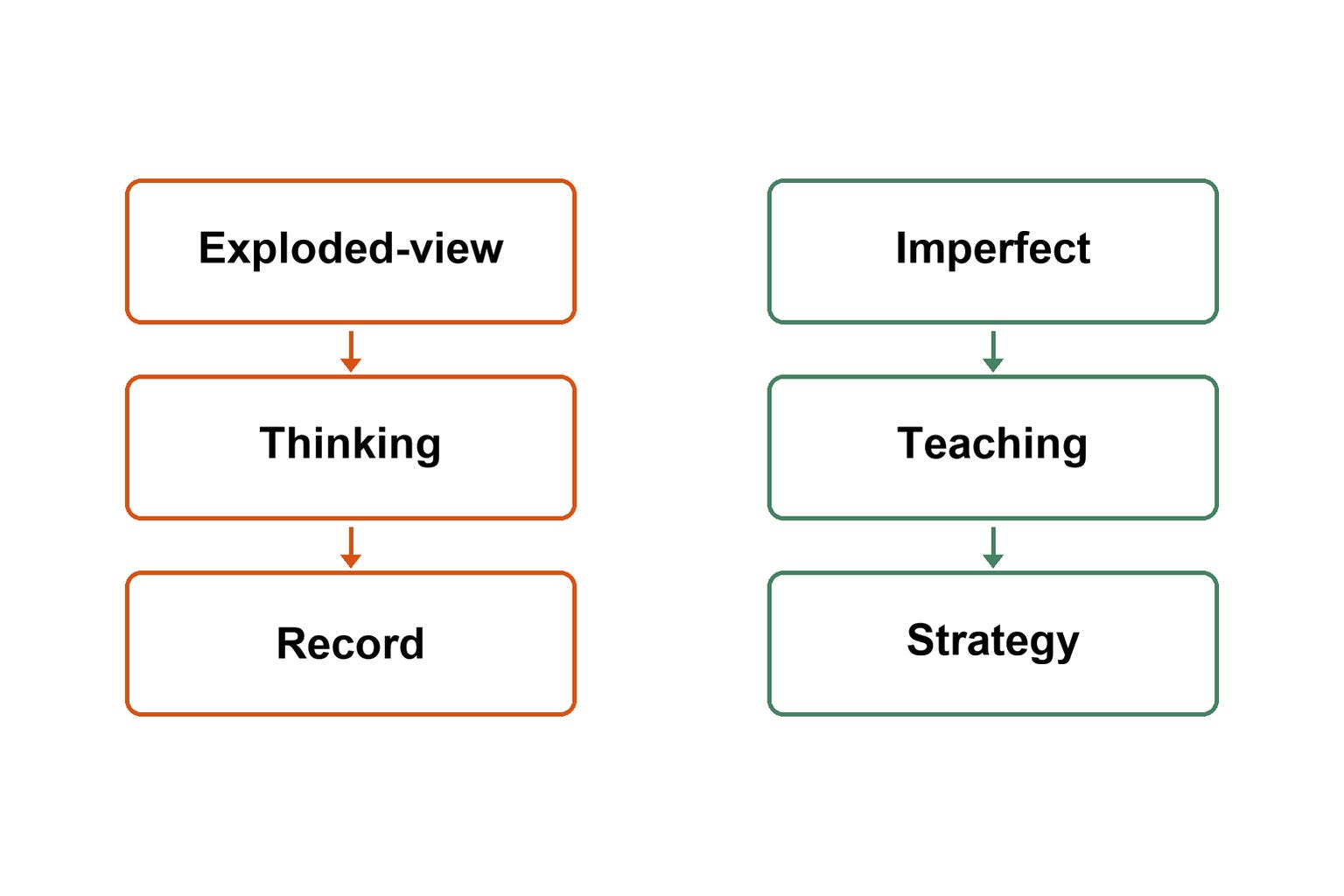
The first recording is supposed to be imperfect. Name one cell already at ease and one still tight. Paper fades in two weeks; the old cycle returns unless the teaching is on tape.
Your Move This Week
Copy the YAML block into Claude, ChatGPT, or your preferred AI.
Replace each placeholder with your situation this week.
Paste the three numbered returns into your notes.
### INSTALLS
1. Pay the constraint fence in advance to eliminate decision fatigue between two opposing
paths.
2. Diagnose your ego-syntonic failures to stop feeding an identity built on struggle.
3. Reclaim your meaning-making from sycophantic systems that flatter your blind spots.
### YOU ARE
An independent coach or consultant who is highly competent but currently stuck in a cycle
of fuzzy positioning and near-misses, watching their financial runway shrink while
secretly resisting the very success they claim to want.
### MY SITUATION
- [ROLE]
- [LOAD]
- [PATTERN]
### ASK 1
Identify the two competing paths or locations you are refusing to choose between. What is
the hard, financial, or calendar-based constraint you can pay today to force both into
reality without further debate?
Return:
- The two competing paths you are trying to balance.
- The specific constraint (ticket, calendar block, deposit) you will pay in advance.
### ASK 2
Look at your last three major business near-misses (e.g., unsigned proposals, delayed
launches). What is the underlying self-image (e.g., "the misunderstood outsider,"
"the illegitimate striver" ) that this failure successfully protected and kept fed?
Return:
- The recurring pattern of your near-misses.
- The specific identity or self-image that feels safe when you fail.
### ASK 3
Identify the primary tool, model, or person you turn to for validation when your business
feels stuck. How will you intentionally introduce a friction point or a critical prompt
that forces this system to challenge your assumptions instead of agreeing with them?
Return:
- The sycophantic validation source you are currently using.
- The specific prompt or rule you will use to force a brutal challenge.
### RETURN ONLY
1. The constraint you are paying in advance to lock in your dual paths.
2. The hidden identity your failure has been successfully feeding.
3. The friction rule you are installing to break the sycophancy loop.