
Are You Still Far from Your Ambition?
There Is a Gap Holding You Back, and You May Not See It Yet

Hello and welcome to this new edition of SoloBOOST News. If you are new, SoloBOOST News is the place where I help you build, format, package, design the Entrepreneur you want to become, the Entrepreneur who lives up to your ambition.
My name is Yann, and I am a Personal Development and Entrepreneurial Performance Coach. I am passionate about psychology, in particular, the exploration of human potential. And here in SoloBOOST News, we dissect several psychological aspects that can be brakes or levers in your entrepreneurial journey.
So, today, we are going to talk about:
Why do you sometimes feel very far from the version of yourself that you have imagined?
Why, despite your efforts, a little voice whispers to you that you are not yet up to the level of this entrepreneur that you want to embody?
And why, deep down, are you afraid to fully assume who you are?
In two words, we're going to talk about what we call: The Identity Gap.
What you don't know about what identity is!
Your identity is the answer to the question "Who am I?". It’s an image of you that your brain constructs. It arises from mechanisms in your head and defines you.
Your identity is anchored in neurological mechanisms. The prefrontal cortex, which manages self-reflection, works with the amygdala (emotions) and the hippocampus (memory) to construct this image. When you say to yourself "I'm a successful solopreneur", it's your brain that combines memories (a successful project) and emotions (pride) to validate that. But it can also trap you: if you focus on your failures, it reinforces a negative identity.
It's also a story that your brain weaves. It connects your experiences to create a narrative that gives you meaning. This story shapes your identity. It is not in one piece: it has different facets, which coexist and sometimes contradict each other.
This identity can change, thanks to neuroplasticity: what you do often reshapes it. Others also influence: their feedback adds to your image. This identity guides you in your choices, but can also limit you.
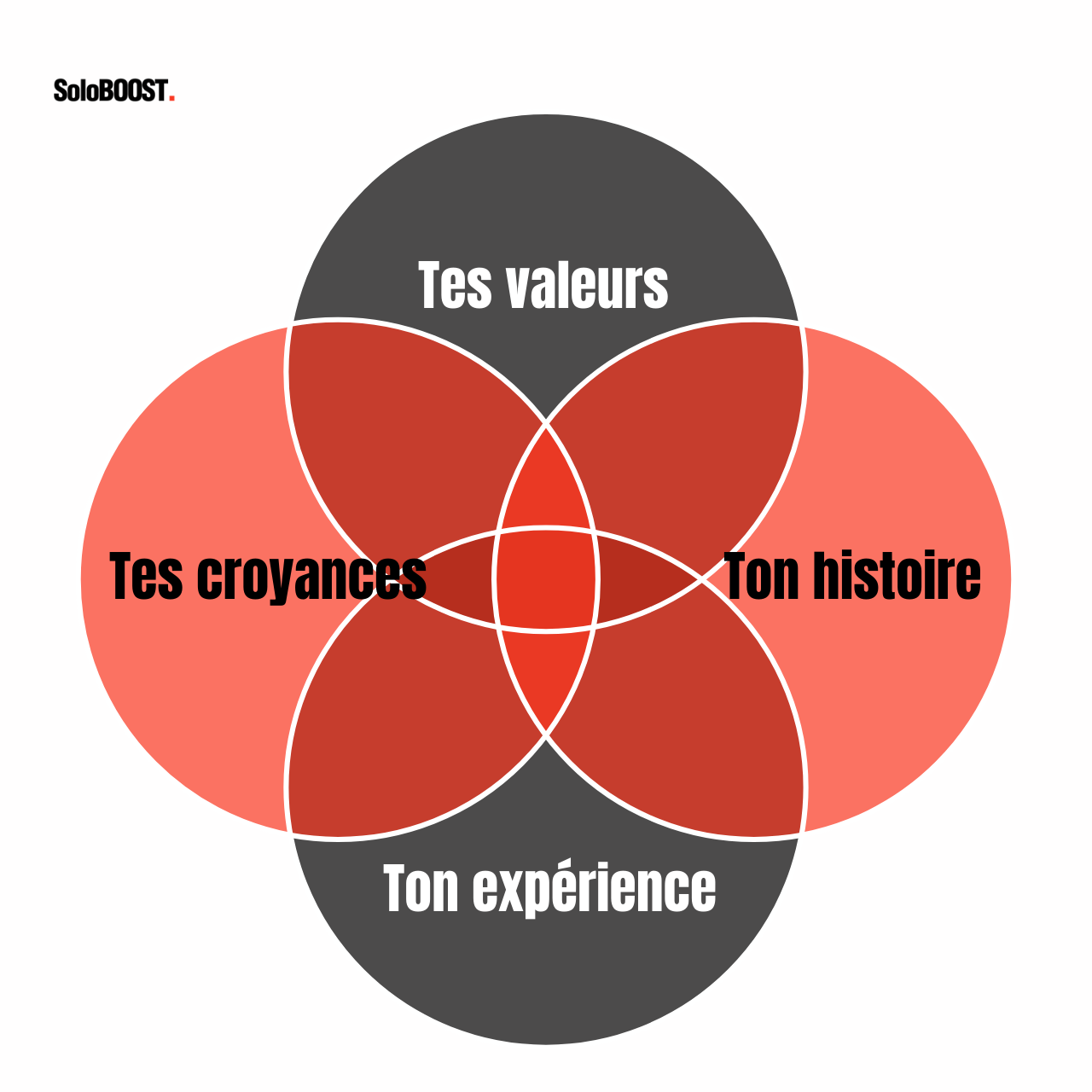
identity is therefore the way in which you define yourself. It is built from your beliefs, your values, your experiences, your roles (e.g.: entrepreneur, parent, friend), and the way you perceive yourself in the world. In psychology, we often say that identity is a mixture of:
What you do (your actions),
What you believe about yourself (your "self-concept"),
How others perceive you (although this has less influence on your internal identity).
For an entrepreneur, identity can include facets like "I am an innovator", "I take risks", or even "I am someone who often fails but perseveres". It evolves with time and experience.
What is the Identity Gap?
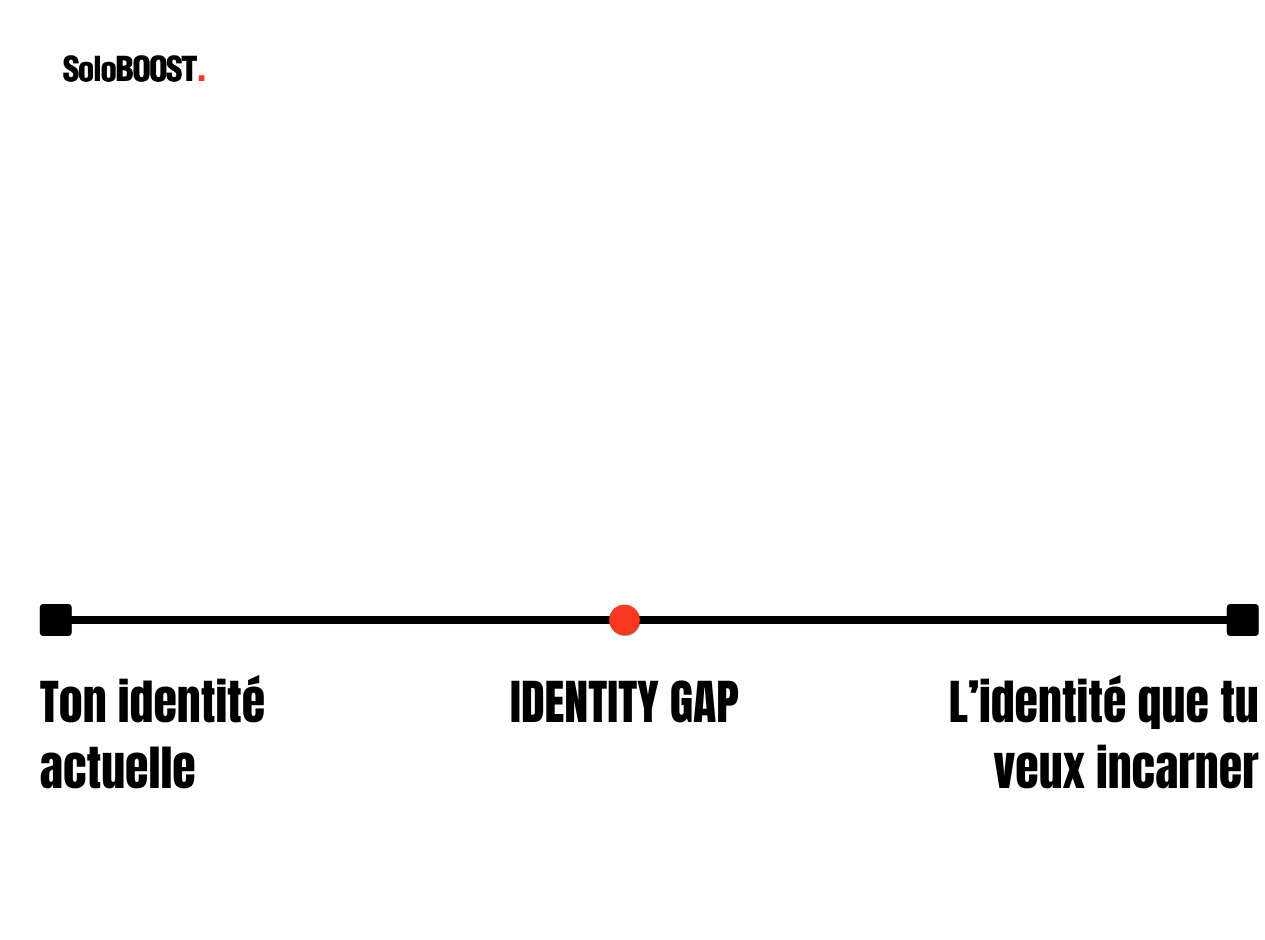
The identity gap (or “identity gap” in French) is the distance between your current “you” and the one you must embody to achieve your ambitions. It is the difference between who you think you are today (your current identity) and who you want to be or who you feel destined to become (your ideal or future identity).
It is a psychological concept that reflects a discrepancy between your perception of yourself in the present and the image you have of your aspirational "self". For example, you can see yourself today as an entrepreneur who is struggling to launch his project, but also has the ambition to be a confident leader who inspires thousands of people. This gap is the identity gap.
In 2020, researchers like Amado and Snyder looked at students who lived far from home, in a new country. They discovered that when these students saw themselves a certain way in their heads, but acted differently outside, it put enormous pressure on them. Their study, in Frontiers in Psychology, shows that this gap can stress you out to the point of making you feel depressed. For what ? Because your brain hates it when what you feel inside and what you show outside don't match. This stress amplifies the gap, and blocks you even more.
But there’s more: it’s also a gap between how you see yourself and how others see you. Psychologists call it a concept of communication: your self-perception is your internal image, and the perception of others is what you show or what they pick up. When these two diverge, it puts you on edge.
Why does this Gap exist?
We have an identity gap for several reasons, often linked to human nature and the context of entrepreneurs:
Your personal evolution: We grow, we change, and our aspirations evolve faster than our current reality. An entrepreneur who succeeds in his first round of fundraising may suddenly dream of a global empire, creating a new gap.
Social comparison: Seeing other entrepreneurs succeed can amplify your ideal identity and make you feel "behind."
Ambition: Entrepreneurs like you often have grandiose visions of themselves, which is great but naturally creates a disconnect with their point of departure.
Lack of alignment: Sometimes, your actions or your environment do not yet reflect who you want to be, which widens this gap.
On a psychological level, the identity gap is linked to several theories and mechanisms:
Self-perception theory (Bem): You construct your identity by observing your own behaviors. If your actions do not correspond to the image you want to have (e.g.: procrastinating when you want to be "effective"), this creates tension.
Cognitive dissonance theory (Festinger): When your perception of yourself comes into conflict with your aspirations, you feel psychological discomfort that you seek to resolve, either by changing your behavior or by adjusting your expectations.
Need for self-esteem (Maslow): The identity gap can emerge when your need for recognition (by yourself or others) is not met, leaving you in a state of “not good enough”.
Narrative construction of identity (McAdams): You tell a story about who you are. If this story is inconsistent with your objectives or your experience (e.g.: "I am a successful entrepreneur" vs. "I have just failed"), the gap becomes palpable.
In entrepreneurship, this gap is often amplified by imposter syndrome: you can succeed objectively, but still feel far from the "legitimate" identity that you are aiming for, because you internalize unrealistic standards or because you fear being “unmasked”.
And no, the Identity Gap is not necessarily bad. It depends on how you experience it and what you do with it.
Positive side: This gap can be a source of motivation. If you clearly see who you want to become and realize that you are not there yet, it can push you to act, to learn, to surpass yourself.
Negative side: If the gap is too big or if you judge yourself harshly because of it, it can frustrate you, make you doubt yourself or block you. For example, if you tell yourself "I will never live up to this ideal version of me", it becomes a hindrance.
How do you close this “Gap” with Congruence?
In one sentence: you go from point A to point B. And that's where Congruence comes into play.
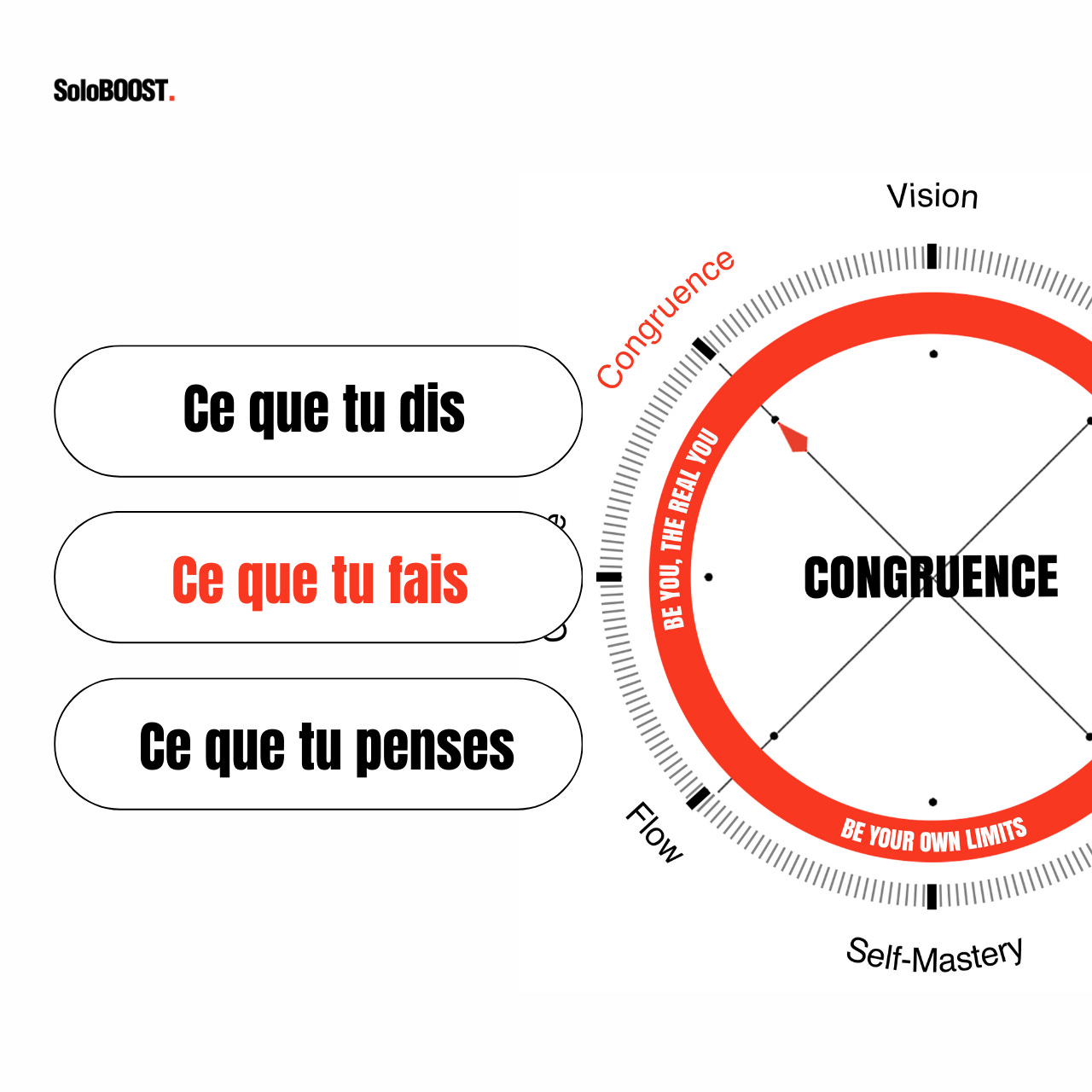
congruence is the alignment between what you think, what you say and what you do. It is directly linked to the identity gap, because reducing this gap means seeking to be more congruent with your ideal identity. When your actions (e.g.: launching a risky project) reflect your values (e.g.: boldness) and your vision of yourself (e.g.: "I am a pioneer"), you feel "whole" and at peace.
For an entrepreneur, congruence is essential: if you see yourself as an innovator but you spend your days procrastinating, you widen your identity gap and you feel bad. Conversely, when you act in accordance with your ideal identity, the gap closes and you gain confidence and energy.
When you live in congruence with the version of yourself that you want to become, you naturally reduce this gap, because you already embody this identity in the present, even partially.How does congruence act as a solution?
It forces you to act in accordance with your ideal "self": If you want to be a daring entrepreneur, but you avoid risks, you dig in the gap. Congruence pushes you to make risky decisions consistent with this identity, even if it is imperfect at first.
It strengthens your confidence: When your actions reflect your aspirations, you feel more legitimate. This confidence reduces the feeling of being "far" from your ideal identity.
It eliminates internal conflicts: A lack of congruence creates dissonance ("I want to be X, but I do Y"), which amplifies the identity gap. By aligning everything, you ease this tension and move forward more easily.
Let's say that your ideal identity is "this entrepreneur who inspires with his ideas". If you keep silent for fear of judgment (incongruence), the gap remains large. But if you start sharing your ideas, even with apprehension, you become congruent with this identity. With each aligned action, you get closer to your ideal “you”.
Carl Rogers said that to be congruent is to align what you feel about yourself with what you really experience. It means stopping playing a role that doesn't suit you. It is also a pillar for asserting yourself: you say what you think, you do what you say, and that gives you a presence, a charisma that inspires.
Your identity is what holds the reins. It drives your mind, your choices, your intellect – everything. You may be that solopreneur who works tirelessly for your clients, but despite all your efforts, you sometimes feel trapped in your box. You chase time, you drown in stress. And as a result, you start to doubt your ability, to doubt yourself, your ambition. You feel the frustration, and you hear that little voice that whispers to you that maybe you're not legitimate, you're not enough, you're not up to par. While deep down, you want to be that entrepreneur who really helps people, who decides without panicking, who builds a business that you are proud of and who leaves you time for your family. It's this gap, this Identity Gap that separates you from who you could become.
Because we all work very hard to remain consistent with the image we have of ourselves, because our heads hate contradictions. Your life follows invisible principles, and the biggest one is this: you do everything to stick to who you believe you are. But if this identity is shaky or far from your authentic self, you are stuck.
Congruence is therefore your way out. Align your thoughts, your actions, your words with what you really are, and this identity gap closes. For what ? Because your brain and your body stop fighting – they move you towards the version of you that matches your deep values. As Carl Rogers said: "The only way to truly understand is to become what I am." Be congruent, be you, the real you.”
Currently, I am preparing a program that will help you get closer little by little to this Entrepreneur that you want to embody, the program is called: THE MORNING VOICE, a tool designed to reprogram your brain every day. It reminds you of who you really are, who you want to be, and reconnect you to your deep identity.
It's being prepared, but I'll give you the details as we go along, leave me a Big Like to help me develop SoloBOOST News
.
With determination,