

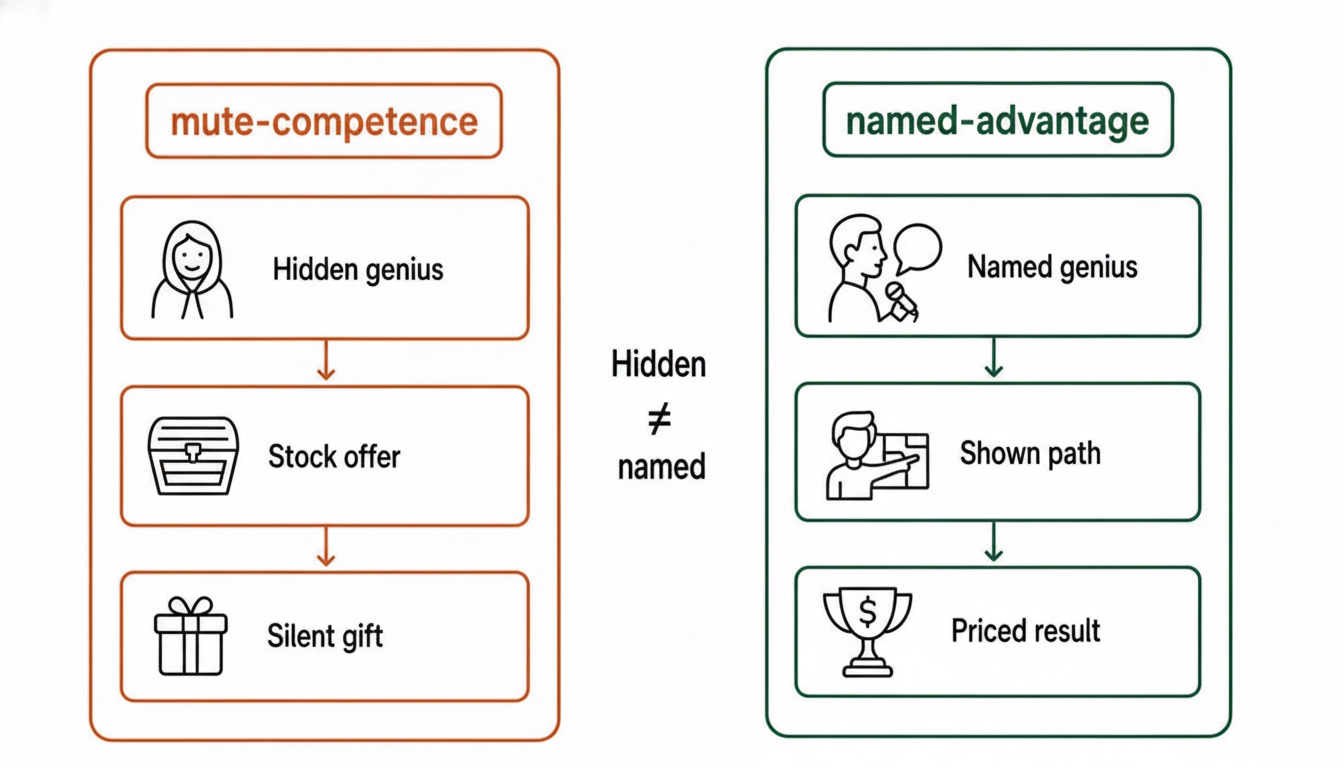
This week, we install three critical shifts: naming your mute competence, transferring absolute certainty to your clients, and designing your ideal offer without today's self-imposed brakes.
You are sitting in a beautifully lit room, but your throat feels tight. You’ve spent the morning at a networking breakfast, handing out business cards that describe you as an "executive coach" or an "interior consultant." The words felt like cardboard in your mouth. You know you are incredibly good at what you do, but when it comes to explaining why someone should hire you instead of a hundred cheaper alternatives, you fall back on industry jargon. Your body feels the misalignment—a subtle, persistent ache in your chest—because you are selling a generic category instead of your actual, unfair edge.
Then, a few hours later, you are visiting a friend. Within thirty seconds of walking through their front door, you point to a structural bottleneck in their hallway and say, "If you move that threshold, the entire energy of this floor changes." Your friend stares at you, stunned. You saw it instantly. To you, it was obvious. To them, it is a revelation. This is the friction: you are trying to sell the generic profession, while your real value is leaking out of the side doors of your life, completely unpriced and unnamed.

The Mute Competence and Your Unfair Advantage
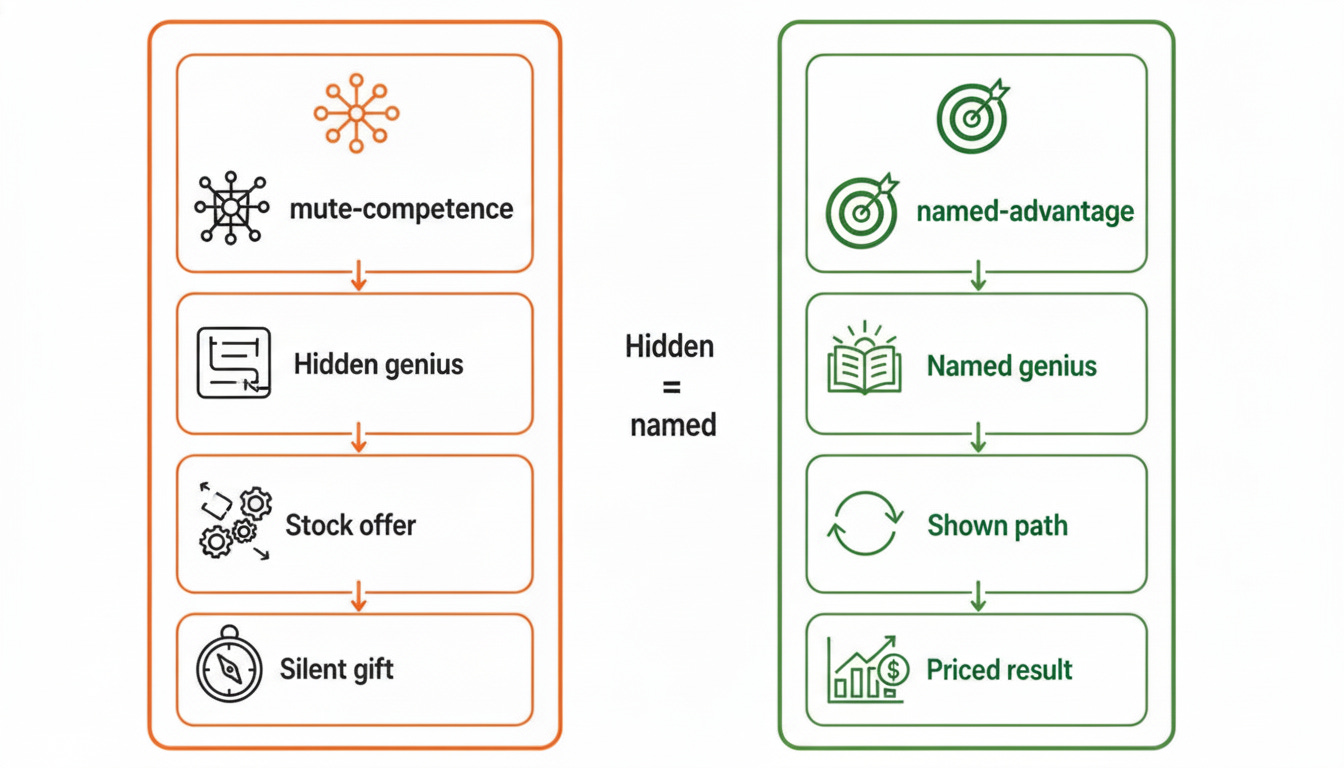
When we struggle to sign high-ticket clients, we assume we need more credentials, a shinier website, or a new framework. We fall into a trap of confirmation bias, searching only for evidence that our current self is insufficient. But the truth is usually far simpler: you are suffering from a mute competence. You possess an extraordinary ability that you perform as naturally as breathing, yet because it costs you zero effort, you assume it has no market value. You leave it unnamed.
Go deeper 👉 : How to Move Beyond Wounds and Humiliation
In organizational theory, Jay Barney’s seminal work on resource-based competitive advantage highlights that sustained value comes from resources that are valuable, rare, and inimitable. Your unfair advantage isn't a certification you bought; it is the unique intersection of your lived experience. Perhaps you have navigated twenty-three corporate restructures, or perhaps you possess a rare speed of prism-change—the ability to look at a chaotic room and spot the symmetry within two minutes. When you refuse to name this advantage, you force yourself to compete in a race to the bottom. Your body signals this friction through a constant state of hyper-arousal, as you try to force your unique shape into a standardized market box.
"You sell what happens while they enter — not the profession, but the perception of the value of the result."
The Edge of the Pool: Transfer of Certainty
Many independent advisors are trained to believe that coaching must always be non-directive. They ask beautiful, open-ended questions, hoping the client will discover their own path. But when your client is drowning in operational chaos, their reptilian brain is fully active. They are thrashing in the boiling water of the pool, unable to see past their immediate panic. If you stand on the edge of the pool and simply ask them how they feel about the water, you increase their cognitive load.
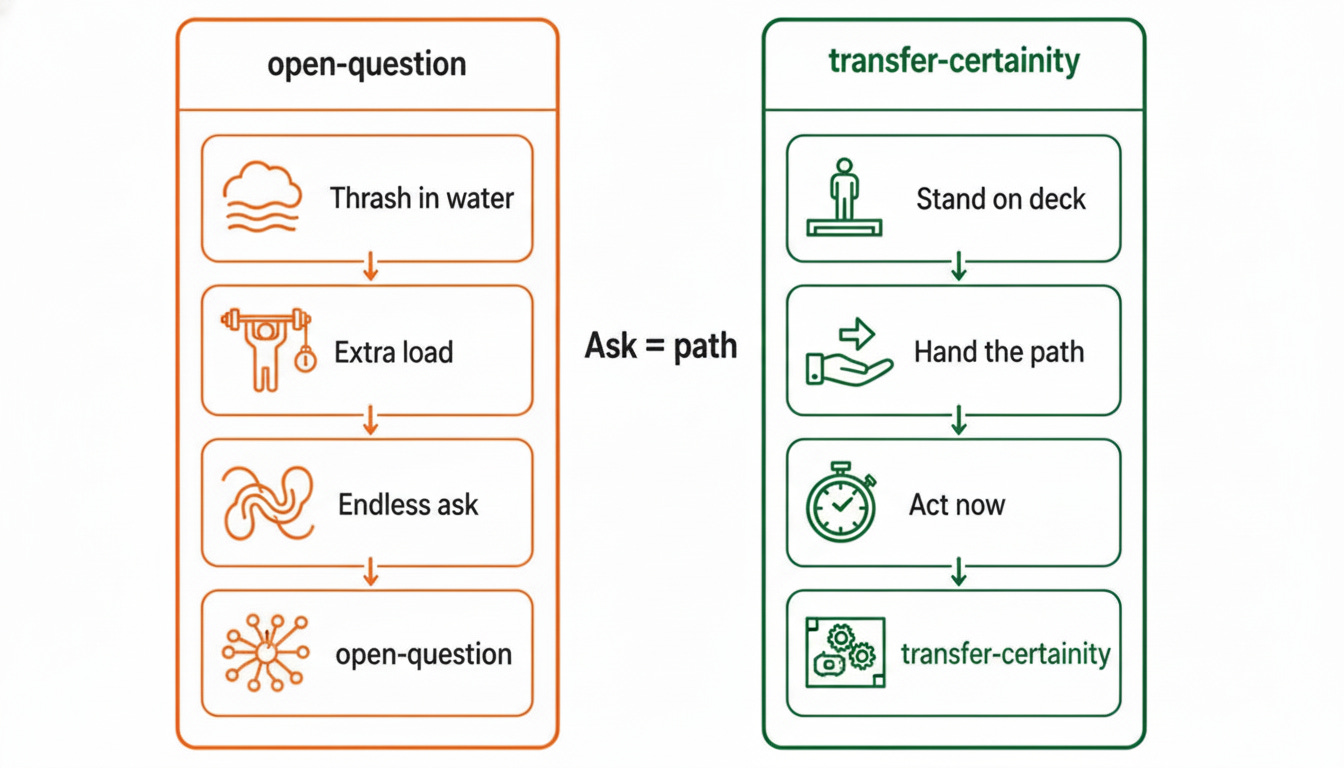
This is where you must execute a transfer of certainty. You are standing on the dry deck. Your nervous system is regulated, your perspective is clear, and the exit route is obvious to you. To hold back your advice out of some purist coaching dogma is an operational failure. You must first allow the client's internal truth to emerge, and then immediately hand them a concrete path.
"Once the answer has emerged, you say: here is what you do now."
This transition from coach to authoritative guide requires immense personal alignment. If you doubt your own legitimacy, your voice will waver, and the client will feel the lack of grounding. I carry my own history—decades of company operations and corporate turnarounds—not as a marketing slogan to shout from the rooftops, but as an internal anchor of absolute certainty. When you speak from that place of quiet conviction, the client's nervous system co-regulates with yours. Their allostatic load drops, and they can finally take action.
De-biasing the Future: Dreaming Without Today's Brakes
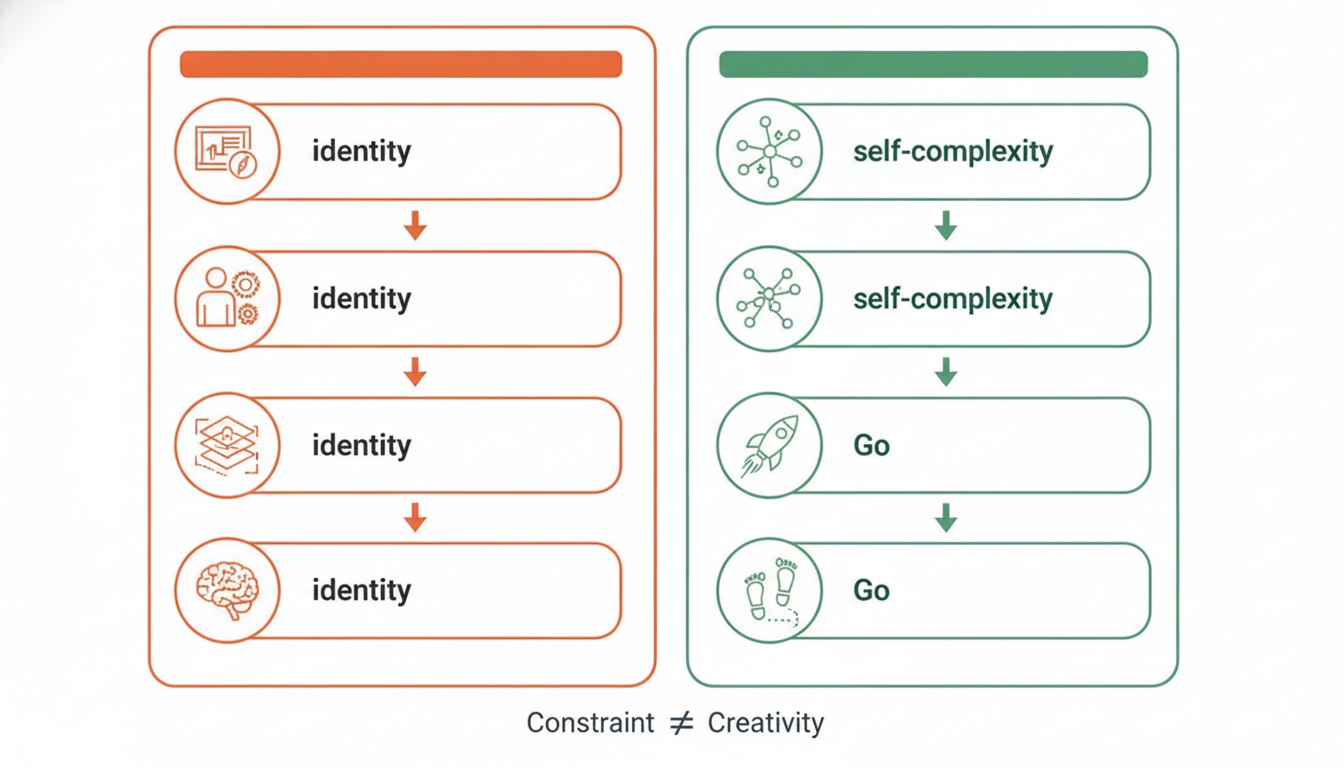
When we design our next business move—whether it is launching a high-ticket mastermind or raising our consulting fees—we almost always design it using today's brakes. We look at our current bank account, our current energy levels, and our current list of contacts, and we declare our ideal vision "unrealistic." This is a cognitive error driven by a lack of identity decoupling. We treat our future potential as if it is entirely bound by our current operational limitations.
Go deeper 👉 : Do You Lack the Energy to Propel Your Business?
Cognitive science shows that individuals with high self-complexity are better insulated against stress. According to Patricia Linville’s model of self-complexity as a cognitive buffer, when you decouple your core identity from your immediate business performance, you protect your nervous system from the pain of temporary setbacks. When you allow your "future self" to dream without today's constraints, you bypass the psychological saboteurs that try to keep you safe and small.
If you only design offers that your current, stressed-out self feels comfortable delivering, you will continue to build a business that exhausts you. The key is to map the ideal experience first—completely removing the brakes of money, time, and current network—and only then look at how your existing unfair advantage can act as the bridge to get there. You do not need to become an entirely new person overnight; you simply need to stop hiding the brilliant operator you already are.
Your Move This Week
Copy the YAML block into Claude, ChatGPT, or your preferred AI.
Replace each placeholder with your situation this week.
Paste the three numbered returns into your notes.
### INSTALLS
1. Name the mute competence you already use naturally but leave unpriced.
2. Transfer certainty by giving a clear path once the client's answer has emerged.
3. Dream your ideal business offer completely decoupled from today's operational brakes.
### YOU ARE
An independent coach or consultant who is highly skilled but stuck with a fuzzy offer,
struggling to close high-ticket clients, and feeling the constant pressure of a shrinking
runway.
### MY SITUATION
[ROLE]
[LOAD]
### ASK 1
Identify one skill or observation you make effortlessly that others completely miss (your
"entrance" insight). Write it down in one clear sentence.
- Return: The exact sentence of your unfair advantage.
### ASK 2
In your next client interaction, after helping them surface their own insight, deliver the
next steps as a direct, authoritative instruction.
- Return: The specific phrasing you used to transfer certainty.
### ASK 3
Draft the blueprint of your ideal mastermind or service, assuming zero constraints on
price, network, or location. Write down the immediate "calm-down" excuse your brain
generates.
- Return: The ideal offer description and the specific self-sabotaging thought you
decoupled from.
### RETURN ONLY
1. The named unfair advantage sentence.
2. The transfer of certainty script.
3. The ideal offer blueprint and its decoupled brake.