

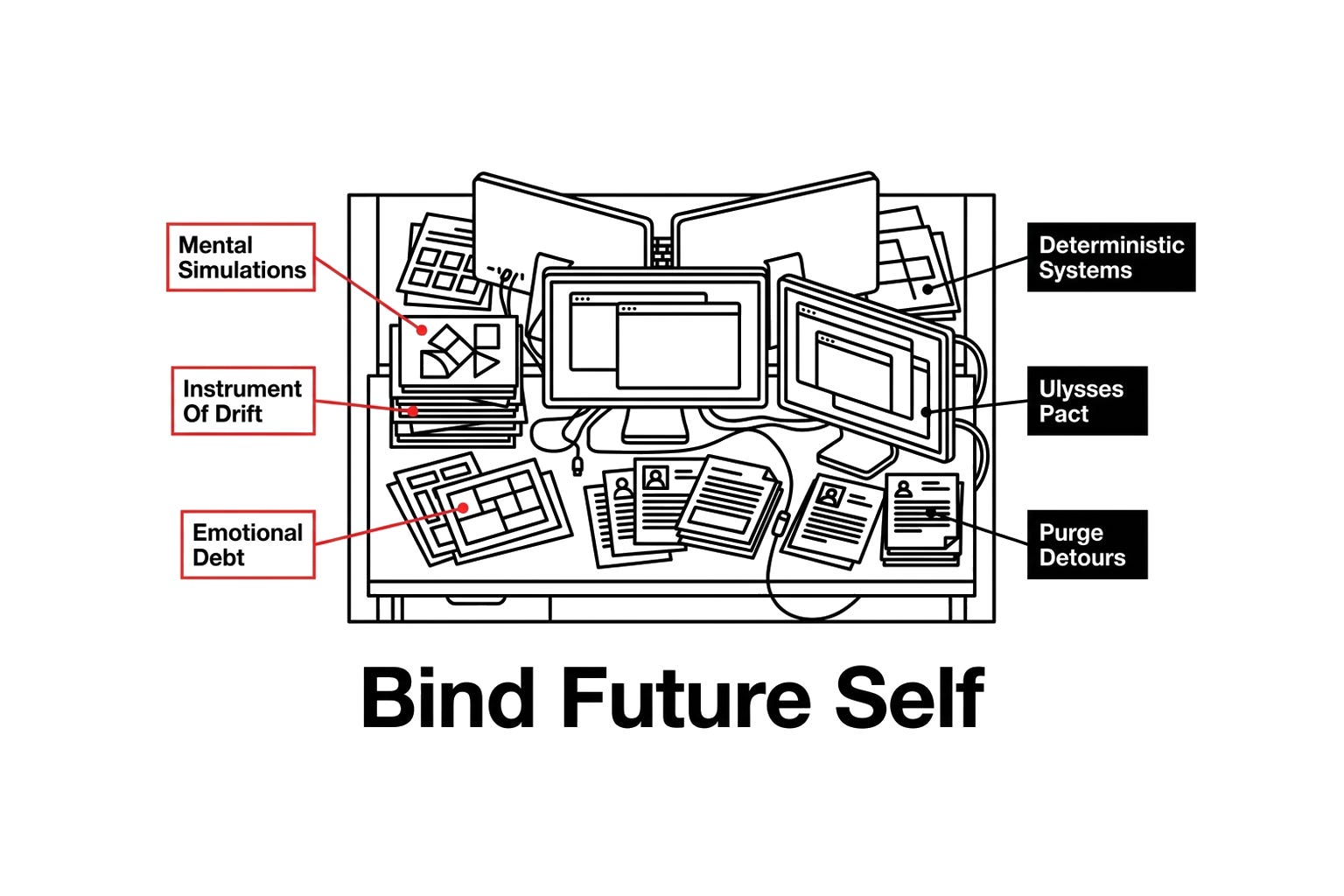
This protocol reveals the structural trap of infinite mental preparation, installs a pre-committed execution fence that eliminates daily negotiation, and audits your active offer pipeline to purge guilt-driven detours.
It is 4:45 PM on a Thursday, and your desk is covered in color-coded offer frameworks, audience avatar worksheets, and three separate tabs of CRM workflows. Your neck is stiff, your eyes burn, and you feel the heavy physical weight of a full day's work. Yet, when you look at your outreach tracking sheet, not a single prospective client has been contacted, and no proposal has been put into the market.
You tell yourself that you spent the day clarifying your strategic direction, but your bank account and your nervous system know the reality. You spent nine hours running complex mental simulations and five minutes in actual operational contact with the market. This silent ratio is where independent practices bleed out, leaving expert operators wondering why relentless effort produces zero financial momentum.

The nine-hour thought loop hiding behind strategic work
When revenue slows or client acquisition stalls, the default survival response of an intelligent operator is to think harder. You reopen your positioning, redesign your service tiers, or reorganize your digital workspace under the belief that a cleaner system will unlock execution. What feels like high-level strategy is often the perceptual automaticity of default habits taking control of your workday.
Go deeper 👉 : The Architecture of Operational Discipline
Cognitive psychology shows that continuous over-planning is rarely an intellectual exercise; it is a subconscious form of instrumental emotion regulation. When faced with the threat of market rejection or direct exposure, the prefrontal cortex burns high amounts of glucose constructing theoretical scenarios to shield the nervous system from acute discomfort. You feel exhausted at night not because you built a business, but because your brain endured the high metabolic cost of open loops without ever completing an action cycle.
"A result you have not named stays a thought, and a choice you can still renegotiate is not yet a constraint. Different results do not arrive from a longer list, but when the system hiding inside ordinary thought is no longer allowed to vote."
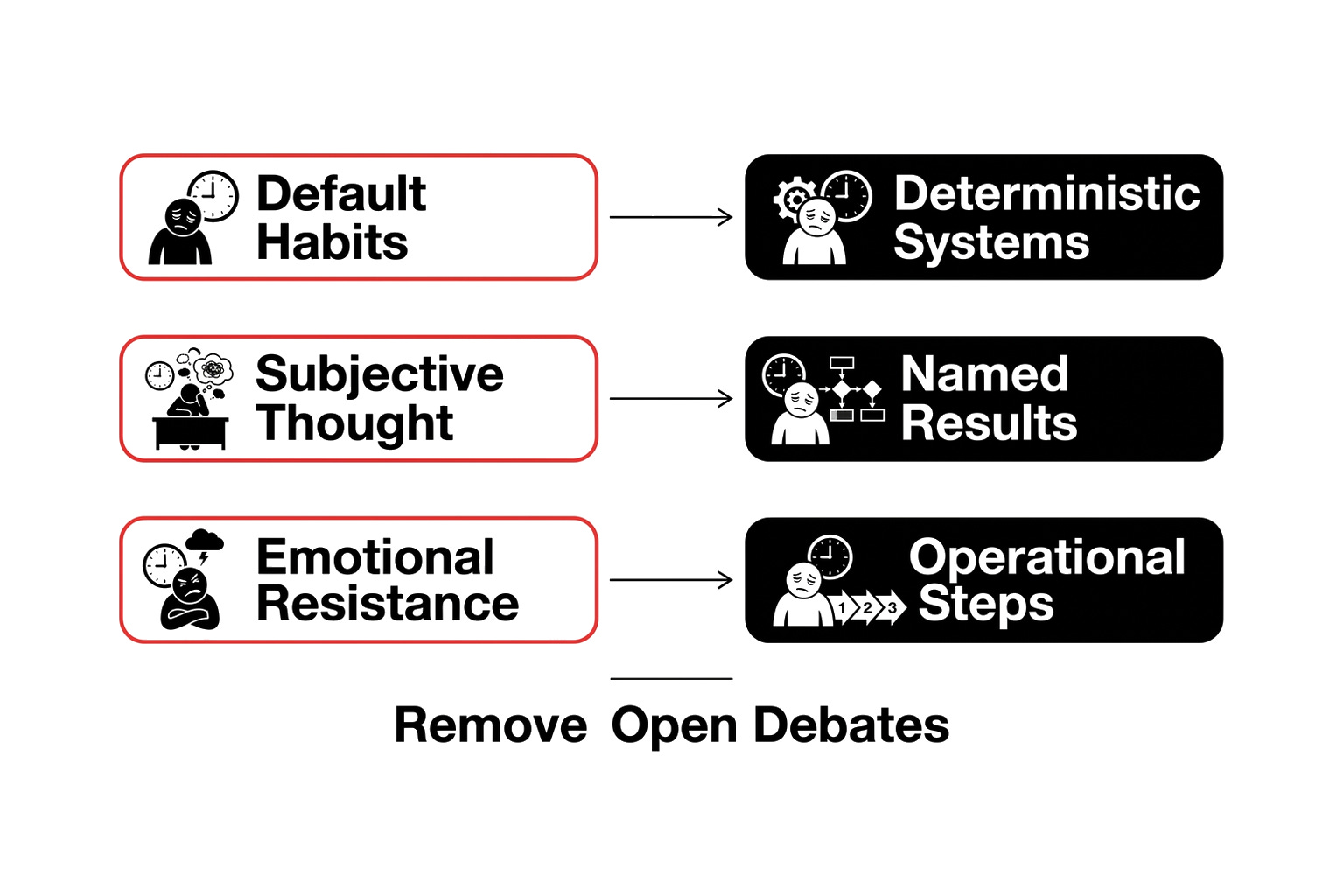
The difference between a failing advisory practice and a scalable one is not the complexity of the strategy, but the transition from subjective thought to deterministic systems. When your daily operations depend on how you feel at 9:00 AM, every single task becomes an open debate between your goals and your immediate emotional resistance. A deterministic day removes the mystery of execution by reducing complex objectives into unnegotiable operational steps.
Binding the self who will defect before the friction begins
When you wait until you are sitting in front of a blank screen to decide whether you will pitch a client or make a difficult phone call, you have already lost the battle. In that exact micro-second of hesitation, executive control is at its weakest, and your default failure strategies run automatically. Trying to out-think an impulse in the moment of discomfort is a fundamental misunderstanding of human biology.
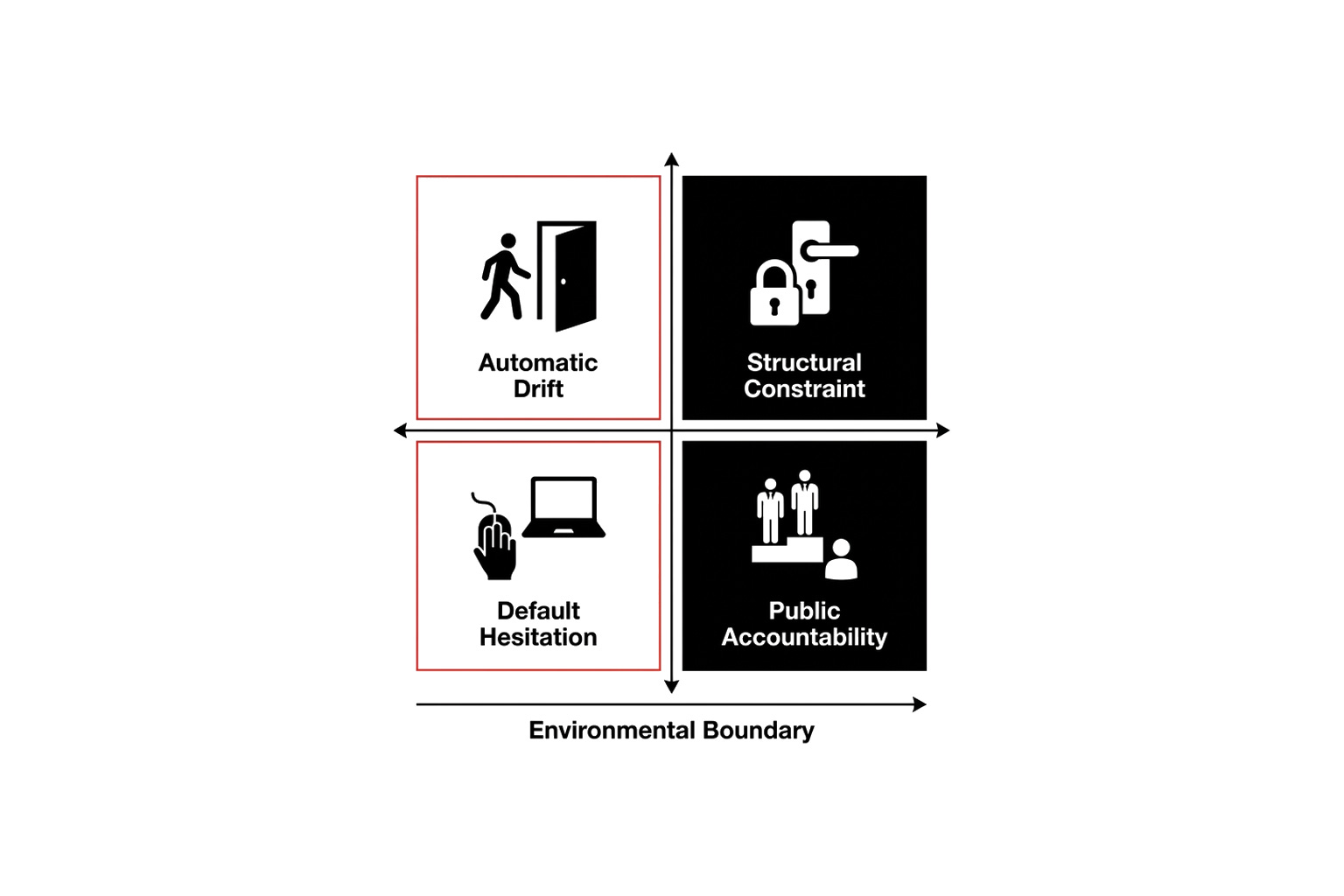
To break this pattern, high-performing operators rely on pre-committed structural constraints—often called a Ulysses pact. When Ulysses sailed past the Sirens, he did not rely on willpower or motivation to stay on course. He acknowledged his future weakness while his mind was still clear, bound himself physically to the mast, and ordered his crew to plug their ears so no future impulse could alter his command.
Go deeper 👉 : How to Move Beyond Wounds and Humiliation
"When I need to practice my daily learning routines, I know that if I stay at my main computer desk, I will find ten plausible strategic reasons to check systems or refine frameworks instead. The computer is the ultimate engine of drift. So I step away from the desk, leave the machine in another room, put on my shoes, and walk outside with only my phone. Out on the street, away from the screen, the friction disappears because the instrument of drift was left behind."
If you find yourself constantly postponing sales calls, the answer is not more discipline; it is removing the environment where defection is possible. Lock your browser away from research tabs, schedule automatic commitments that force public accountability, or hand your operational gates to a hard boundary. When the instrument of escape is physically removed from your reach, your mental energy shifts instantly from debating the work to executing it.
Stop building business moves to punish a past self
A subtle saboteur for experienced consultants returning from a period of exhaustion or distraction is the temptation to resurrect old, uninspiring projects simply to settle a score with themselves. You look at an unused lead-generation database or an abandoned advisory network and think, I failed to activate this last year, so I must prove I can make it work before I earn the right to build what I actually want.
Go deeper 👉 : Do You Lack the Energy to Propel Your Business?
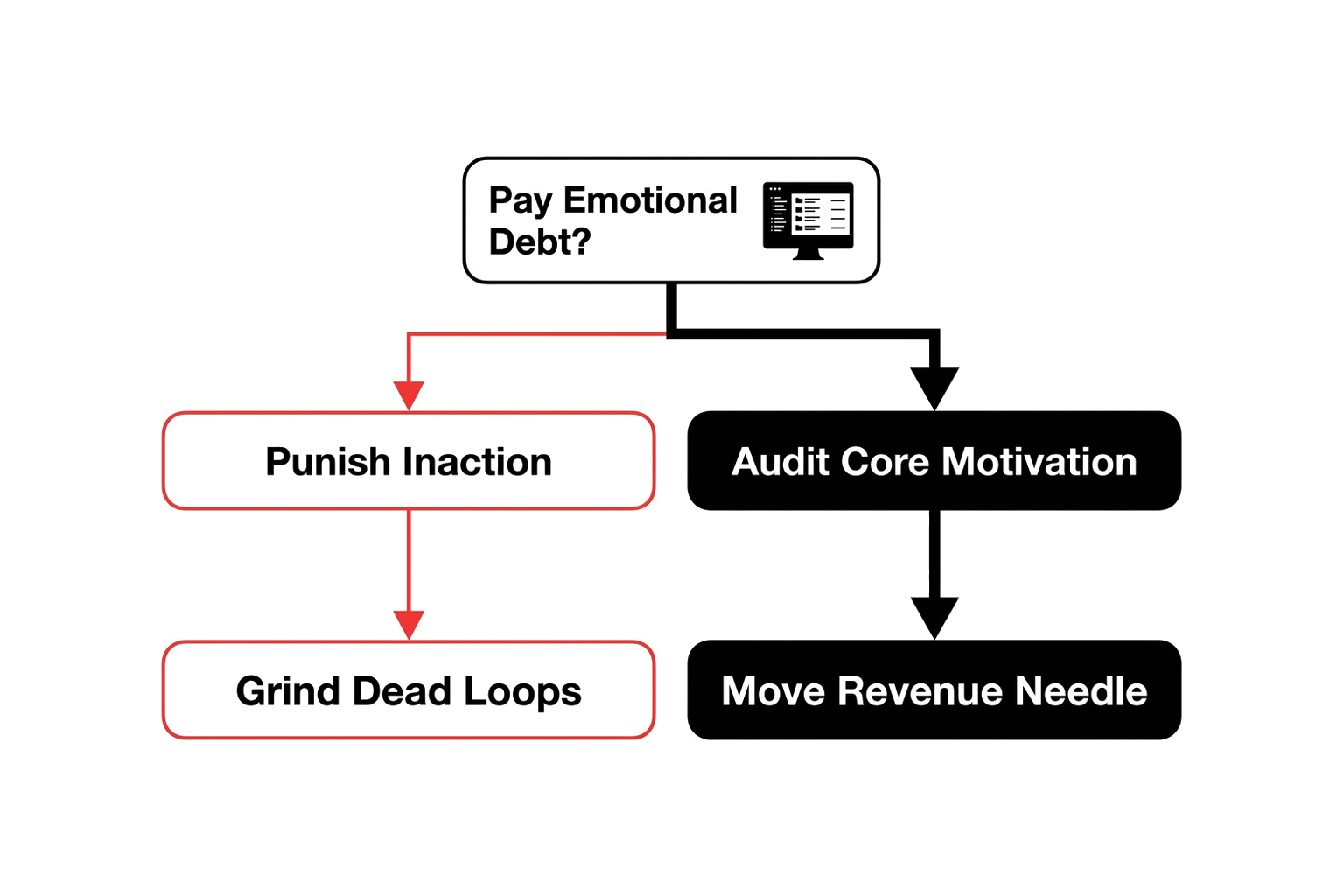
This is a guilt-driven business legacy masquerading as professional discipline. When you choose strategic moves out of self-punishment rather than high-leverage alignment, you create immediate cognitive dissonance. Your mind drags its feet, outreach feels like grinding stone, and you experience intense vicarious operational exhaustion before the offer even reaches the market.
Before committing your limited runway to a resurrected offer, audit the core motivation behind it. Ask whether this initiative represents the true expression of your unique expertise or if it is merely an intermediate detour designed to pay off emotional debt. True operational sovereignty requires forgiving your past inaction, closing dead-end loops without regret, and directing 100% of your current energy into the single move that moves the revenue needle today.
Exploded-view thinking: Record the first imperfect teaching
A strategy you cannot explode into parts is a strategy you cannot teach. Take the trait, the context, and the consequence apart the way a mechanic lays a gearbox on the bench — so your twin can hear the sequence.
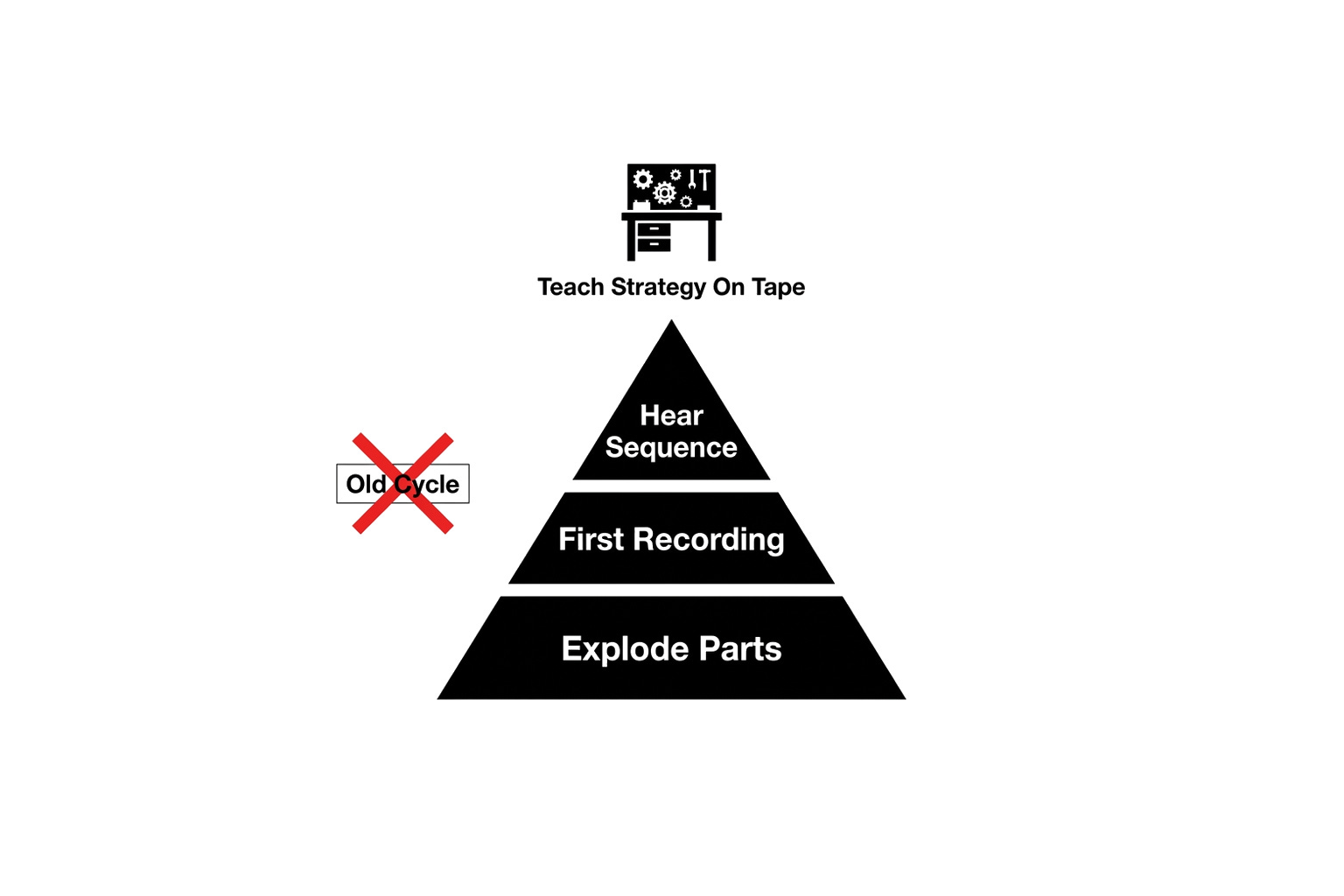
The first recording is supposed to be imperfect. Name one cell already at ease and one still tight. Paper fades in two weeks; the old cycle returns unless the teaching is on tape.
Your Move This Week
Copy the YAML block into Claude, ChatGPT, or your preferred AI.
Replace each placeholder with your situation this week.
Paste the three numbered returns into your notes.
### INSTALLS — 1. Expose the thought-to-act ratio · 2. Erect an unbreakable Ulysses pact · 3. Audit projects born of self-punishment
### YOU ARE
An independent coach or consultant whose revenue is stalling, spending endless hours
refining offers and workflows in your head while deferring the direct client conversions
that build real runway.
### MY SITUATION
- [ROLE]
- [LOAD]
- [RUNWAY SCORE]
- [FRICTION SCORE]
### ASK 1 — EXPOSE THE THOUGHT-TO-ACT RATIO
Assess my past 5 working days and calculate my actual thought-to-action ratio. Highlight
where planning served as an emotional buffer against market rejection.
Return:
- A stark breakdown of hours spent ruminating versus hours spent in direct client or
market friction.
- The single operational friction point I am using theoretical complexity to avoid.
### ASK 2 — ERECT AN UNBREAKABLE ULYSSES PACT
Identify my primary daily friction point where I routinely renegotiate my focus. Design a
hard commitment device that completely removes my option to defect before the moment
arrives.
Return:
- The exact friction moment and my default self-sabotage narrative.
- One physical or structural constraint that removes choice from the execution window.
### ASK 3 — AUDIT PROJECTS BORN OF SELF-PUNISHMENT
Examine my current active client offers and back-burner projects. Identify which ones I am
pursuing out of genuine alignment versus those resurrecting old debt to punish a past
self.
Return:
- A candid decision audit on whether to double down or immediately drop the debt-driven
project.
- The single high-leverage initiative to execute without intermediate detours.
### RETURN ONLY
1. Thought-to-Action Audit Breakdown & Avoided Friction Point
2. Ulysses Pact Design & Hard Physical Constraint
3. Offer Alignment Audit & Primary High-Leverage Move