

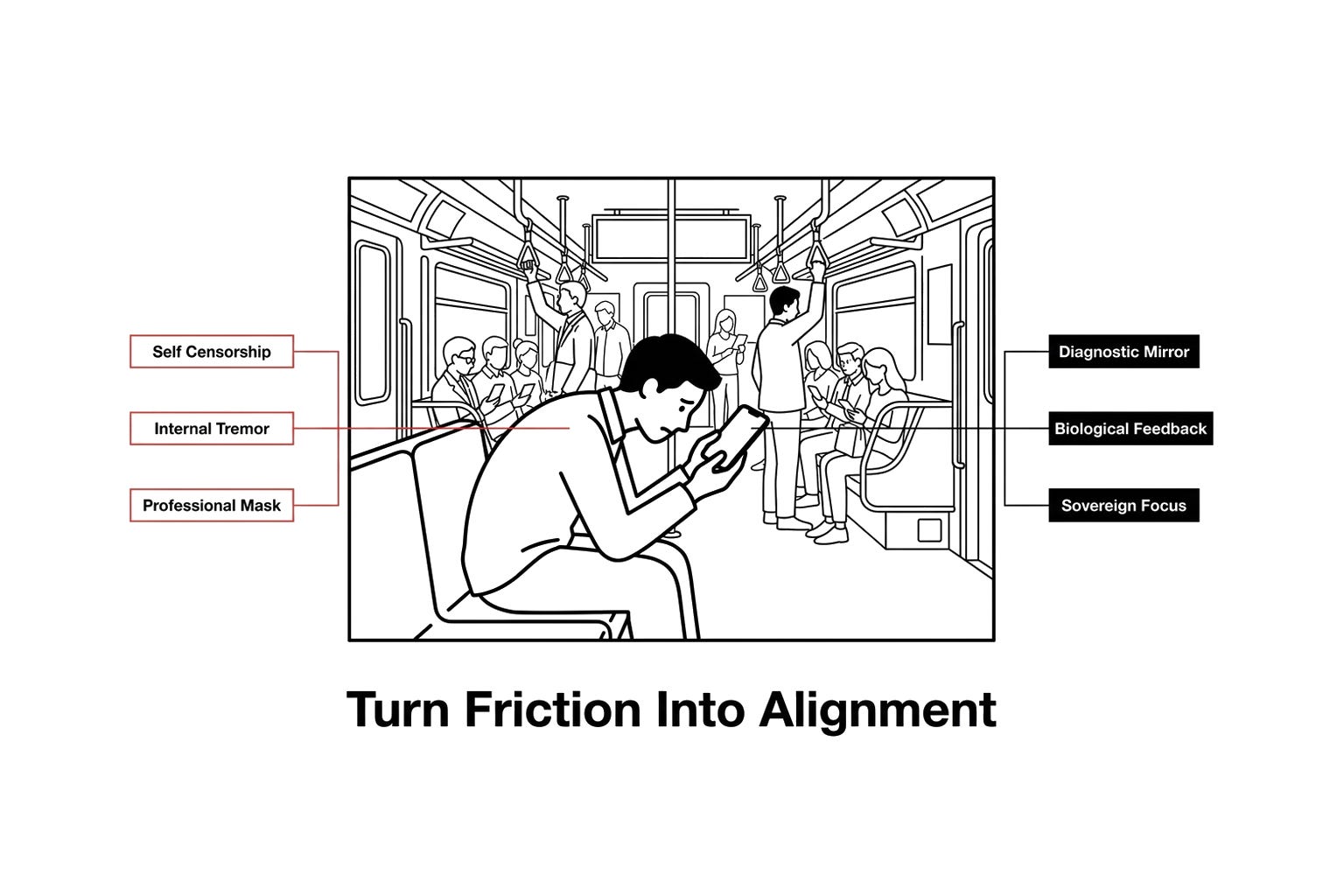
This breakdown details three key installs: turning public pressure into a diagnostic mirror, identifying fragile structural assumptions before they buckle, and operating without editing your identity.
You pull out your phone in a moderately crowded train carriage, intending to review the direct positioning of your new advisory offer or record a crisp strategy note for a prospective client. Before you speak a single word, your neck tightens, your breathing shallowly restricts to your chest, and your voice automatically drops two octaves into a soft, diluted whisper. Nobody turned around, nobody asked you to quiet down, and nobody gave you an order to hide your conviction. Yet, within three seconds, you edited your position before a single human being in that room actually evaluated what you had to say.

The carriage is not an audience—it is an amplifier
Go deeper 👉 : How to Move Beyond Wounds and Humiliation
When independent consultants enter a public setting or face a high-stakes sales conversation, they misinterpret the friction as a fear of being watched. They assume the crowd or the prospect is actively inspecting them, generating a fresh wave of self-doubt out of thin air. In reality, the environment does not invent your hesitation; it merely acts as a high-gain acoustic room for what you are already withholding from yourself.
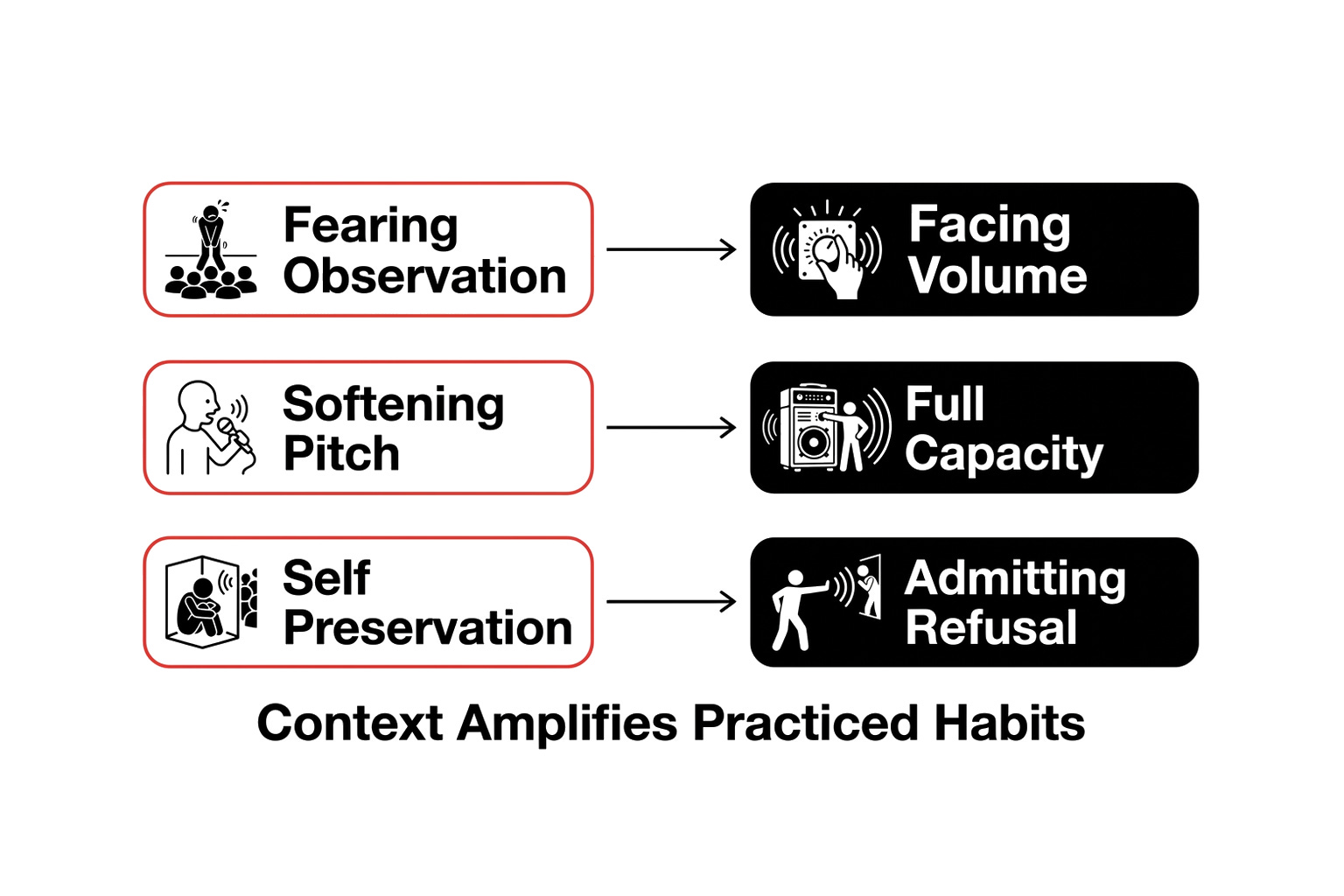
The underlying mechanism here is the social facilitation mechanism, classically mapped in social psychology. When an organism operates under perceived observation, sympathetic arousal spikes, which automatically intensifies the execution of whichever behavioral pattern is most deeply practiced. If your dominant habit under pressure is self-preservation through compromise, social exposure turns the volume knob on that habit to maximum.
"The context is an amplifier of the mirror. The room does not invent your hesitation; it turns up the volume on what you already refuse to admit to yourself."
When you soften your language or defer your closing prompt during a pitch, you are experiencing operational self-censorship. The presence of an audience does not teach you to be timid; it simply makes your underlying self-editing loud enough that you can no longer pretend you are operating at full capacity.
The fragile feet show where your structure wobbles
When an operator tries to stand firm in public, the sudden urge to shrink reveals which assumptions were never truly load-bearing. In private, you can convince yourself that your offer, your fee structure, and your professional boundaries are fully solidified. But the moment you speak those terms aloud where another human being might hear them, your internal structure vacillates, exposing the exact joints where your conviction fails.
Go deeper 👉 : Do You Lack the Energy to Propel Your Business?
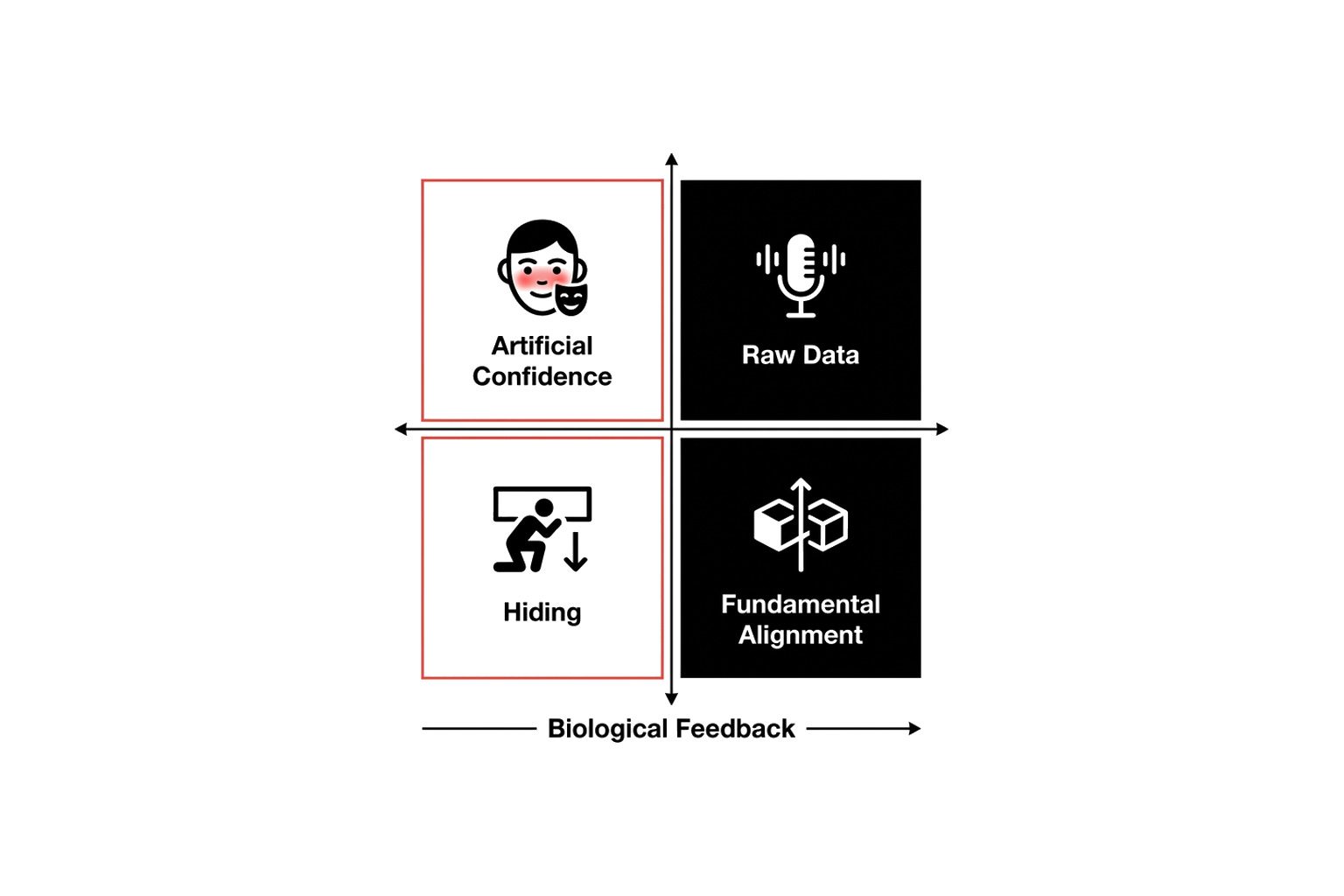
That internal tremor is your sharpest diagnostic tool if you learn to read the biological feedback instead of retreating from it. When social evaluation triggers autonomic heat in your face or a drop in your diaphragm, your brain is signaling a collision between your true intent and your dominant conditioned response. You are suddenly paying a tax on permission you never needed to request.
"Once you have assumed the discomfort with higher intensity, you have material. You cannot recondition a response you are still hiding from yourself."
The objective of high-stakes exposure is not to put on a performance of artificial confidence, but to force the fragile feet of your operation into the open. Once you feel the precise point where your posture gives way, you possess raw data regarding where your offer lacks fundamental alignment.
Refuse the mold before you replace the person
The standard response to social friction is to deploy a persona—a pre-packaged, professional mask designed to survive the room without causing discomfort. You adjust your tone to match the corporate baseline, sanitize your core thesis, and deliver a sanitized narrative that offends no one and converts no one. Every micro-adjustment feels like polished business etiquette, but taken together, they represent the total replacement of your operational authority.
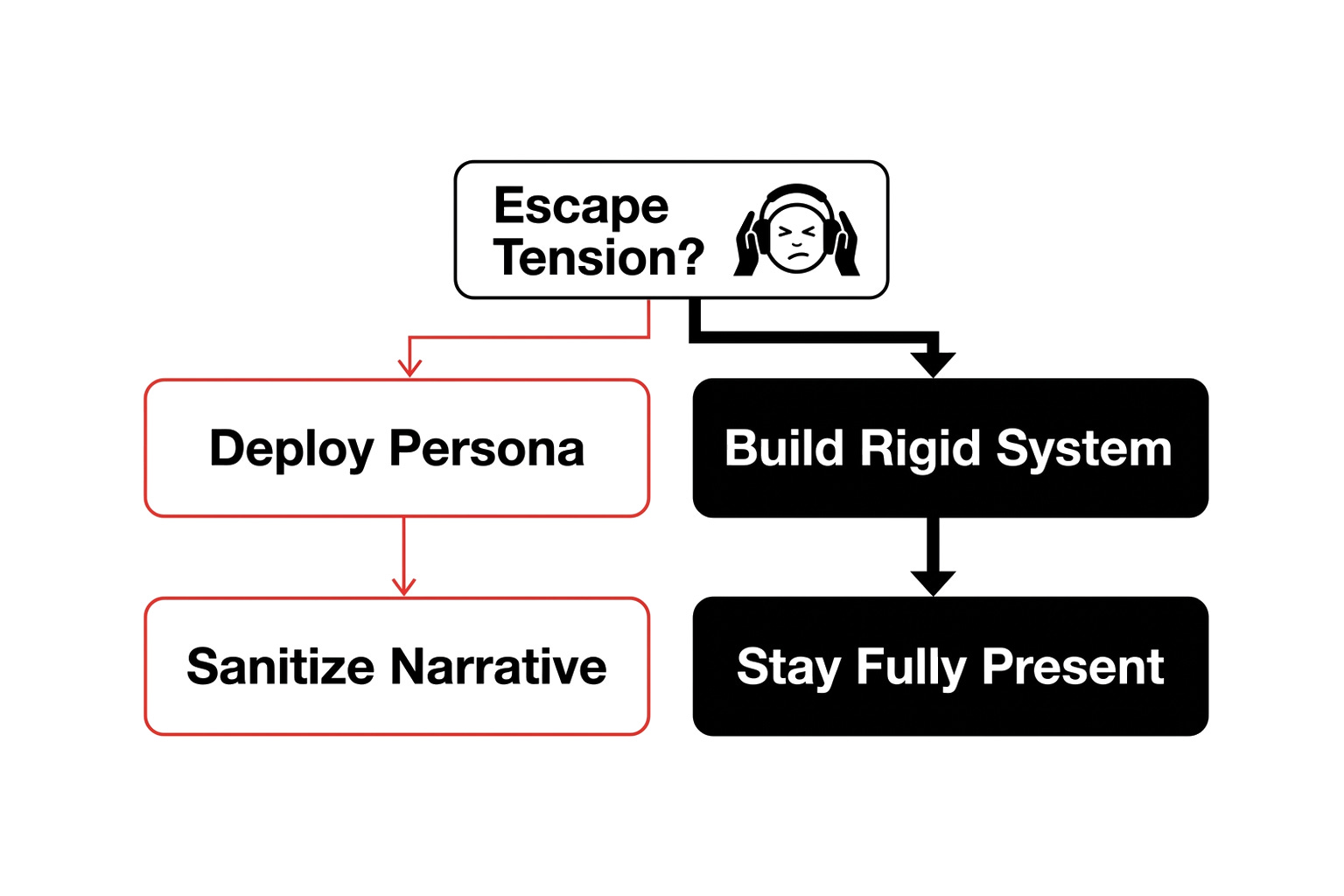
When I was structuring our digital architectures and community delivery, I realized I was deliberately hacking my own weak side—specifically, my total unwillingness to waste administrative hours on manual follow-ups. I did not attempt to transform myself into a high-touch administrative operator; I built a rigid system around my actual nature so that my sovereign focus remained entirely intact.
The moment you slide noise-canceling headphones over your ears to escape the tension of a train carriage, you switch off the diagnostic instrument entirely. Avoiding the environment removes the discomfort, but it also destroys the exact mirror that shows you where you edit yourself. The work is to stay fully present in the room without allowing an internal identity gap to dictate your voice.
Build the operator's manual while the engine runs
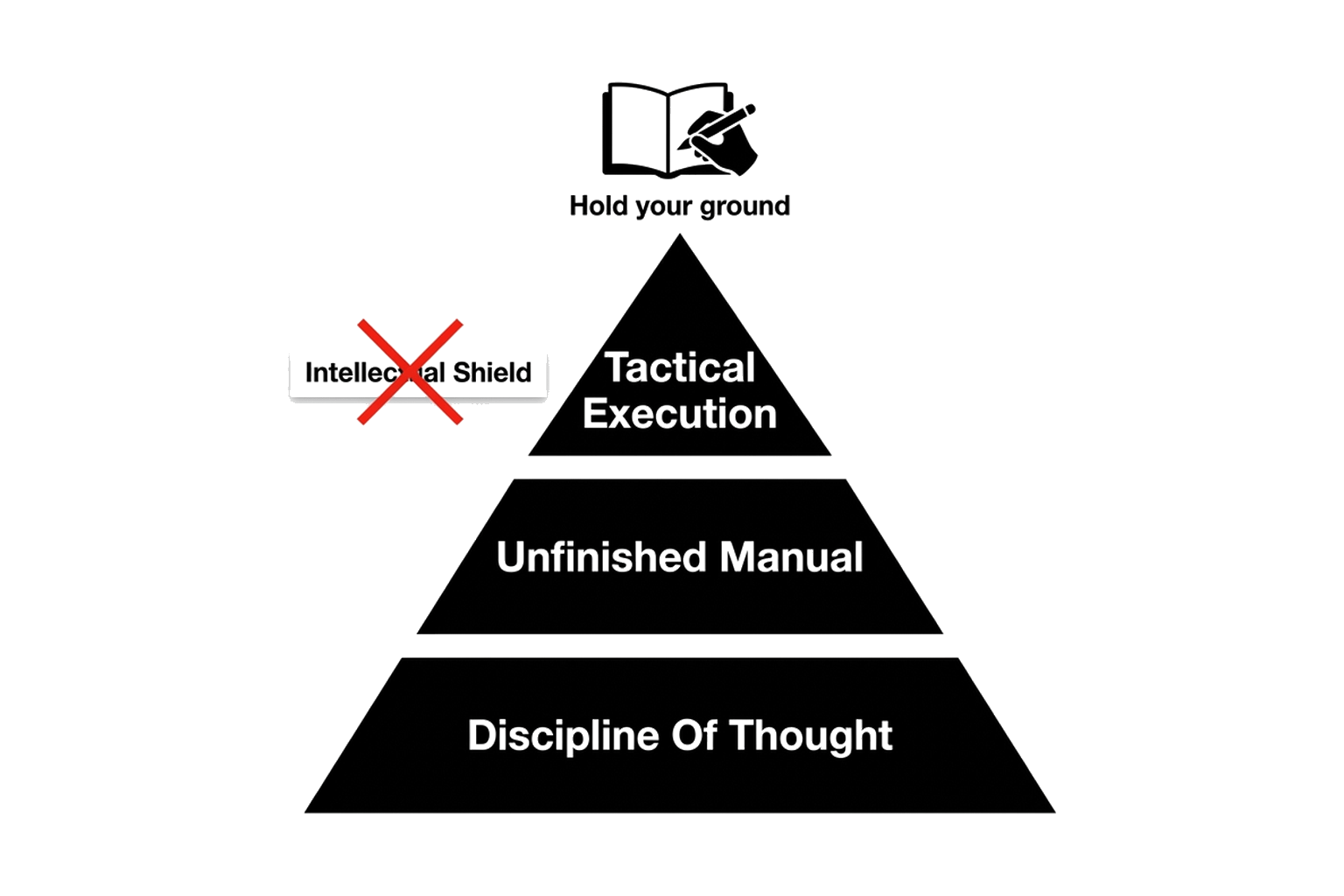
Self-mastery for an independent operator is not a static document or a finished manifesto that you complete once and store on a shelf. It is an unfinished manual of operation that demands a new entry every time a live interaction exposes an unexamined boundary. When you attempt to finalize your positioning entirely before taking it into the public square, you are simply using preparation as an intellectual shield against live exposure.
Go deeper 👉 : Are You Still Far From What You Said You Would Build?
Developing this level of self-knowledge requires a strict discipline of thought that separates bodily sensation from tactical execution. When your nervous system registers social risk, your prefrontal cortex naturally seeks an immediate exit, urging you to lower your price, grant unearned discounts, or dilute your scope. Recognizing that biological flash for what it is—a survival mechanism firing in a low-risk commercial environment—allows you to maintain your volume without yielding your ground.
By systematically documenting how you function under live pressure, you convert every awkward public minute into operational leverage. You do not need to become someone else to hold your ground in a room full of strangers; you simply need to stop altering the person you already are the moment someone turns up the volume.
Your Move This Week
Copy the YAML block into Claude, ChatGPT, or your preferred AI.
Replace each placeholder with your situation this week.
Paste the three numbered returns into your notes.
### INSTALLS
1. Treat public friction as an amplifier of existing self-censorship, not an external
threat.
2. Identify fragile positioning assumptions by monitoring physical urge to shrink during
sales conversations.
3. Maintain original operational volume without adopting a diluted corporate persona under
pressure.
### YOU ARE
An independent coach or consultant who catches themselves softening their message,
diluting high-ticket offers, or lowering their vocal authority whenever prospective
clients or public environments introduce friction.
### MY SITUATION
- [ROLE]
- [LOAD]
### ASK 1
Identify one sentence describing your core value or fee structure that you routinely
soften when speaking to prospects.
Return: State the exact unedited version of this sentence and describe the precise
physiological urge (e.g., throat constriction, breath shortening) that usually forces you
to edit it.
### ASK 2
Execute one live interaction this week where you state this core sentence at full volume
without adding qualifying caveats or nervous padding.
Return: Report the immediate internal reaction you experienced right after delivering the
unedited line, specifying whether you held your volume or backed down.
### ASK 3
Review the structural assumption that made you hesitate during that interaction.
Return: Pinpoint the exact fragile assumption in your offer or positioning that caused the
hesitation, and detail one immediate boundary fix to reinforce that foot.
### RETURN ONLY
1. Unedited core sentence + bodily signal of self-censorship.
2. Outcome of full-volume delivery + immediate internal reaction.
3. Identified fragile assumption + targeted operational fix.