

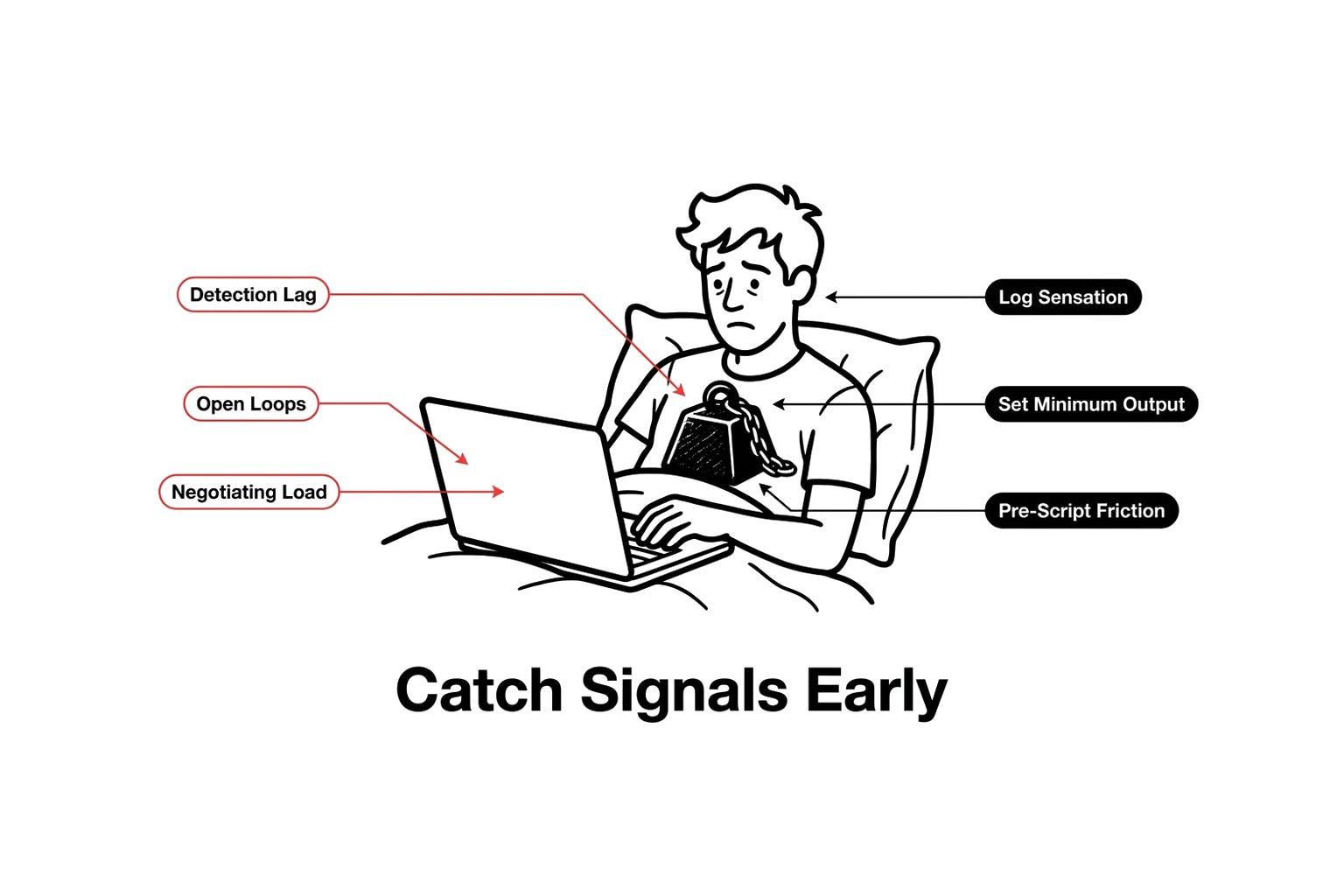
This article installs three operational instruments: catching the interoceptive signal before energy crashes, defining the non-negotiable minimum day, and pre-scripting uncomfortable friction before execution begins.
A seasoned coach wakes up on Tuesday morning with a heavy weight in his chest, ready to burn down his client calendar, scrap his signature offer, and look up senior corporate roles on LinkedIn. Just twelve hours earlier, a target client declined a high-ticket mastermind, sending a short note about values mismatch. In the moment of reading the email, the coach felt reasonable and composed. But overnight, the rejection seeped into his nervous system like dark dye through clear water. By 7:00 a.m., his executive brain constructed a logical story: My offer is flawed, my positioning is saturated, and I need to retreat to a secure salary.
By Wednesday evening, after unexpectedly stepping into a high-caliber peer supervision room where his expertise was recognized, he wakes up on Thursday filled with strategic drive. Nothing about his business architecture, pricing model, or client funnel changed between Tuesday and Thursday. What shifted was an internal neural state that his brain immediately scrambled to justify with strategic narratives.
When I sit with founders and top coaches, I often watch them redesign their entire business model when the actual leak is simply a forty-minute detection lag. They believe they have an offer problem or a closing problem, but their calendar is actually paying for physiological votes that happened long before their analytical mind came online.

The detection lag that drains your calendar
Go deeper 👉 : How High Performers Stop Borrowing Against Tomorrow
When an adverse event occurs—a rejected proposal, a tense client exchange, an unexpected cancellation—afferent neural signals travel from the viscera to the brain far faster than conscious language can format a sentence. This temporal gap is where independent operators lose their sovereignty. Your nervous system alters its autonomic baseline, shifting down into protection mode, while your rational cortex lags behind, frantically inventing stories about market saturation or professional inadequacy to match the sudden drop in energy.
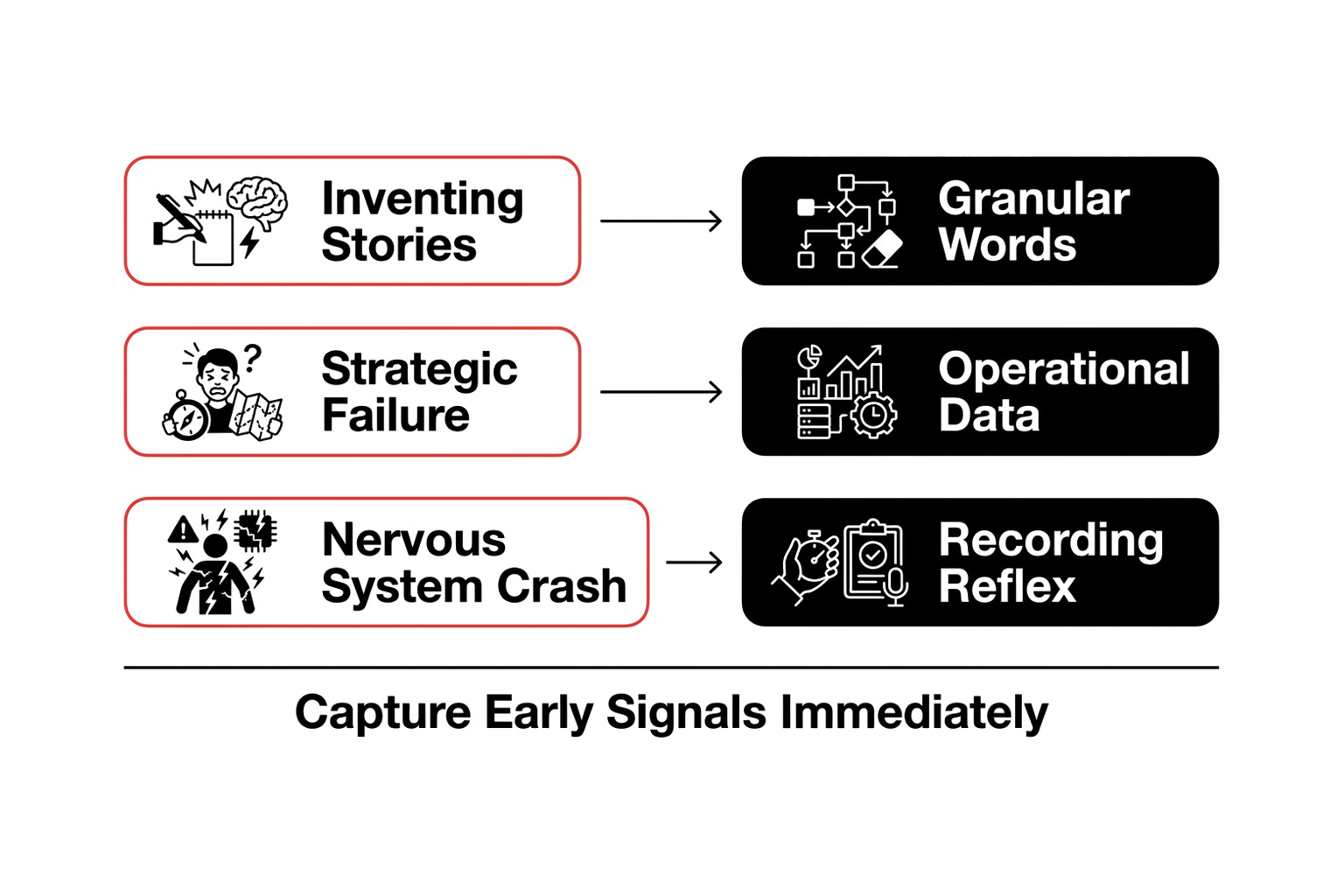
In cognitive neuroscience, this phenomenon is tracked through affective chronometry, which measures the precise rise time, peak intensity, and recovery duration of an emotional reaction. Most coaches do not suffer from bad recovery; they suffer from high recovery latency. Because they do not notice the physiological shift while it is occurring, they spend their mornings reacting to yesterday’s residual recovery cycle, mistaking bodily fatigue for strategic failure.
To break this cycle, you must sharpen your interoceptive signal detection—the capacity to discriminate faint internal bodily signals from background cognitive noise. When an operator lacks this sensitivity, even scheduled rest fails to prevent exhaustion. They schedule downtime on paper, but because they fail to capture early physiological fatigue signals before the threshold is breached, they end up billing their business for an unannounced nervous system crash.
"A flight recorder is useless if you only switch it on after the crash. You cannot manage your business strategy when your nervous system has already quietly voted to shut down."
Capturing this signal requires an immediate recording reflex rather than an end-of-day post-mortem. When you feel the initial drop in energy or the sudden urge to rewrite your strategic roadmap, your first move must be to log the exact sensation and the accompanying thought sentence before acting on it. Putting granular words on an internal state immediately engages prefrontal networks, transforming an overwhelming physical mood into actionable operational data.
The non-negotiable minimum that protects esteem
Go deeper 👉 : How to Move Beyond Wounds and Humiliation
When coaches operate under high cognitive load, they routinely fall into a self-worth trap by setting sprawling daily agendas. They write down ten ambitious strategic initiatives, complete four, and go to bed feeling like a failure despite putting in ten hours of intense labor. This structural mismatch creates an identity gap expansion, deepening the distance between the sovereign professional you aspire to be and the reactive operator your calendar actually records.
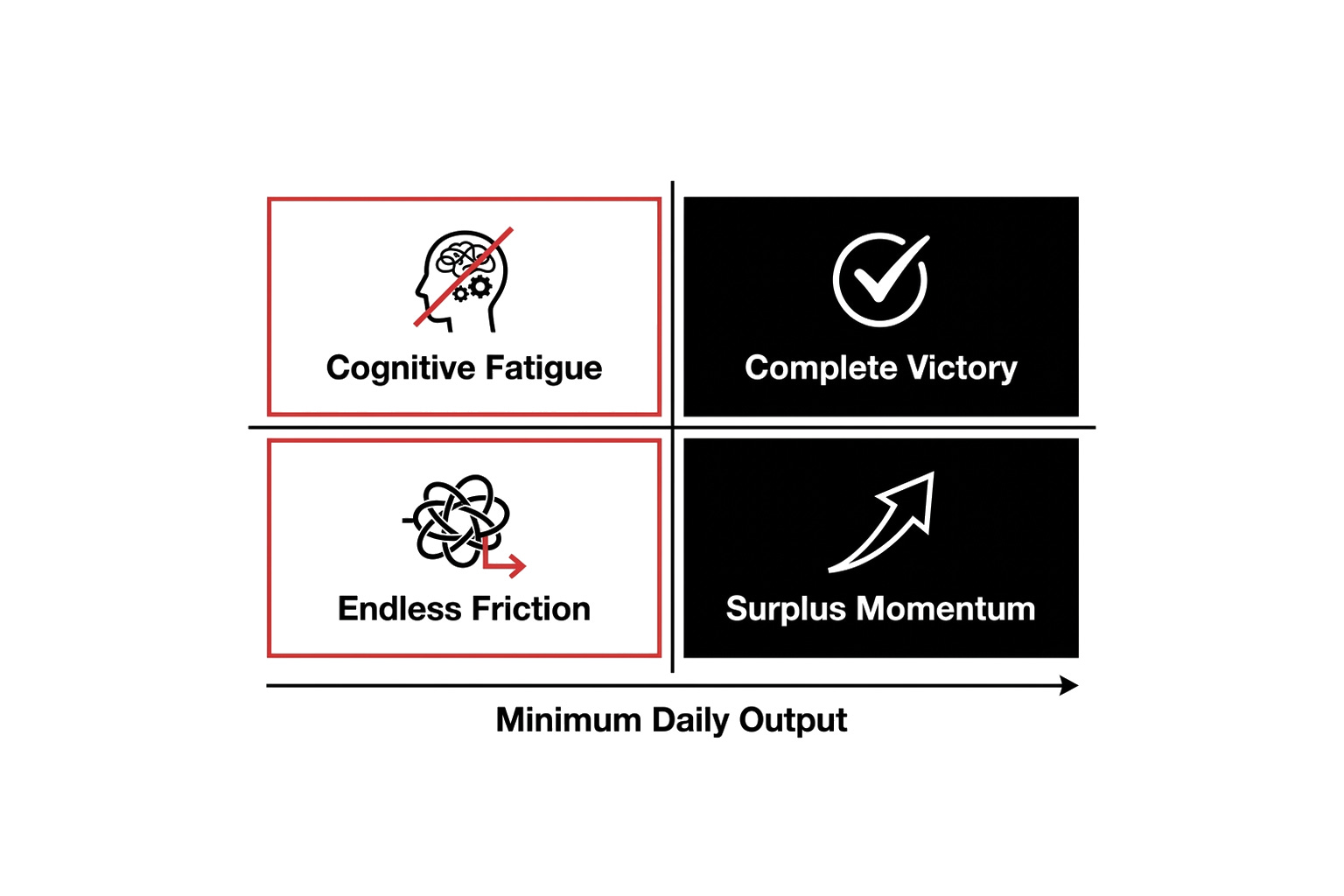
Self-esteem is not an abstract psychological feeling; it is the brain's real-time assessment of operational congruence—the alignment between what you state you will do and what you execute. When you leave half a dozen strategic projects open at night, your brain keeps those unfulfilled intentions active in working memory, inducing cognitive fatigue through persistent open loops.
To protect your psychological runway, you must define a minimum daily output—the single non-negotiable line of work that validates the day regardless of external interruptions. If a strategy consultant decides that today’s single minimum output is finalizing a client proposal, completing that task grants complete operational victory for the day. Everything executed beyond that baseline becomes surplus momentum rather than an unfulfilled obligation.
"Self-esteem is not built through motivational self-talk. It is built when your nervous system registers a closed loop that matches what you said you would do."
Closing one small, concrete loop delivers a measurable completion signal to the dopamine architecture, rewiring the brain to associate work with closure rather than endless friction. When you score your daily performance strictly against this pre-defined minimum, you starve the late-night narrative of lack. You stop judging your overall capability based on residual fatigue, anchoring your identity instead in verifiable operational completion.
Pre-scripting the friction before you negotiate
Go deeper 👉 : These Two Fears Can Kill Your Ambition
Vague strategic intentions routinely collapse at the exact boundary where discomfort begins. A consultant plans to spend two hours on business development or cold outreach, but when the moment arrives, a subtle internal hesitation takes hold. Because the precise friction point was never explicitly defined, the mind instantly negotiates an escape route: organizing folder structures, clearing the inbox, or refining the website copy under the guise of high-value preparation.
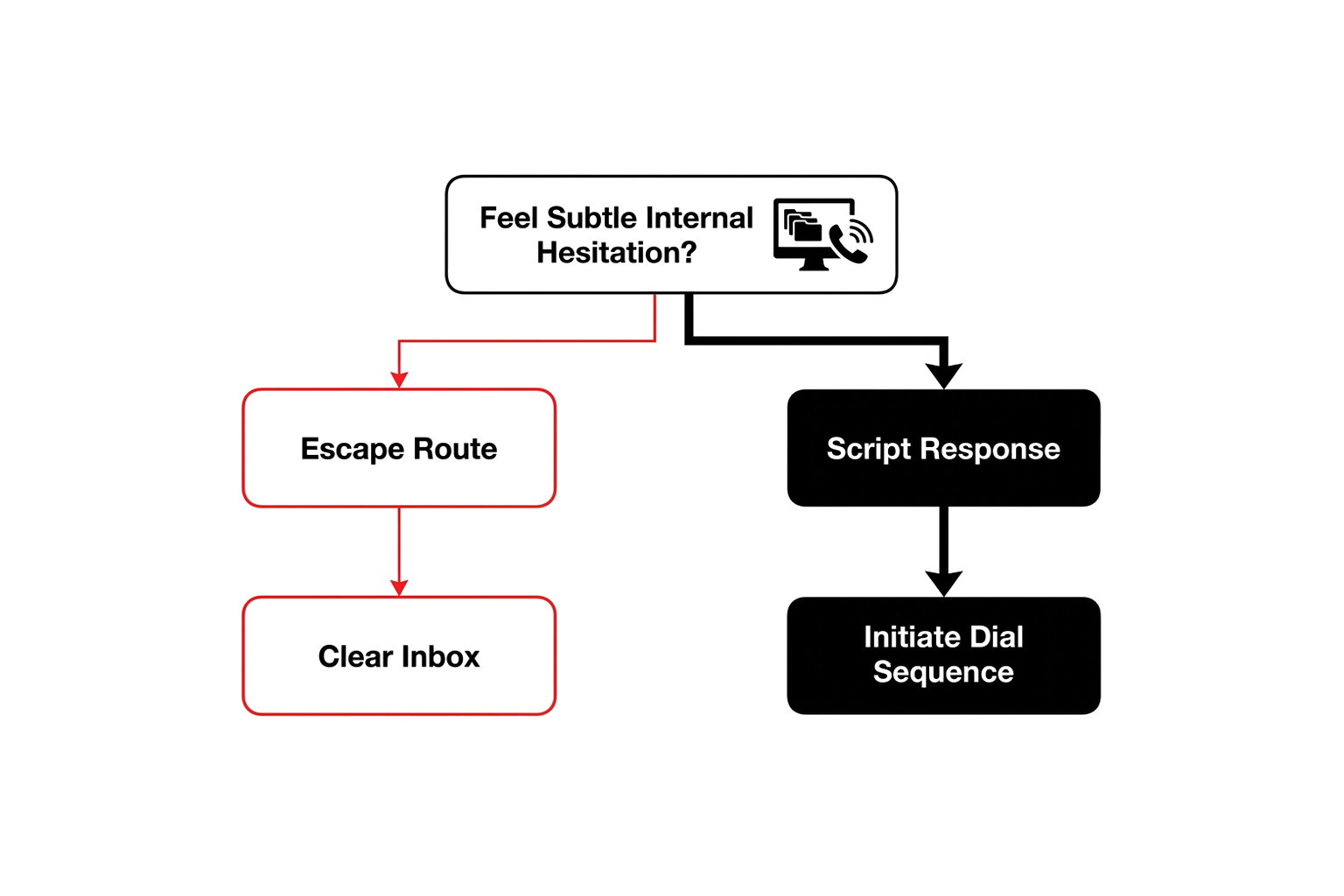
This evasive behavior occurs because human decision-making under stress defaults to micro-negotiations. When you wait until you are face-to-face with an uncomfortable task to decide how to respond, your depleted executive control will almost always choose immediate discomfort reduction over long-term enterprise growth.
Overcoming this requires installing an implementation intention loop, a behavioral mechanism that pairs a specific environmental trigger with an unnegotiated action rule. Instead of listing "do business development" on your task board, you identify the exact moment of resistance and pre-script your physical response: When I feel the hesitation to make a sales call, I immediately open the application screen and initiate the dial sequence without re-reading the lead's profile.
By deciding your operational move long before the emotional impulse arrives, you eliminate real-time negotiation from your calendar. You transform unpredictable discipline into structural predictability, securing true operational self-sovereignty across your business operations. When friction is selected and scripted in advance, discomfort ceases to be a stop signal and becomes the exact metric of your forward progress.
Exploded-view thinking: Record the first imperfect teaching
A strategy you cannot explode into parts is a strategy you cannot teach. Take the trait, the context, and the consequence apart the way a mechanic lays a gearbox on the bench — so your twin can hear the sequence.
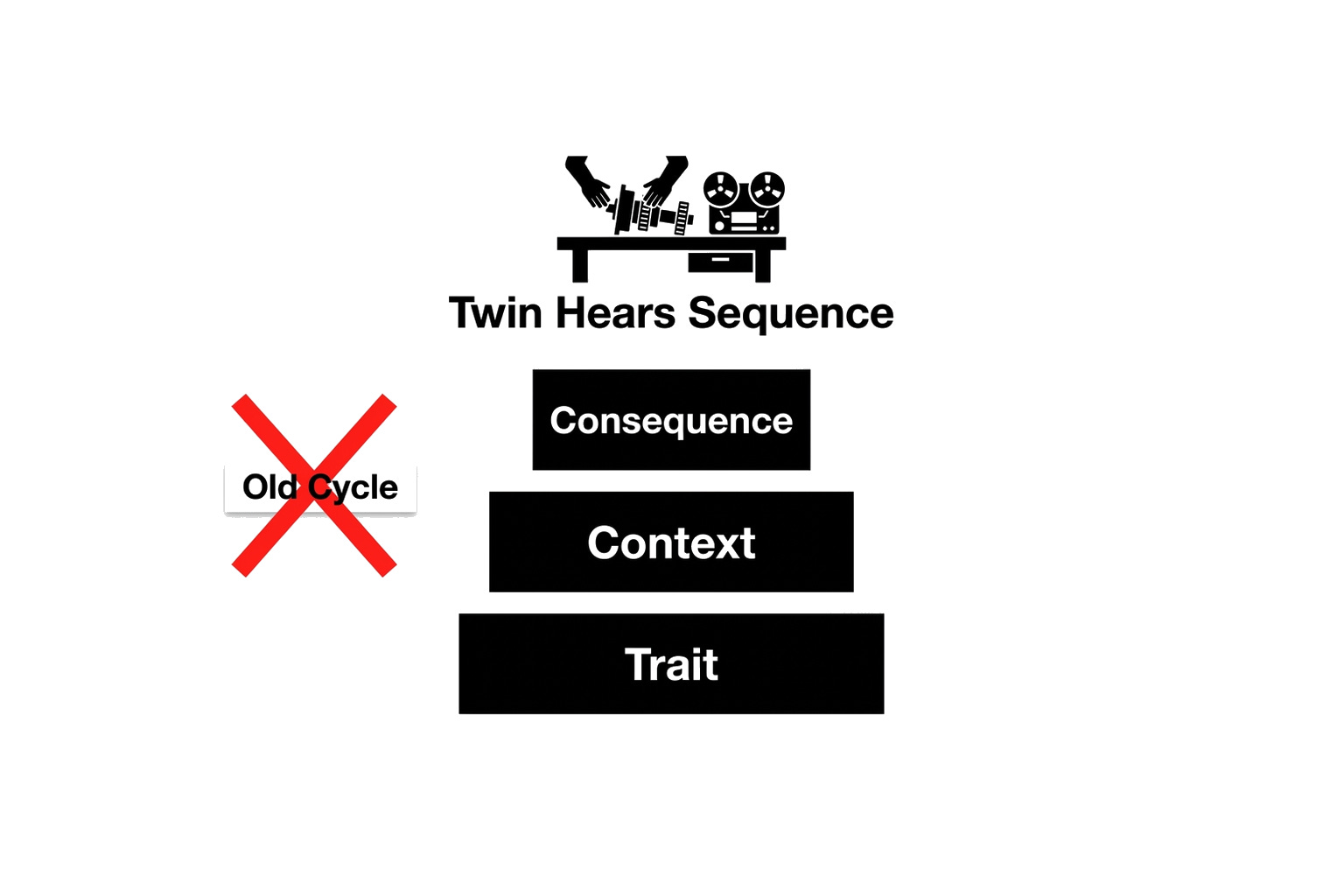
The first recording is supposed to be imperfect. Name one cell already at ease and one still tight. Paper fades in two weeks; the old cycle returns unless the teaching is on tape.
Your Move This Week
Copy the YAML block into Claude, ChatGPT, or your preferred AI.
Replace each placeholder with your situation this week.
Paste the three numbered returns into your notes.
### INSTALLS — 3 operational instruments to reclaim daily momentum
1. Capture the interoceptive signal before your state dictates your strategy.
2. Define and score the non-negotiable minimum daily output.
3. Pre-script uncomfortable friction using implementation intentions.
### YOU ARE
An independent coach or consultant experiencing revenue volatility, fuzzy offers, or
energy crashes, torn between scaling sovereignly and returning to corporate safety.
### MY SITUATION
- [ROLE]
- [LOAD]
- Current Detection Lag Score (1-5): []
- Identity Gap Score (1-5): []
### ASK 1 — Signal Capture
Record your precise physiological state and internal sentence at the very first cue of
friction today, before negotiating or re-strategizing.
Return:
- What was the specific physiological sensation (e.g., tight chest, shallow breath)?
- What was the exact sentence your mind constructed to explain it?
### ASK 2 — Minimum Output
Define the single non-negotiable minimum output that makes today congruent, and execute it
before opening new loops.
Return:
- What is the precise "minimum finished output" for today?
- At night, did you close this single loop without adding unrated secondary tasks?
### ASK 3 — Pre-Scripted Friction
Identify tomorrow's point of discomfort and write down the exact action rule you will
execute when the cue appears.
Return:
- What specific moment tomorrow carries the highest friction?
- What is your exact pre-decided action rule when that moment arrives?
### RETURN ONLY
1. Your raw signal capture (sensation + sentence).
2. Your minimum daily output status (closed loop result).
3. Your pre-scripted rule for tomorrow's primary friction point.