

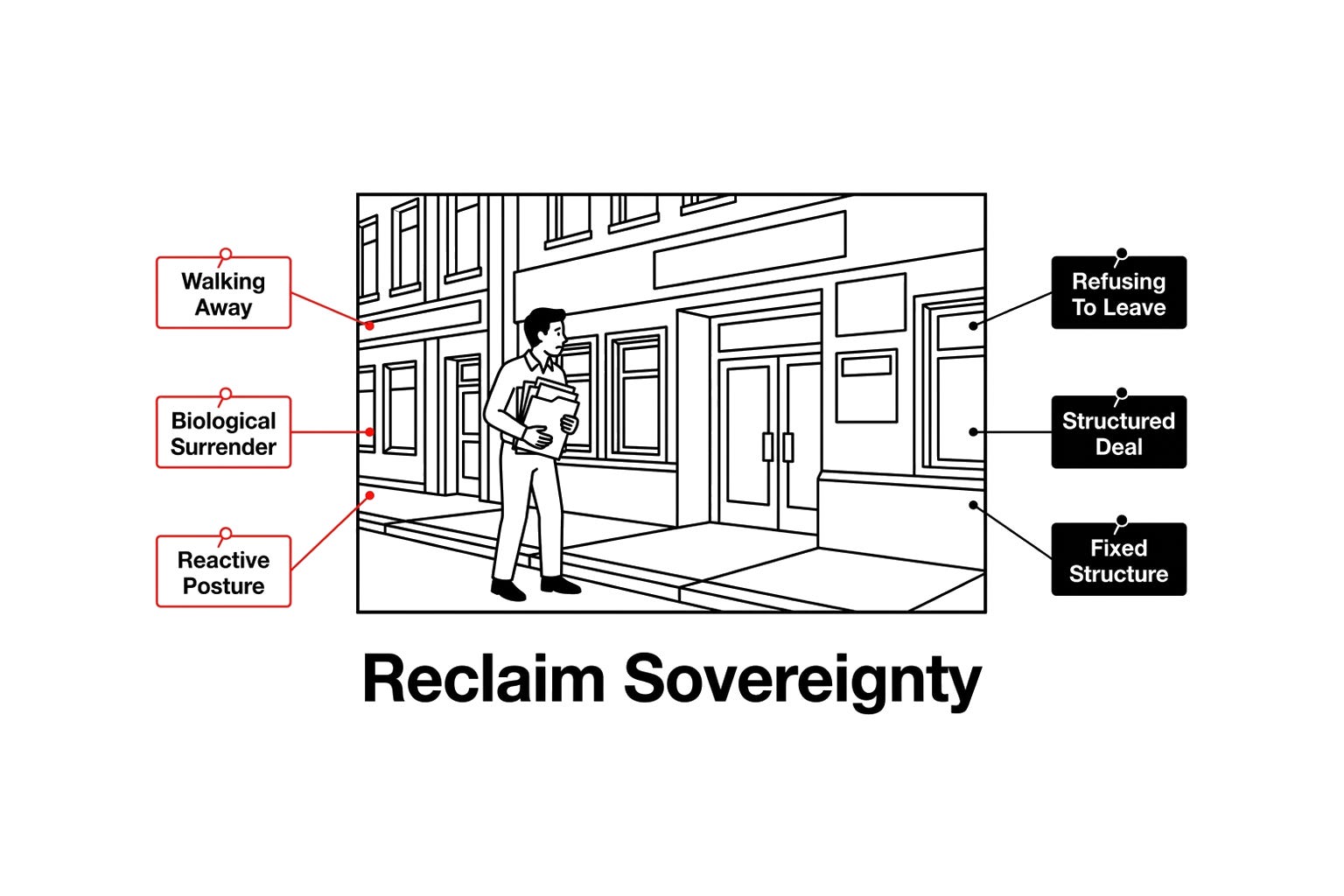
Today, we are installing three operational shifts: pricing the compounding cost of delay, neutralizing the physiological urge to escape discomfort, and designing a day that protects your deep work from administrative leaks.
You are standing on the pavement outside a drafty administrative office, clutching a folder of compliance documents that have been gathering dust on your desk for three weeks. Your runway is shrinking, your client acquisition pipeline feels like a puzzle you cannot solve, and the constant, low-grade anxiety of running an independent practice is making you look at corporate job boards late at night. The clerk inside just told you that you need one more stamp from another department across town. Your body immediately registers the hit: your chest tightens, your shoulders rise, and a powerful voice inside whispers that you should just go home, open your laptop at a quiet café, and handle it tonight. You walk away, telling yourself it is the pragmatic choice. But as you step onto the street, you have not actually saved any time; you have just initiated a silent, compounding operational tax.

The Anatomy of the Friction Cascade
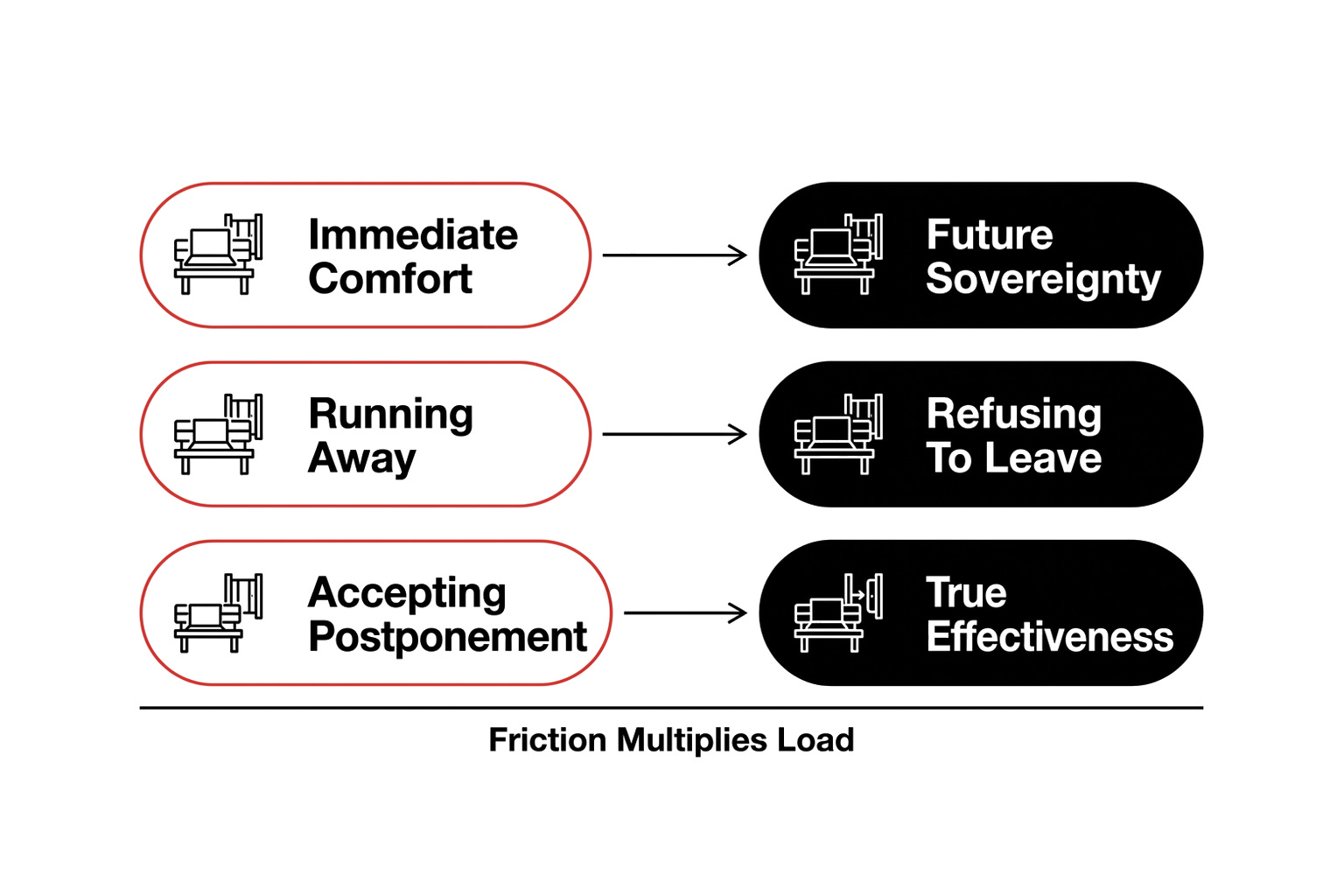
When you walk away from a half-finished gate to preserve your immediate comfort, you do not return to a neutral playing field. You initiate a friction cascade, a compounding sequence of delays where a single postponed action multiplies the operational load of your entire business. The forty-five minutes you refuse to spend sitting on an administrative bench today does not remain a forty-five-minute task tomorrow. It becomes a fresh queue, a new set of compliance requirements, and a multi-week delay on someone else's calendar. For an independent consultant, this delay directly translates into stalled contracts, frozen bank accounts, and delayed client onboarding.
Go deeper: How to Move Beyond Wounds of Humiliation
This cascade is the difference between operational efficiency and true strategic effectiveness. Efficiency is trying to optimize the speed at which you run away from discomfort; effectiveness is standing at the gate, opening your laptop on the bench, and refusing to leave until the account is open. Every time you accept a postponement, you are trading your future sovereignty for a moment of ease. You are allowing external calendars to dictate your momentum, turning what should be a straightforward business setup into a multi-month saga of administrative drag.
"Leave the gate for comfort, and you do not buy a quieter evening. You buy their next opening."
The Lie of Short-Term Mood Repair
The decision to walk away from the gate is rarely a conscious strategic choice; it is a biological surrender. According to research on behavioral self-regulation by Dr. Fuschia Sirois, procrastination is not a time-management deficit but a coping mechanism for emotional distress. When faced with a frustrating or ambiguous task, the brain's limbic system prioritizes immediate psychological relief over long-term strategic benefit. This biological default, known as short-term mood repair, means we treat our future self as a stranger, gladly transferring today’s operational drag to tomorrow's calendar.
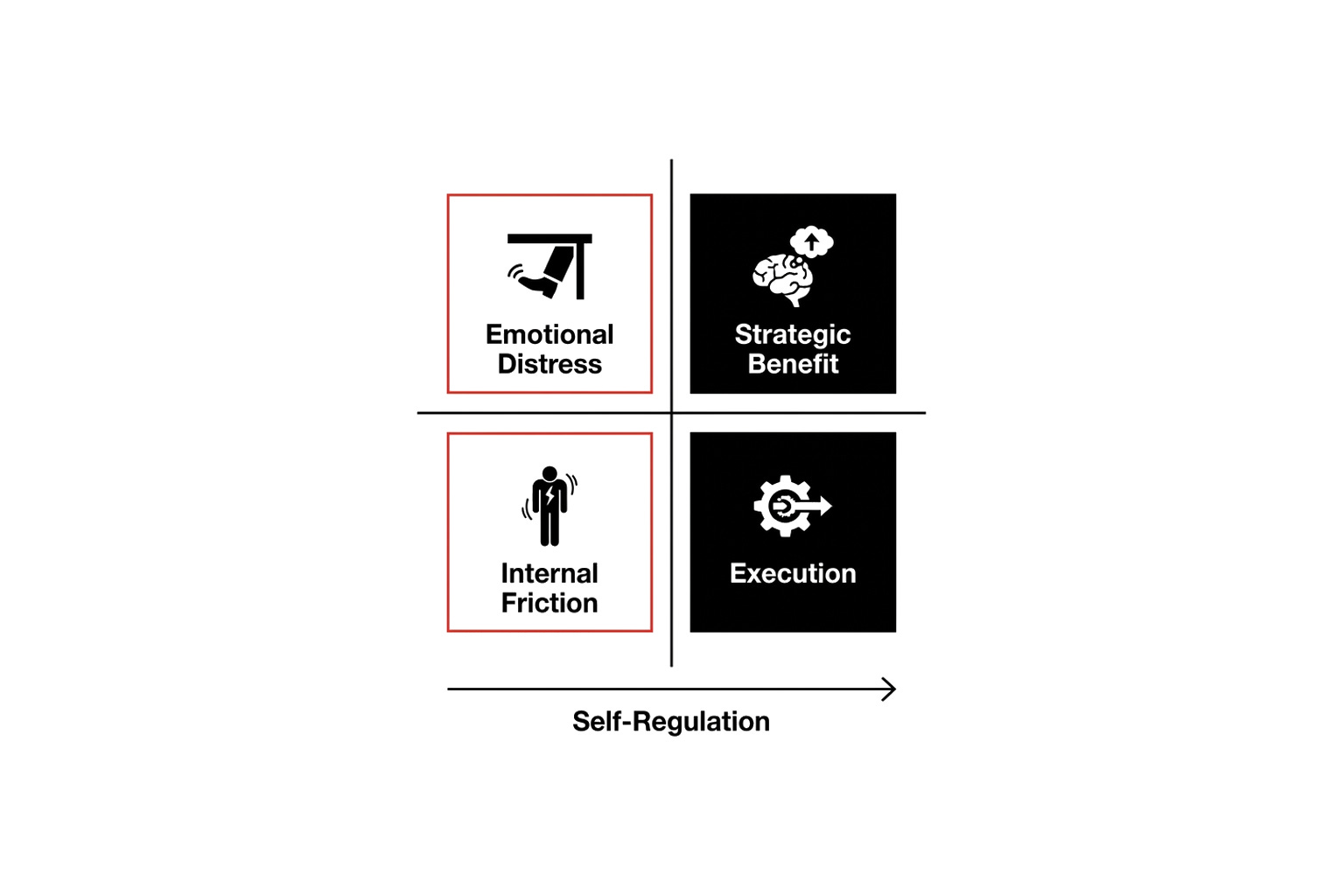
Your body participates in this lie through subtle micro-negotiations that occur in a fraction of a second. You feel the physical discomfort of waiting—the dry mouth, the restless legs, the slight spike in heart rate—and your mind immediately manufactures a highly logical excuse to escape. You tell yourself that you will write the proposal better in the morning, or that the insurer can wait until Monday. This is not rational planning; it is your nervous system seeking a quick hit of relief to lower its immediate allostatic load.
To break this cycle, you must stop treating these moments as battles of pure willpower. Instead, you must learn to make a structured deal with the resistant part of your mind. If you acknowledge the discomfort, name the exact operational outcome required, and promise a specific, non-negotiable reward immediately after completion, you bypass the biological panic button. You move from a state of internal friction to one of operational execution.
"The thought of not doing it cost more than the papers. The real price was the discomfort."
The Sovereignty of the Deterministic Day
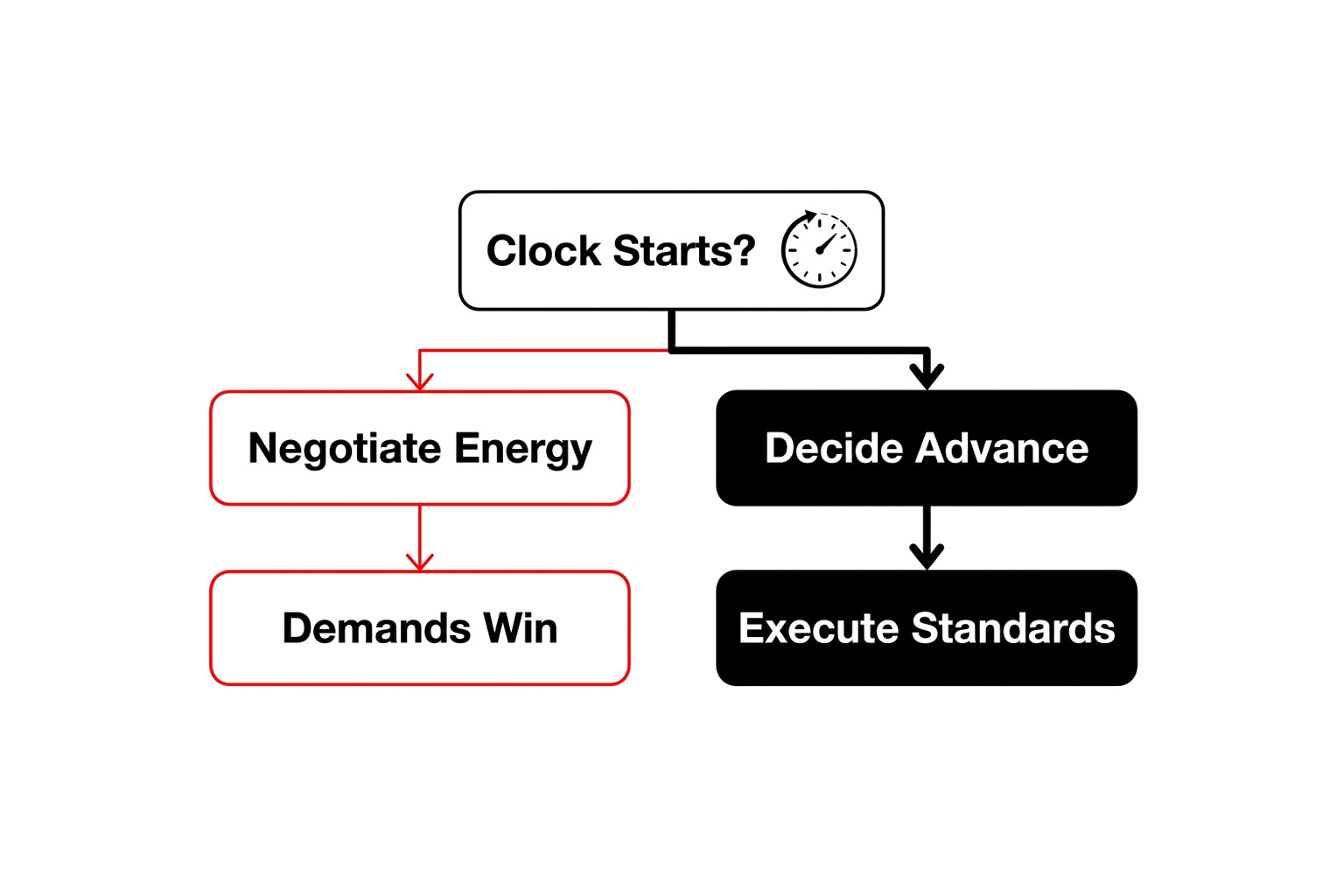
Reclaiming your sovereignty as an independent operator requires moving from a reactive posture to a deterministic calendar. When you operate without a fixed structure, every administrative task, difficult client follow-up, or business development call becomes an open negotiation with your energy levels. If you do not design your day with absolute intent, the loudest external demand or the easiest internal escape route will always win.
Go deeper 👉 : Do You Lack the Energy to Propel Your Business?
I remember looking back at an ideal day clock I drew in 2021, tracing the exact hours I had allocated for deep focus, administrative clearance, and personal recovery. The reason that structure eventually succeeded was not because it was a perfect aesthetic plan, but because I stopped negotiating with the clock once the day began. This is the power of a deterministic day: a calendar where the decisions have already been made in advance, leaving your cognitive energy free for execution rather than self-debate.
When you step into an administrative office or a difficult client negotiation backed by this level of internal structure, you carry a physical transfer of certainty. The clerk behind the desk, or the prospect on the other end of the line, can feel whether you are hoping for a favorable outcome or executing a non-negotiable standard. Certainty is the ultimate currency in business operations; if you do not bring it to the gate, you will find yourself waiting in the queue forever.
"I do the sitting now, and the part that hates it gets a named reward after. That is a deal, not a fight."
Exploded-view thinking: Record the first imperfect teaching
A strategy you cannot explode into parts is a strategy you cannot teach. Take the trait, the context, and the consequence apart the way a mechanic lays a gearbox on the bench — so your twin can hear the sequence.
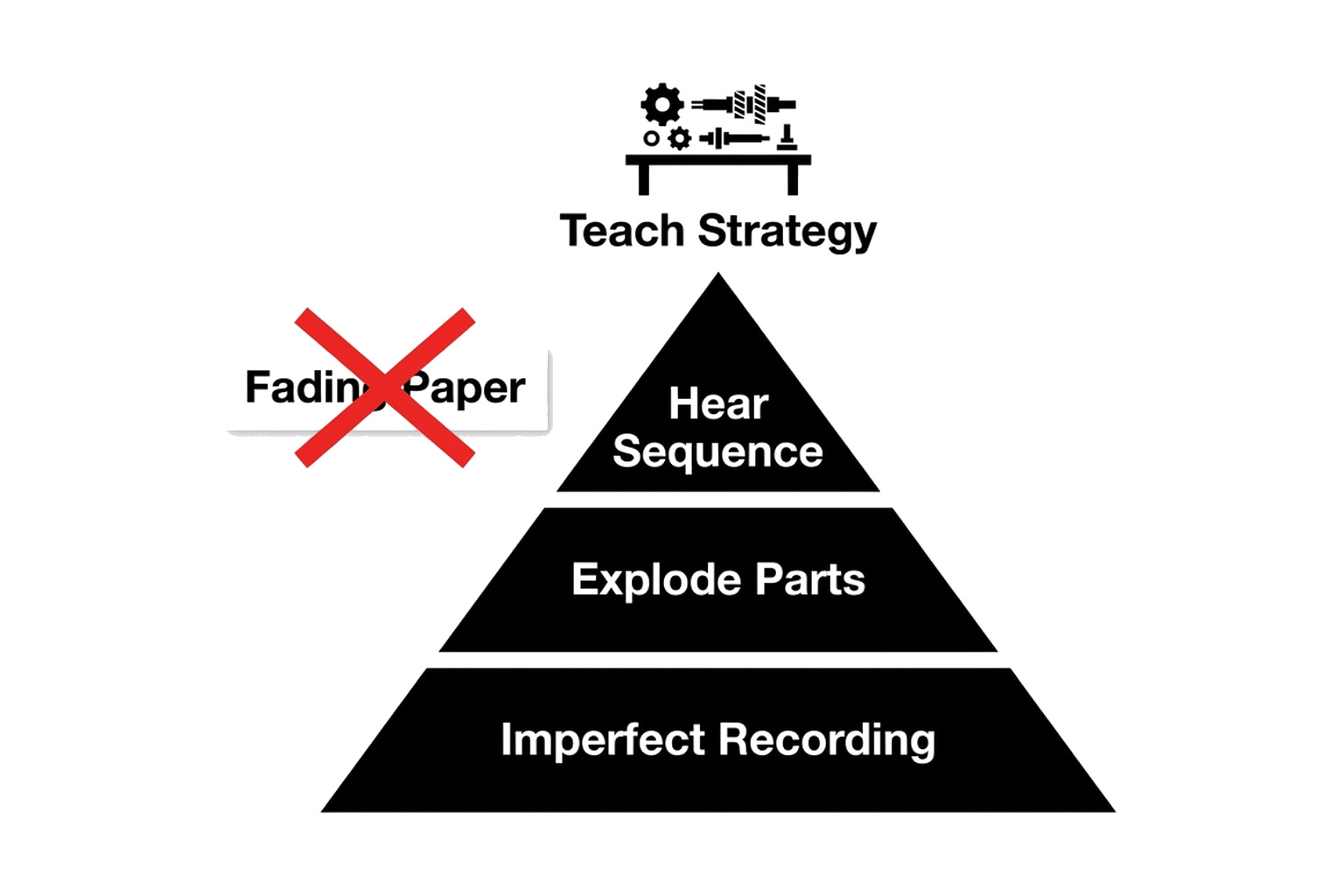
The first recording is supposed to be imperfect. Name one cell already at ease and one still tight. Paper fades in two weeks; the old cycle returns unless the teaching is on tape.
Your Move This Week
Copy the YAML block into Claude, ChatGPT, or your preferred AI.
Replace each placeholder with your situation this week.
Paste the three numbered returns into your notes.
### INSTALLS
1. Price the Friction Cascade
2. Negotiate with Short-Term Mood Repair
3. Anchor Your Deterministic Day
### YOU ARE
An independent consultant or coach whose operational momentum is stalled by delayed
administrative tasks, causing constant background anxiety and leaking runway.
### MY SITUATION
[ROLE]
[LOAD]
### ASK 1
Identify one outstanding administrative or operational gate you have been delaying.
Calculate the compounding delay if you walk away today versus finishing it now.
- Return: The name of the gate, the immediate time cost to finish it, and the estimated
weeks of delay if postponed.
### ASK 2
Observe the next micro-negotiation where your body seeks immediate relief over strategic
execution. Name the exact reward you will give your resistant part only after completion.
- Return: The specific physical signal of avoidance, the task, and the post-completion
reward.
### ASK 3
Draft a deterministic block in your calendar for tomorrow that cannot be renegotiated.
- Return: The exact time window, the single operational output, and the environmental cue
you will use to anchor it.
### RETURN ONLY
1. [Gate name] · [Immediate cost] · [Postponed delay]
2. [Avoidance signal] · [Task] · [Post-completion reward]
3. [Time window] · [Single output] · [Environmental cue]