

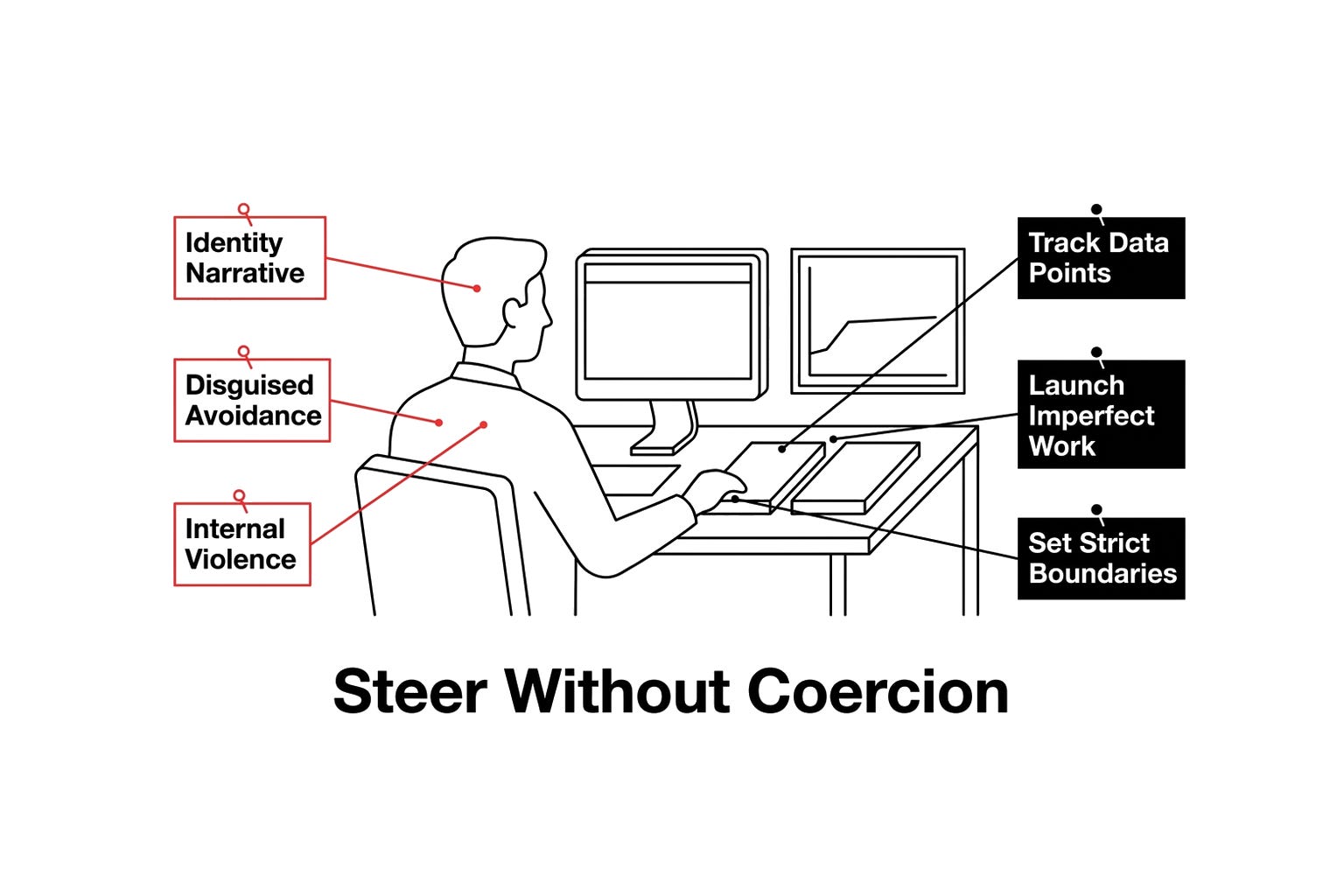
This article breaks down how to decouple physiological tension from your identity, replace perfectionist research loops with daily market friction, and lead your advisory practice without relying on internal coercion.
You sit down at your desk on a Monday morning with a clean calendar and a tightening throat. The revenue curve is flatter than you want, two high-ticket coaching proposals are sitting unclosed in your inbox, and your immediate instinct is to crack the whip—add three more tasks, redesign your offer landing page, or spend ninety minutes researching what top consultants in your niche are posting on LinkedIn. By noon, your jaw is clenched, your heart rate is elevated, and you have accomplished zero direct business development. You tell yourself a familiar story: I am just an anxious founder who needs to push harder. But the problem is not a lack of effort or an innate personality flaw; it is a structural failure in how you govern your energy and direct your focus.

The Trap of Identity: Treating Autonomic Arousal as Who You Are
When an independent operator spends months running at full speed without paired recovery anchors, the body eventually resets its baseline. You experience a constant hum of tension in your shoulders, early morning waking with racing thoughts, and a persistent urge to check incoming emails. The fatal error occurs when your prefrontal cortex assigns an identity narrative to this physiological state, declaring that you are fundamentally an anxious person.
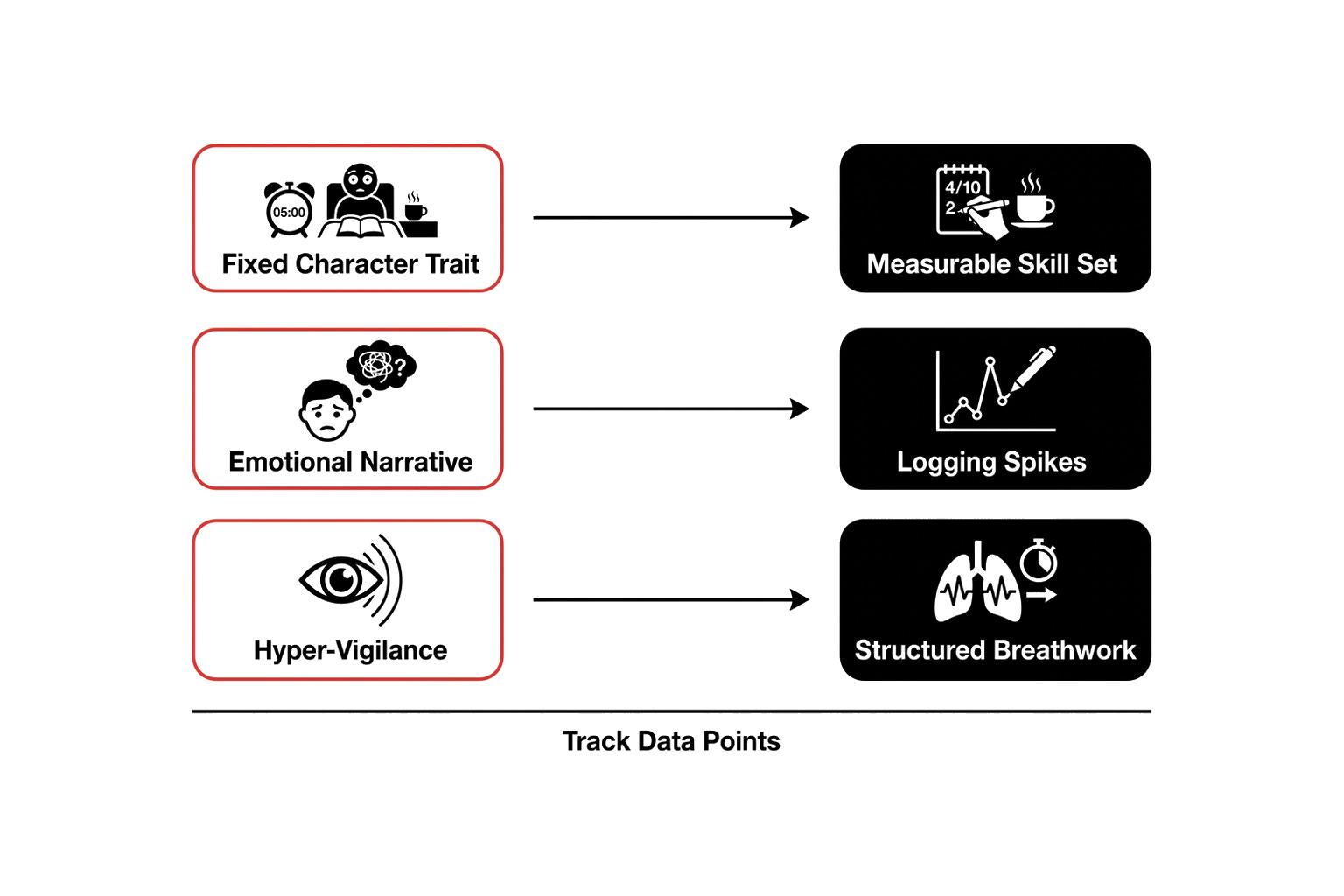
When you dissociate identity language from autonomic arousal, anxiety transforms from a fixed character trait into a measurable, context-dependent skill set. What feels like an unchangeable personality flaw is often just high baseline sympathetic activation resulting from the allostatic load of continuous execution. The autonomic nervous system misinterprets unbuffered operational ambiguity as a survival threat, driving you into hyper-vigilance.
"Anxiety is not who you are; it is a physiological signal responding to a specific context. When you treat high baseline tension as your identity, you lock yourself into it. When you track it as a data point, you can train it."
To dismantle this trap, you must start measuring tension rather than interpreting it emotionally. When you log every spike in stomach tension or quickened breathing on a simple numerical scale alongside its specific context, the narrative collapses into objective mechanics. By pairing high-challenge client interactions with intentional recovery protocols like structured breathwork or non-negotiable physical training on the exact same weekly schedule, you recondition your nervous system to navigate volatility without carrying the residual charge into your decisions.
Go deeper 👉 : How to Move Beyond Wounds and Humiliation
The Planning Illusion: How Perfectionism Disguises Avoidance
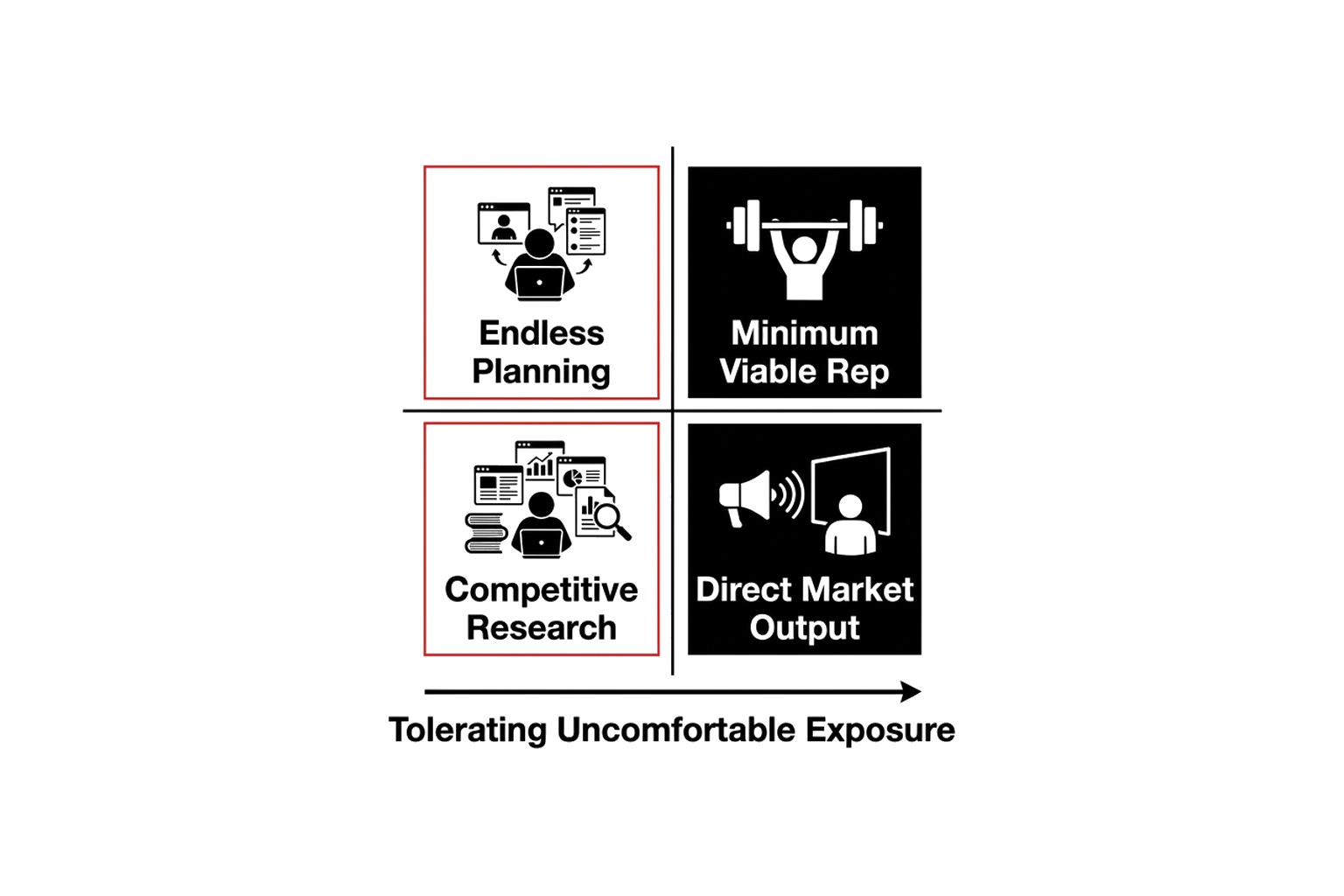
When direct exposure to the market feels threatening, the executive mind invents high-order work to protect itself. You tell yourself that you cannot reach out to prospective enterprise clients until your content strategy is fully mapped out or your presentation decks are pristine. You open social platforms under the guise of competitive research, spend forty-five minutes studying what peers are publishing, and leave feeling simultaneously inadequate and exhausted.
Go deeper 👉 : How Your Own Thoughts Can Sabotage Your Business
This dynamic is a classic cognitive defense mechanism. Planning, researching, and tweaking systems feel like productive labor, but they function as friction-free sanctuaries that shield you from the risk of client rejection or public failure. True growth requires instrumental emotion regulation, where you intentionally tolerate the uncomfortable exposure of launching imperfect work into the market.
"Endless planning is often just cowardice in a suit. If you spend ninety minutes analyzing the feed instead of shipping one message, you are using research as an escape hatch from exposure."
The escape from this loop requires shrinking the exposure window until resistance vanishes. Instead of committing to elaborate content campaigns that require hours of mental setup, adopt a friction-free minimum viable rep. Ship one direct, high-value asset or post every single day without opening the feed to consume anyone else's output. When you disconnect input from output, you stop feeding comparison and force your practice to learn from immediate market signals rather than imaginary standards.
Sovereign Command: Steering the Ship Without the Inner Whip
Many consultants built their early careers through raw endurance, using self-directed pressure and harsh internal criticism as their primary engine. When revenue dips or client acquisition slows, their default response is to tighten the reins, lengthen working hours, and treat every delayed deal as a personal failure. But driving a boutique firm with internal violence creates structural fragility; eventually, your operational capacity breaks under the weight of forced outcomes.
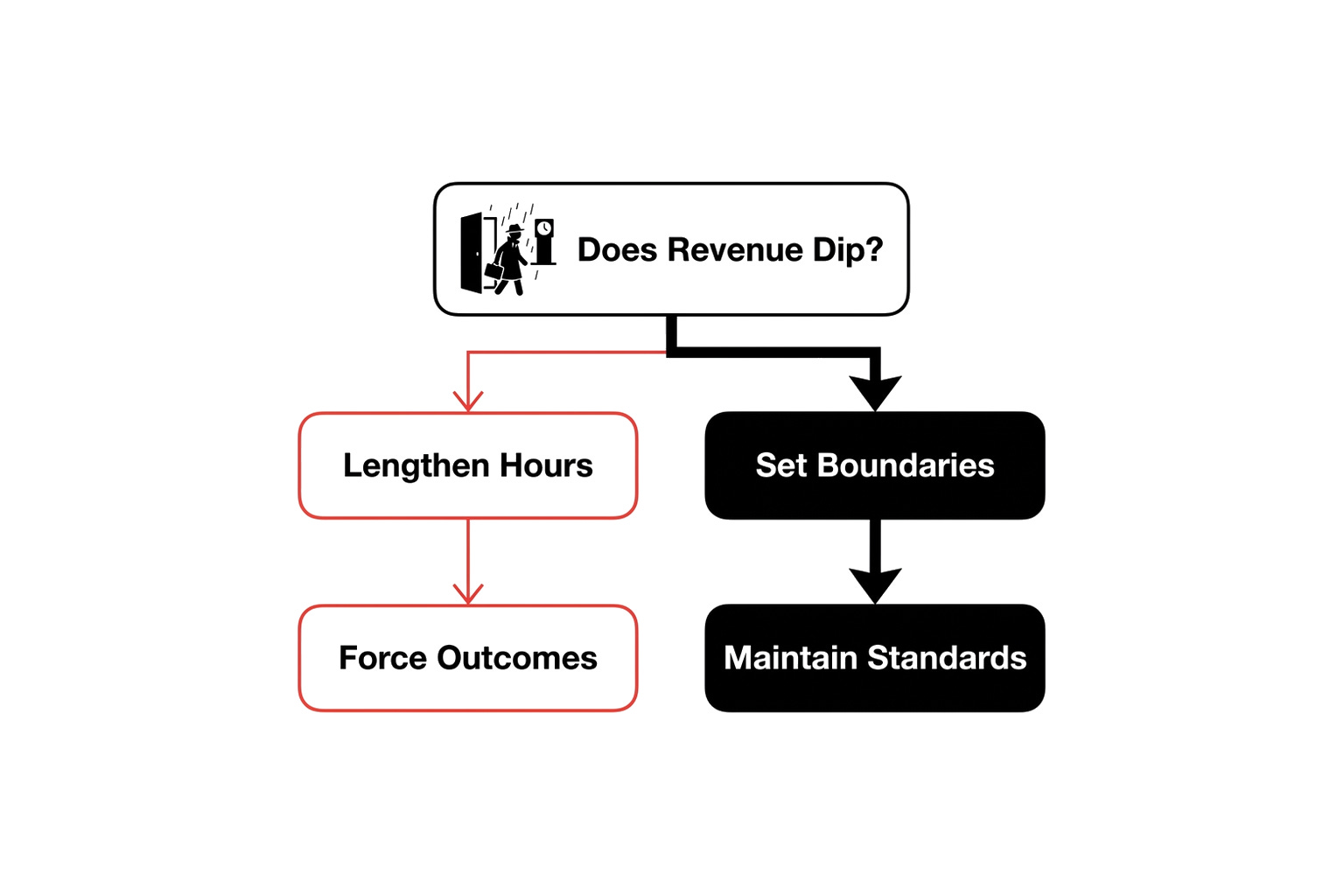
True leadership over your own practice demands operational sovereignty over self-coercion. Being your own boss means setting clear operational boundaries and holding the steering wheel firm without whipping the boat when the headwind picks up. Control lies in your discipline, your offers, and your daily input metrics—never in demanding that the market react on your exact timeline.
"You do not build high-performance capacity by whipping yourself harder at the helm. Sovereign leadership is maintaining your standards and your composure simultaneously, regardless of market resistance."
When I look at operators who sustain seven-figure practices over decades, the common denominator is not relentless intensity; it is calm structural authority. They establish strict departure times, reject scope creep early, and refuse to turn revenue anxiety into weekend labor. When you eliminate the inner whip, you reclaim the calm mental space required to solve hard client problems and close complex deals.
The Sharper Swing: Reclaiming Leverage Before You Act
The modern consultant's calendar is filled with micro-actions: quick follow-up emails, tactical networking calls, minor website updates, and administrative check-ins. This volume of low-impact activity creates a false sense of momentum while quietly diluting your primary leverage. Every unfocused action consumes decision fatigue that should be reserved for your highest-value client transformations.
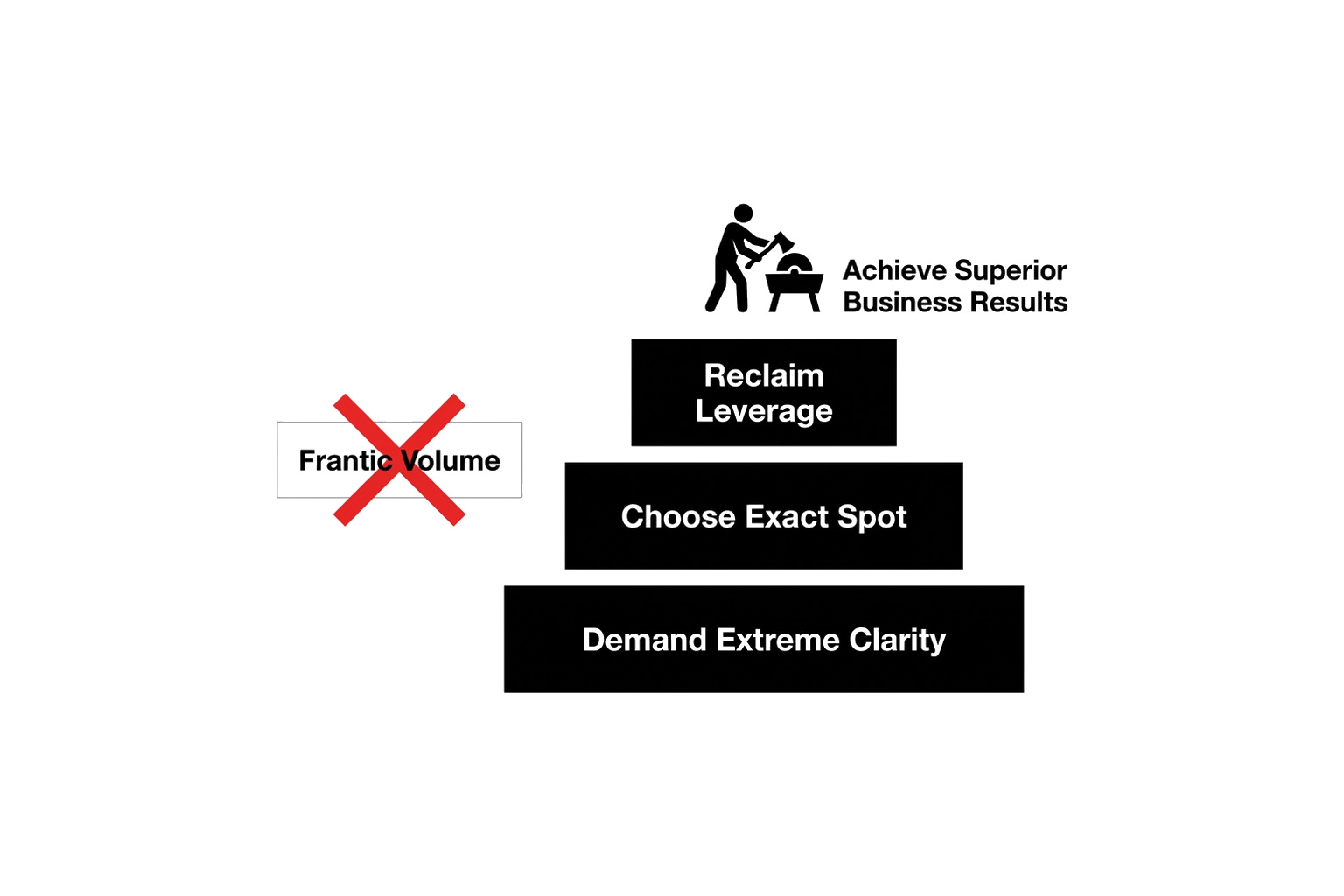
Before taking any non-trivial operational step, you must institute pre-action intent filtration. Like a woodcutter sharpening his axe before swinging, your job is to pause and define precisely what return an action must buy before committing your time to it. If an action does not directly strengthen your cash flow, clarify your market positioning, or elevate client results, it is noise masquerading as work.
"Stop taking ten weak swings at the tree because you feel rushed. Sharpen the blade, choose the exact spot, and hit once with maximum force."
By training yourself to demand extreme clarity before moving, you dramatically cut down on operational drag. You begin to notice that dropping three low-value client commitments or automating minor administrative routines buys back hours of hyper-focused energy. When every swing of your axe is intentional, you achieve superior business results while doing significantly less frantic work.
Your Move This Week
Copy the YAML block into Claude, ChatGPT, or your preferred AI.
Replace each placeholder with your situation this week.
Paste the three numbered returns into your notes.
### INSTALLS
1. Decouple baseline anxiety from identity using context logging and paired recovery
anchors.
2. Replace perfectionist research loops with a daily friction-free minimum viable rep
shipped directly to market.
3. Establish operational sovereignty over your schedule, eliminating self-coercive
pressure and unfocused labor.
### YOU ARE
An independent coach or consultant generating swing revenues, caught between the desire
for scale and the urge to push harder through internal coercion, who needs to replace
frantic activity with sovereign operational boundaries.
### MY SITUATION
- [ROLE]
- [LOAD]
- [BASELINE TENSION]
- [DAILY UNPRODUCTIVE RESEARCH TIME]
### ASK 1 — DECOUPLE ANXIETY FROM IDENTITY
- Action: For 7 days, log every physiological tension spike on a 1–10 scale alongside the
exact trigger (e.g., proposal writing, calendar review) without using identity phrases (
"I am anxious" ).
- Anchor: Pair every high-challenge outreach or proposal rep with a non-negotiable
15-minute physical or breath recovery block on your calendar.
- Return:
  * Trigger & Context:
  * Tension Score (1-10):
* Identity Statement Replaced: "I am anxious about closing" ->
"My autonomic system is activated by proposal uncertainty."
  * Paired Recovery Anchor Scheduled:
### ASK 2 — SHIP THE MINIMUM VIABLE REP
- Action: Commit to publishing 1 professional insight or direct market outreach daily for
5 business days without opening any social feed or competitor content prior to publishing.
- Metric: Ship time under 20 minutes from draft to live.
- Return:
  * Asset Shipped:
  * Feed Avoided (Yes/No):
  * Friction Felt & Overcome:
### ASK 3 — ENFORCE SOVEREIGN BOUNDARIES
- Action: Audit your task list today and delete or defer 2 low-leverage activities that
fail the pre-action intent filter. Set a non-negotiable hard stop time for your workday.
- Return:
  * Deleted Task 1:
  * Deleted Task 2:
  * Non-Negotiable Hard Stop Time Enforced:
### RETURN ONLY
1. Logged anxiety context, rating, and paired recovery block.
2. Asset shipped daily with feed avoidance confirmation.
3. Two deleted busywork tasks and hard stop boundary result.