When Effort Does Not Pay Off (Yet)
Regulate Frustration Before It Sabotages Your Solopreneurial Journey

Hello and welcome to this new edition. I am Yann Gabioud, coach, Life Designer and determined entrepreneur. For more than 10 years, I have deciphered what makes the difference between those who dream about their lives…and those who live it fully. Passionate about human psychology, I decided to share the psychological aspects that can constitute brakes or levers in your entrepreneurial journey.
Here, I help you design, program and condition your mindset so that you can undertake initiatives that live up to your greatest ambition. So hold on tight, because today's topic may affect you directly or indirectly: frustration.
You are in charge. Alone. Your ambition is overflowing, your objectives are clear, sometimes dizzying. And on this path that you trace, a traveling companion often invites itself, without being invited: frustration. This heavy feeling, this internal tension when results are delayed, when an unforeseen obstacle arises, when the colossal effort does not seem to pay off... immediately.
You know her well. Maybe too good. It can eat away at you, make you doubt, push you to give up. Many will tell you to ignore it, to “stay positive”. It is a superficial approach that neglects a fundamental truth: frustration is not your enemy. Not if you decide it won't be anymore.
As a solopreneur striving for excellence, your ability to navigate frustration is as crucial as your marketing strategy or financial management. This is a high-level psychological skill.
This newsletter is your step-by-step guide to mastering this art. We will dive into the deep mechanisms, explore pragmatic strategies and, above all, reframe your perception of this powerful emotion. Get ready to turn that weight into power.
Understanding the Psychology Behind Frustration
Frustration, in the clinical and psychological sense, is an emotional reaction caused by the gap between an intention and its non-realization. In other words, you experience an internal conflict between what you are aiming for and what is momentarily inaccessible to you.
According to Kurt Lewin's field theory, this gap between tension directed toward a goal and the impossibility of achieving it generates psychic pressure. This pressure seeks to be released either by redirection, by abandonment, by aggression, or by adaptation.
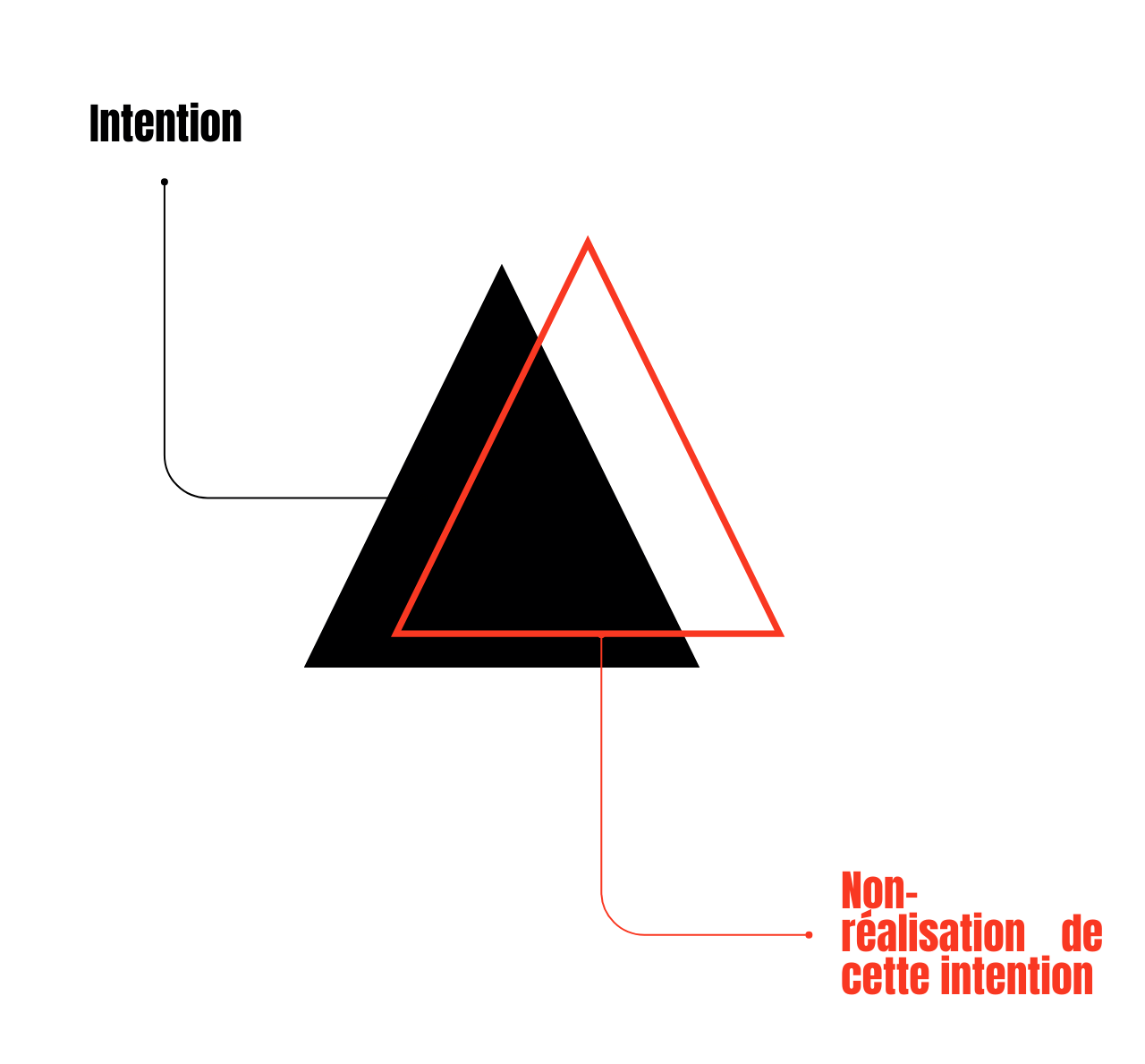
What most people call "lack of motivation" Or "loss of meaning" is often an accumulation of undigested frustrations. When you move towards an entrepreneurial objective such as, for example, creating a product, launching a service, convincing customers and the response from the outside world is slow, indifferent, or hostile, you feel a gap. And this gap, if it is not understood and integrated, can turn into withdrawal, exhaustion or resentment.
The Fundamental Mechanism: Goal Blocking
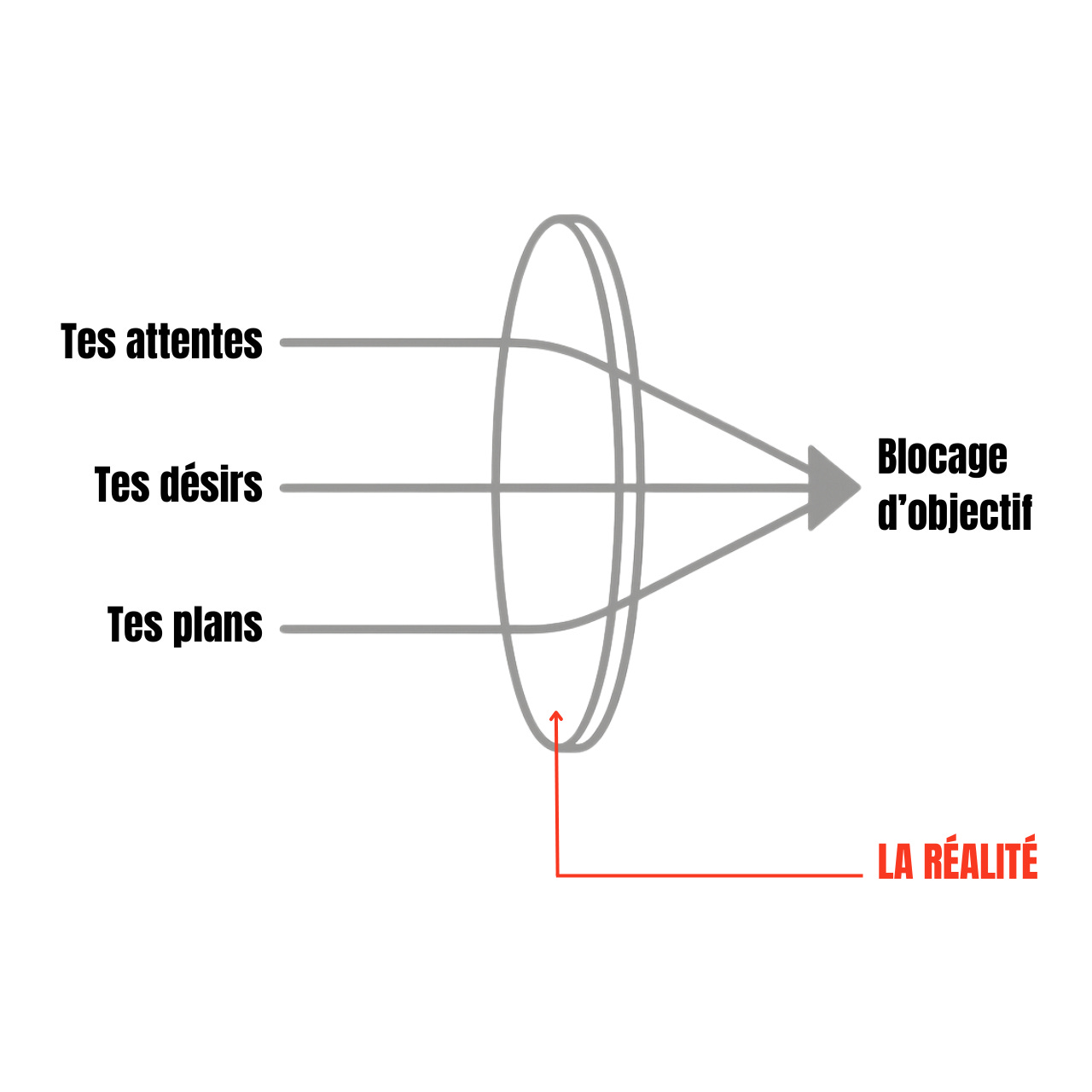
Behind every frustration, there is a gap between your expectations, your desires, your plans and the reality you encounter. You set a goal, you mobilize your energy and resources to achieve it, and an obstacle arises.
This obstacle can be external (a refusal of financing, an unforeseen technical problem, a negative market reaction) or internal (a lack of specific skills, procrastination, fear). The crucial point is the interruption of movement towards the goal.
Research like that initiated by Neal E. Miller and John Dollard in the 1930s (notably their famous Frustration-Aggression hypothesis) laid the foundations. Although the idea that frustration systematically leads to aggression has since been nuanced, the fundamental link is established: frustration generates energy, a psychological tension that seeks an outlet. It signals that our efforts to satisfy a need or achieve a goal are being hindered.
The Emotional and Cognitive Components
Frustration manifests itself as a mixture of often negative emotions: anger, irritation, disappointment, anxiety, feeling of helplessness. But she also has a essential cognitive component. It is your interpretation of the situation, your evaluation of the obstacle and your abilities to overcome it, which modulates the intensity and nature of your frustration.
The works of Richard Lazarus and Susan Folkman on stress and coping (coping meaning “to face”) are very relevant here. They emphasize the importance of cognitive evaluation. You first assess the situation (is it a threat, a challenge?). Then you evaluate your resources to deal with it. If you perceive the obstacle as insurmountable and your resources as insufficient, the frustration will be intense and can lead to a feeling of distress. If you perceive it as a stimulating challenge and you believe in your abilities, the frustration could even motivate you to redouble your efforts (this is sometimes called constructive frustration).
Thwarted needs: what frustration reveals to you
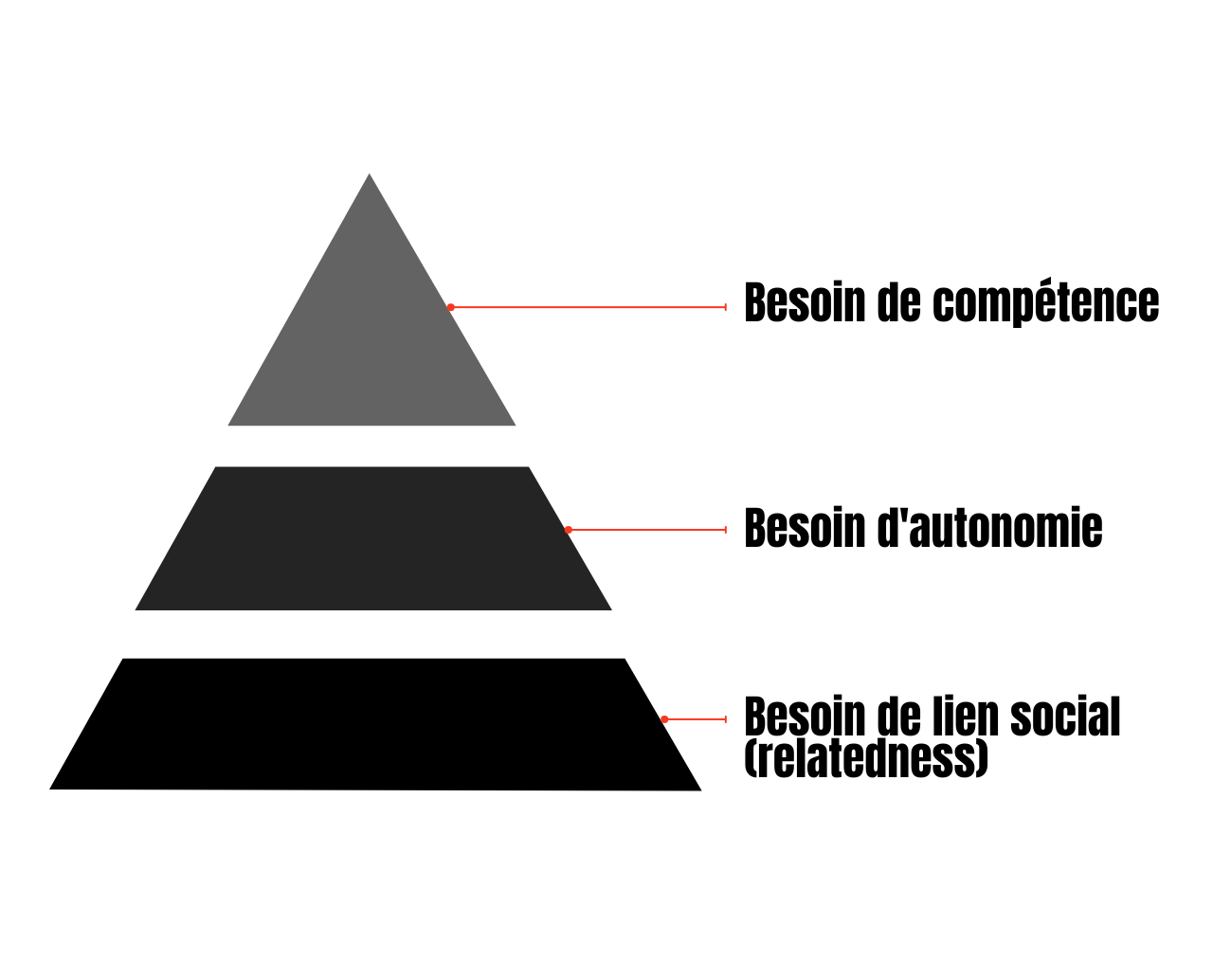
Frustration often touches on fundamental psychological needs described by Deci and Ryan's Self-Determination Theory:
Need for skills: Failure or blockage calls into question your sense of effectiveness.
Need for autonomy: External obstacles make you feel like you are losing control over your trajectory.
Need for social connection (relatedness): Conflicts with associates, employees or rejection by customers can generate frustration linked to this need.
When these needs are thwarted, frustration is an almost inevitable response.
Entrepreneurship is a school of frustration, as they say, because The very nature of this adventure multiplies the opportunities to encounter obstacles and see one's expectations disappointed. It's a playground where the cycle of frustration is particularly active and frequent. You're not just building an activity. You build yourself. And this construction goes through phases of intense friction.
Entrepreneurship exposes you to discomfort chronic:
You have to convince without guarantee.
You must create before you harvest.
You have to hold on when everything seems uncertain.
Researchers in cognitive psychology, such as Albert Bandura, have shown that the feeling of personal efficacy – the impression of “I can do it” – is especially forged in adversity. Not when everything works. But when you hold on then everything falters.
And that’s exactly what frustration comes to offer you. Strength training. You become more stable, not because everything is easier, but because you learn to stop getting disorganized when results are delayed.
Typology of frustration among solopreneurs
Frustration does not manifest itself uniformly. It takes different forms depending on the stage you are at, the level of consciousness, And the type of thwarted expectation. Here are four specific shapes, with their internal dynamics.
1. Frustration with action (or performance)
You are making an effort. You launch, you produce, you communicate. But the return is slow, if not non-existent.
Signs:
You get up with discipline, but you end the day with a feeling of stagnation.
You give, but you don't receive. Not enough. Not yet.
You see others succeed with less apparent intensity.
What it reveals: An imbalance between investment and return. But above all: an implicit expectation of control over timing or external validation.
2. The frustration of inaction (or voluntary blocking)
You know what to do. You even have the strategy. But you're stuck. You push back. You avoid.
Signs:
You spend time on secondary tasks to avoid real confrontations.
You feel a tension between lucidity and paralysis.
You accumulate content, ideas… but nothing materializes.
What it reveals: An unresolved inner conflict: fear of judgment, failure, success... or undigested overload. You are not lazy. You are frozen by a tension that you have not yet clarified.
3. Frustration of alignment (or dissonance)
You move forward. You're doing the right things. But your identity is not yet embodied in your reality.
Signs:
What you experience professionally does not reflect what you want to embody.
You feel that what you are offering is not yet up to what you have within you.
You are between two versions of yourself: the old one is outdated, the new one is not yet consolidated.
What it reveals: A gap between vision and current posture. This step that you are “late” means that you are in the process of aligning. And this step can be uncomfortable — but it is foundational.
4. The frustration of meaning (or existential emptiness)
You achieve results. The numbers are rising. But inner vibration is absent.
Signs:
You accomplish goals but you no longer get joy or momentum from them.
What you are doing works... but you are no longer sure that it suits you.
You feel a loss of meaning despite external indicators of success.
What it reveals: A need to refocus. To re-question what you want to serve. The problem is not failure. It’s success without meaning.
How to turn frustration into directional force
1. Create an interior observation space
Before any strategy, you must learn to observe frustration without identifying with it. It's a tension. Not a definition of you. What you need to do first is observe without immediate reaction.
Pendant une semaine, note chaque moment de tension. What triggered it? A wait? A silence? A comparison?
Then, name it: is it a frustration of action? Alignment? Meaning? Just this movement of observation restores your inner authority.
2. Channel blocked energy into useful movement
Every frustration contains a charge. If ignored, it becomes a contraction. But if it is channeled, it becomes a reservoir of lucid combativeness.
Re-question your behavior:
Does this frustration show me a lack of rigor in my execution?
Does it show me a place where I lied to myself about my true desires?
Is it revealing an old version of me that I haven't yet let go of?
Use this tension to make a clear decision, a real action, a tangible adjustment. Not an emotional reaction. A strategic response.
3. Move from a reflex of control to a posture of commitment
Frustration is often a signal that you are still attached to a specific idea of “when” or “how” things should happen. You are still in control. But the solopreneur in control of his mental space knows that reality is not there to submit to his plans. He is there to refine his discernment.
If you accept that this tension is a rite of passage... it ceases to be an anomaly. It becomes your next level of requirement.
Integrate GRIT And FORTITUDE as engines of transformation
This is how the GRIT and the FORTITUDE come to the rescue with your frustration management, and why these concepts are crucial for solopreneurs seeking longevity and lasting success.
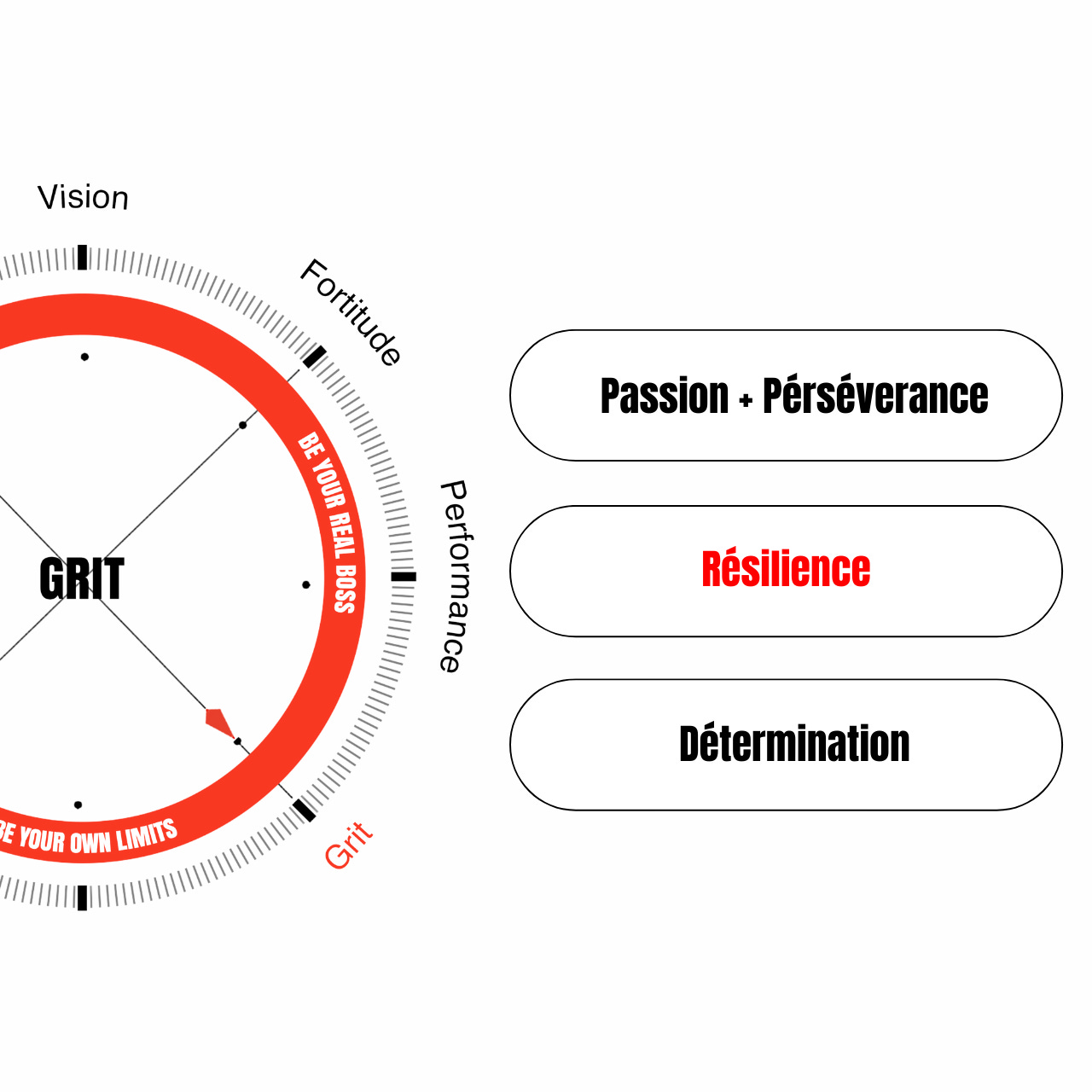
1. GRIT: The power of passion and perseverance
The GRIT, it is much more than a simple desire to succeed: it is the ccombination of passion and perseverance towards long-term goals. It’s the unwavering energy that pushes you forward even when the road gets bumpy. THE GRIT, this is the inner flame which keeps you moving, even in fatigue or doubts.
To integrate the GRIT, we must remember the formula 3B:
Be You, The Real You: Grit is amplified when you are fully aligned with your true identity. The more in tune you are with yourself, the deeper and more authentic your motivation.
Be Your Real Boss: Accept that you are the captain of your own ship. THE GRIT is born when you take total responsibility for your journey, without waiting for external conditions to validate your direction.
Be Your Own Limits: Grit strengthens when you realize that your limits are often self-imposed. The more you dare to surpass them, the more your GRIT grows.
THE GRIT, it is this engine of resilience and of determination which allows you to overcome each obstacle, step by step, while nourishing a ardent desire And sustainable to achieve your goals.
2. FORTITUDE: Inner strength in the face of adversity
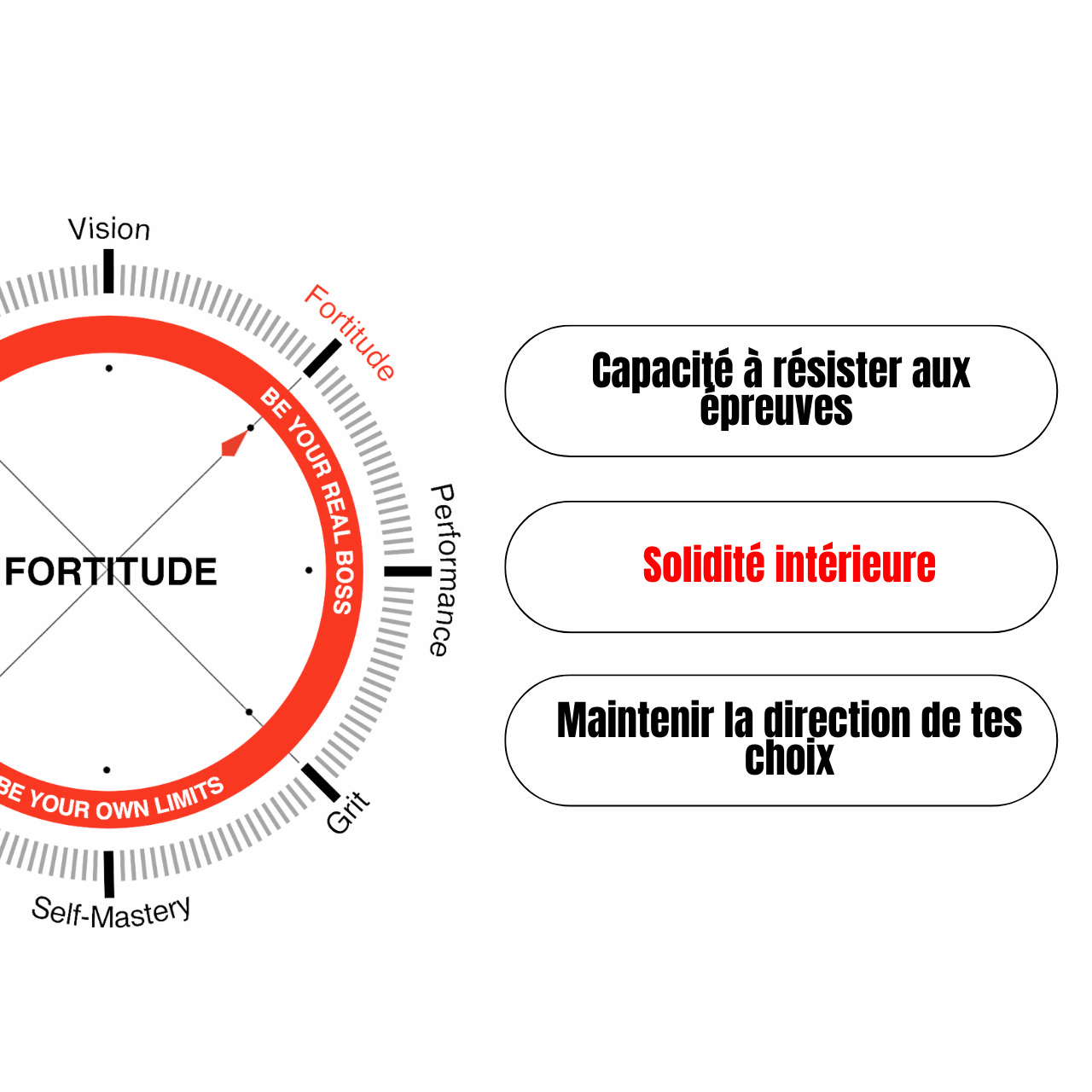
There FORTITUDE, Or fortitude, this is what inner shield which allows you to face challenges without being swallowed up by pain or adversity. It represents the ability to resist trials, to stay the course even when life seems to attack you. It's this quiet resilience which ensures that you do not waver, even when everything around you seems to waver.
There FORTITUDE also feeds onformula 3B:
Be You, The Real You: Fortitude draws its strength when you assert yourself in your true nature. It’s your authenticity that gives you the stability you need to weather the storms.
Be Your Real Boss: By taking the direction of your choices and actions, you strengthen this inner solidity. Your conviction allows you to maintain direction, even in times of uncertainty.
Be Your Own Limits: Recognizing that your limits are often mental allows you to fortitude to grow up. By surpassing them, you become stronger, ready to overcome any obstacle.
There FORTITUDE is the foundation of your resilience and your courage in the face of obstacles. It allows you to go through suffering and difficulties without losing sight of your path.
Understanding the roots of your frustration, as we have just detailed with surgical precision, is the first fundamental step. But the diagnosis, however precise it may be, is not enough to win the daily fight. Mastering your internal states, turning frustration into fuel, staying the course despite turbulence – all of this requires deliberate practice, constant training.
Right now, I'm in a phase where I want to simplify, get to the essentials. You know, I have always had this tendency to complicate things – to pile up ideas, projects, concepts.
And with this in mind, I decided to replace the name SoloBOOST and SoloBOOST News which is less consistent with my vision and which will simplify my communication. And perfection is achieved not when there is nothing more to add, but when there is nothing more to take away.
And in this same dynamic of simplification and return to basics, I am driven by a project that is close to my heart: the reactivation of Yann’s Club. It’s a space that I’m relaunching with raw energy, designed for you, the Solopreneur who wants to transform his frustrations into fuel and align his ambitions with his results. We will talk about this in more detail next week.
In the meantime, if what we explored today speaks to you, if you're ready to work on your mindset like an athlete, leave a big LIKE. It shows me that you are with me in this adventure.
Be You, The Real You
Be Your Real Boss
Be Your Own Limits,