
How to Overcome Procrastination and Move Toward Your Ambition
Three Psychological Keys to Outsmart Procrastination

Hi, I hope you are in great shape. Welcome to this new edition of SoloBOOST News. If you have just discovered me, I am Yann Gabioud, Life Designer, expert in performance psychology and deliberate practice. I help entrepreneurs and leaders unlock their full potential.
I help you become the entrepreneur you need to be to have the company and the business that really suits you, up to your greatest ambitions.
And here in SoloBOOST News, we work on psychological aspects that can block you, or propel you in your entrepreneurial journey.
Today, we are going to talk about a self-blocking mechanism, a subject that concerns us all from near or far: procrastination.
The psychological aspects linked to Procrastination:
Procrastination is this reflex that you sometimes have to put off an important task, even if you know that it brings you closer to your ambitions. It's not just laziness. Laziness is characterized by a lack of desire or motivation to do anything, including enjoyable activities.
Procrastination is a problem of emotional regulation. it is a complex behavior, often linked to emotions such as fear of failure, perfectionism or mental overload. As a solopreneur, you can procrastinate because you put enormous pressure on yourself to have everything perfect, or because you doubt your ability to reach the level you are aiming for.
Hence the fact that procrastination is one of the self-blocking mechanisms.What is the self-blocking mechanism? it’s this internal loop that sets up when you procrastinate. Example: you avoid this task of writing a new offer for your clients, you put off calling this investor for your new project, which makes you feel guilty or stressed. This guilt paralyzes you even more, and you find yourself stuck in a vicious cycle. It's like your brain is pressing "pause" to protect you from immediate discomfort, but ultimately sabotages your long-term progress. For you, this mechanism may come from an unconscious fear of not living up to your great ambitions.
Psychologically, in your brain, there is a battle between two areas:
The amygdala, your emotional danger detector, which sees this task as a threat (fear of failure, of judgment). It pushes you to flee towards distractions to “protect” yourself.
The prefrontal cortex, your headquarters of logic and discipline, which knows that this task brings you closer to your dreams.
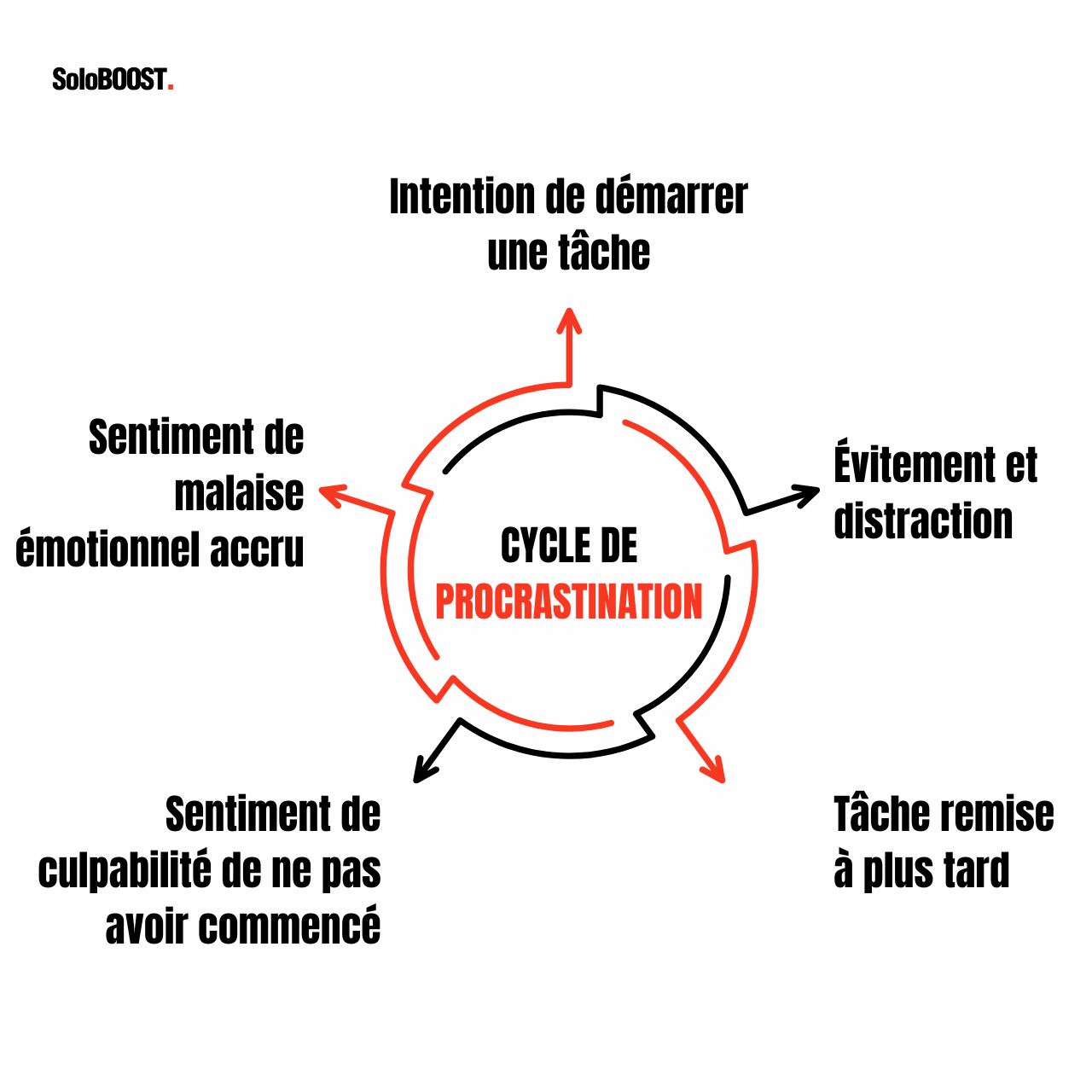
When you procrastinate, the amygdala wins. A 2018 study in Psychological Scienceshowed that chronic procrastinators have a more active amygdala and a weaker connection to the prefrontal cortex. Result ? You feel overwhelmed, and your brain activates a self-blocking mechanism:“Not now, it’s too risky.”It’s not weakness, it’s a primitive response that paralyzes you.
In your case, I bet you feel this tightness. You want to explode your limits, but a little voice whispers to you:“What if you screw up?”This doubt pushes you to procrastinate until tomorrow, and each day that passes reinforces this loop.
But, there are other self-blocking mechanisms apart from procrastination such as: Impostor syndrome, perfectionism, culture of unhappiness, social comparison, lack of limits, chronic indecision, neglect of yourself.
It's a pretty broad topic, but we're going to focus specifically on procrastination.
How does procrastination affect our lives?
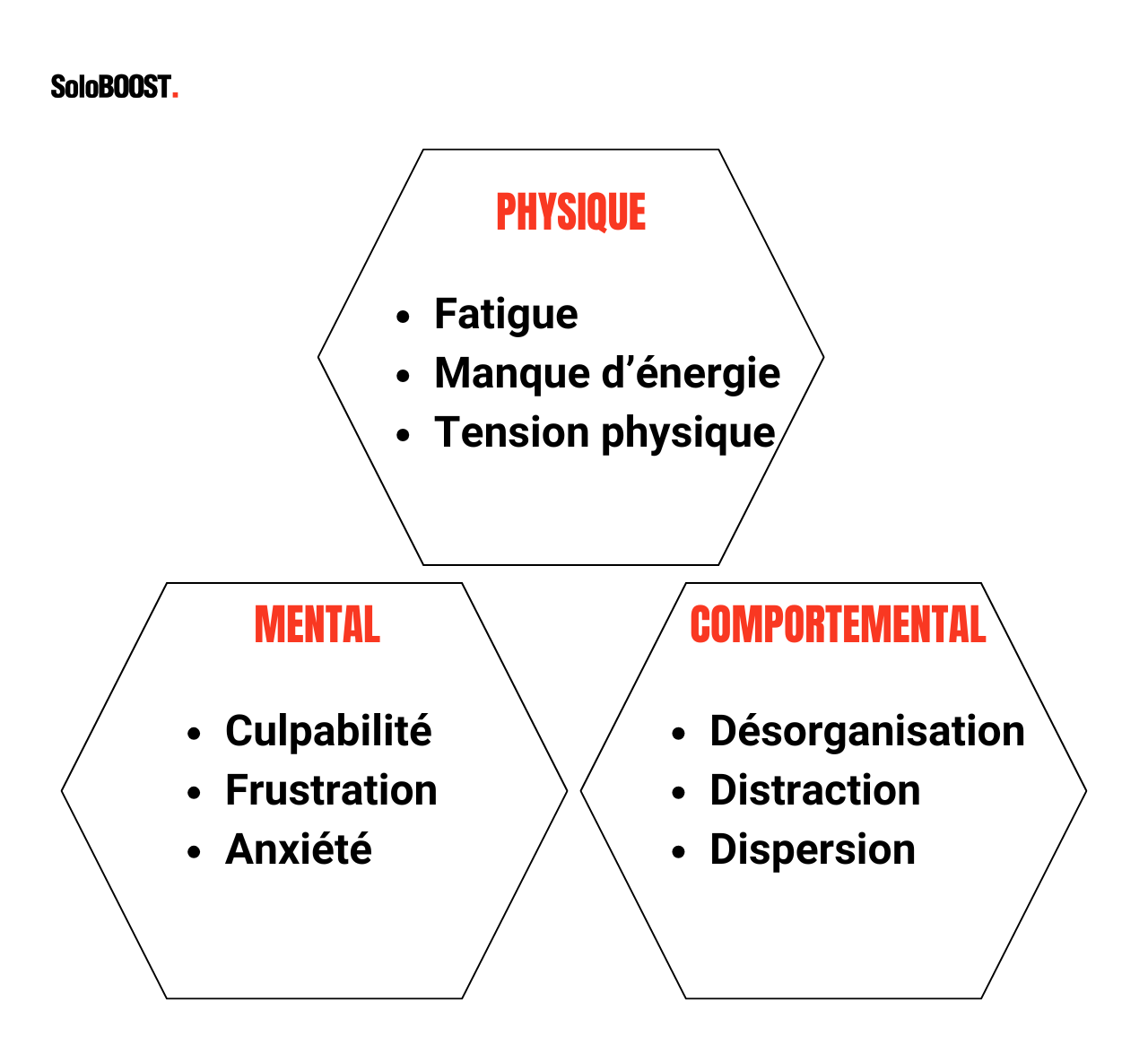
Procrastination isn't just a waste of time. It's a mechanism that infiltrates your daily life and which, little by little, changes the way you feel, the way you act, and even the way your body reacts.
As a solopreneur, you perhaps feel it even more strongly: every day you don't move forward is a day where you are not yet up to your ambition, where your competitors overtake you, where you wonder if you are really made for this activity. It affects you on several levels: your body, your habits, your mind, and here's how:
Physically
When you procrastinate, your body absorbs the stress of inaction. You may constantly feel tired, like you lack energy, even without working hard. It's not just a coincidence: chronic stress related to procrastination increases your level of cortisol, the stress hormone.
According to a 2015 study in The Journal of Behavioral Medicine. This cortisol drains you, leaving you exhausted.
You may also feel physical tension, headaches, pain in the neck or shoulders, because your body somatizes this inner conflict. Often, you stay up late to “make up” for lost time, which disrupts your sleep and pushes you towards a more sedentary lifestyle.
Behavioral
In terms of actions, procrastination pushes you into useless patterns. You take on secondary tasks: organizing your desk, responding to unimportant emails, because your brain prefers these small, quick victories.
This is the completion bias, highlighted in Frontiers in Psychology (2019): you give yourself the illusion of being productive without touching on what really matters. You can recognize yourself in that: you start lots of projects with enthusiasm, but as soon as it becomes complex or uncomfortable, you move on to another task. It's a vicious circle that disorganizes you.
Mentally
Every time you push back, you judge yourself:I should be further away, I'm wasting my potential.
A 2020 study in Journal of Rational-Emotive & Cognitive-Behavior Therapy links procrastination to a drop in self-esteem.
Your anxiety increases, because you know that time flies and that your vision does not come true on its own. And this frustration... it eats away at you, because you see what you could be, but you feel chained by this inertia..
The good news is that procrastination can be prevented and overcome. And here's how:
How to overcome procrastination?
From a purely logical point of view, yes, procrastination could be avoided if we were perfectly rational beings, devoid of emotions and psychological biases. If we could coolly assess the importance and urgency of a task, and act accordingly without being influenced by fear, anxiety or lack of immediate motivation, then procrastination would have no reason to exist.
However, we are complex human beings, with emotions, fears, limiting beliefs and psychological needs that profoundly influence our behaviors.
Procrastination is often an emotional response to a situation perceived as threatening, unpleasant or too difficult. It is an avoidance strategy, even if it is counterproductive in the long term.
So, although logically avoidable on paper, procrastination is a frequent psychological reality. Overcoming it requires understanding its underlying mechanisms (fear of failure, perfectionism, lack of clarity, etc.) and implementing strategies that take into account our emotional nature. In other words, it's not a simple matter of "want to" quit, but rather of understanding "why" we procrastinate and acting on those root causes.
Let's say you're a solopreneur in the investing space. So you own an investment business. Recently, you have been considering creating a new product, for a specific niche.
Today, you know that you should take a serious look at researching and designing this new product. It is a complex task that requires analysis, creativity and planning. Yet, you find yourself spending time on social media, telling yourself it's to keep up to date with market trends (but it lasts much longer than expected). You feel overwhelmed by the magnitude of the task and tell yourself that you will work on it "tomorrow, when you have more energy
All these are manifestations of procrastination. Your mind seeks easier and less anxiety-inducing activities to avoid confronting the complexity and uncertainty of the important task. This is why we need these three solutions:
1. Focus: Take back control of your attention
Focus is your ability to direct your attention and your energy towards a specific task or objective, ignoring internal distractions (such as: your distressing and external thoughts) (notifications, various requests).
A 2012 study in Journal of Cognitive Neuroscienceshows that focusing your attention on a single task strengthens your prefrontal cortex, the part of your brain that can say “no” to the amygdala and its flight impulses.
Focus is one of my character traits. I have this ability to stay focused for hours, which means that every time I have important projects, I activate this focus mode.
Choose a key task, say, writing a proposal for a client. and set a timer for 25 minutes (Pomodoro technique: turn everything off: phone on silent, notifications off. Tell yourself:“During these 25 minutes, that’s the only thing that exists.”
).
Result: You teach your brain to stay on track. The more you practice, the more he obeys, and procrastination loses ground.
2. Deep Work: Diving into the essential
Deep work, a concept popularized by Cal Newport, designates a state of intense and uninterrupted concentration on a cognitively demanding task. It's a way of working where you immerse yourself completely in your activity, eliminating distractions as much as possible (notifications, social networks, interruptions, etc.).
The goal is to produce high quality work, efficiently and in a shorter period of time.
Set aside 2 hours each morning for this new product. To get into deep work, you need to know precisely what you are working on and what the expected result is. This clarity of purpose reduces ambiguity and the feeling of “not knowing where to start,” which is a breeding ground for procrastination. By fully engaging in this defined task, you are less likely to get distracted by less important or easier activities (the famous procrastinatory tasks).
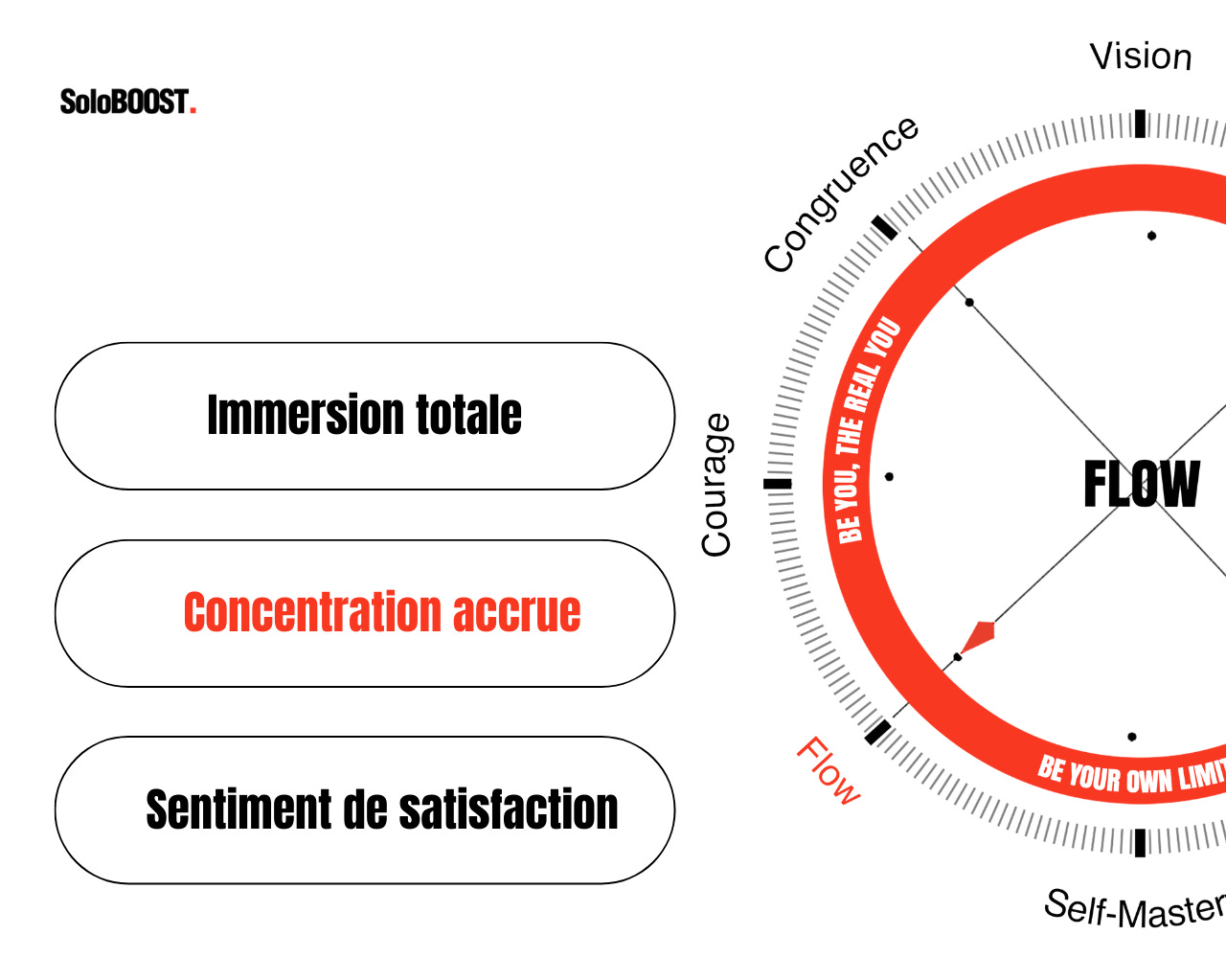
To make these deep work sessions even more powerful and enjoyable, you can enter what is called the state of Flow. It's that state of total immersion where you are fully engaged in an activity, with maximum concentration and natural efficiency.
In this state, time seems to stand still, and you reach peaks of productivity and creativity. Flow becomes a source of deep satisfaction, making work rewarding and enjoyable.
Flow occurs when the challenge you set for yourself is just at the limit of your skills: stimulating but not insurmountable. By choosing tasks that require you to push yourself slightly, you open the door to this total immersion where procrastination no longer exists, replaced by a deep feeling of satisfaction. It is in these moments of flow that your work takes on a new dimension, combining productivity and pleasure.
Result: You reconnect with your “why”, the fire that pushed you to become a solopreneur. Procrastination has no place when you are immersed.
3. Self-discipline: Build your mental muscle
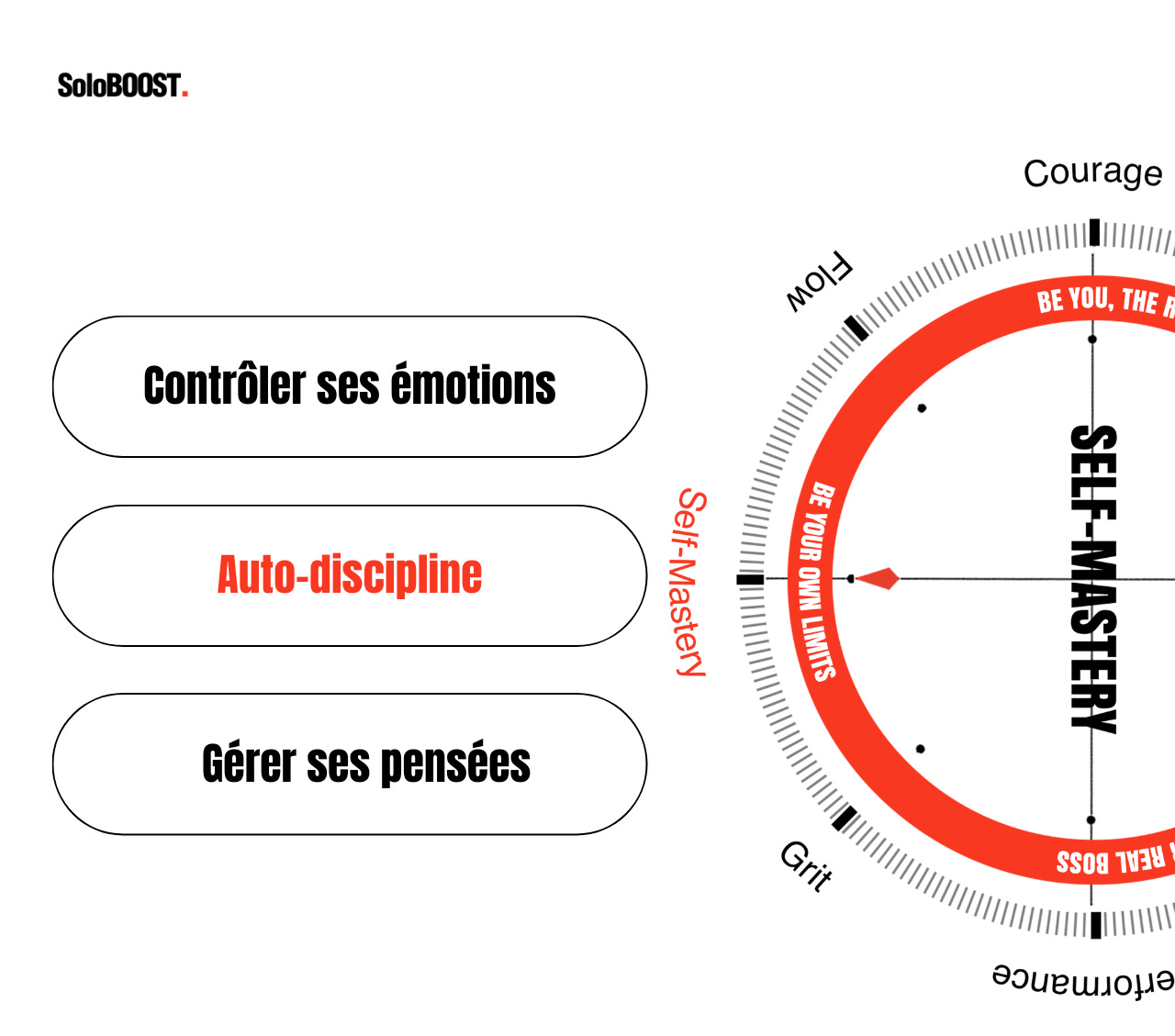
Self-discipline is your ability to set goals and persevere to achieve them, even when you don't feel like it or when you encounter difficulties. It's the inner strength that pushes you to act in accordance with your values and long-term ambitions, rather than being guided by your immediate impulses and desires.
Procrastination is often a response to negative emotions (boredom, stress, fear) or impulses (desire for distraction). Self-discipline helps you to recognize these feelings without letting yourself be carried away by them, and to consciously choose to continue your tasks despite these temporary inconveniences.
Self-discipline, this force which pushes you to act despite the lack of desire, finds its source in a deeper understanding of yourself: Self-mastery. Learning to know and control your emotions, identifying the fears and beliefs that fuel your procrastination, is the first step to exercising enlightened self-discipline. It's not about forcing yourself stupidly, but rather consciously choosing to act in line with your values and your long-term ambition.
Self-mastery helps you define clear and important objectives, which makes self-discipline easier to mobilize because it is aligned with what really matters to you. And each time you demonstrate self-discipline, you strengthen your self-confidence and your ability to act, which nourishes your Self-mastery.
Result: you become less dependent on your current motivation and you develop this mental strength which allows you to overcome obstacles and not get trapped by procrastination.
You saw it: procrastination is not a question of laziness. It's a signal. A message that your mind sends you, often hidden under layers of fear, self-sabotage or limiting beliefs.
So, why wait? Every step you take to overcome procrastination is a step toward the version of yourself you aim to embody. A part of you felt this frustration of seeing your projects stagnate, despite your ambitions.
But now, you have a choice. Either you let these mechanisms lock you in, or you expose them and take back control. You have the tools. The structure. Clarity.
What’s left for you to do? Make a decision.Waiting for that “perfect” moment will only reinforce this stuck loop. Action, on the other hand, triggers new momentum. And every micro-action you take today, no matter how small, is a declaration: “I choose to move forward.”
I am preparing a program called: The Morning Voice. It's a program that will also help you reprogram your brain every day and take action with clarity and determination. Details coming soon! If this resonates with you, leave me a big Like. Your support will help me a lot to refine the content and bring you even more value.
Du full value comme toujours