How to Find the Right Balance Between Perfection and Imperfection
Discover the Freedom to Be Imperfect

Hi !! Welcome back to this News. In addition to the Life Designer that I already showed you, I am also passionate about Performance Psychology. Today, we dive to the heart of what really paralyzes you: this pesky quest for "perfect" which, let's be honest, is often an elegant mask for the fear of action.
I show you how to deconstruct this illusion, distinguish the imperfections that weigh you down from those that propel you, and above all, how you can start to use these “useful flaws” to move forward faster and more peacefully. We will explore the psychology behind this need for absolute control and how to transform it into a force for pragmatic action. No more tying your brain up with unattainable standards.
Here is the plan:
Find out how to distinguish “good” from “bad” imperfections to finally move forward.
The Urgency to Let Go of “Too Perfect” (and What It REALLY Changes for You).
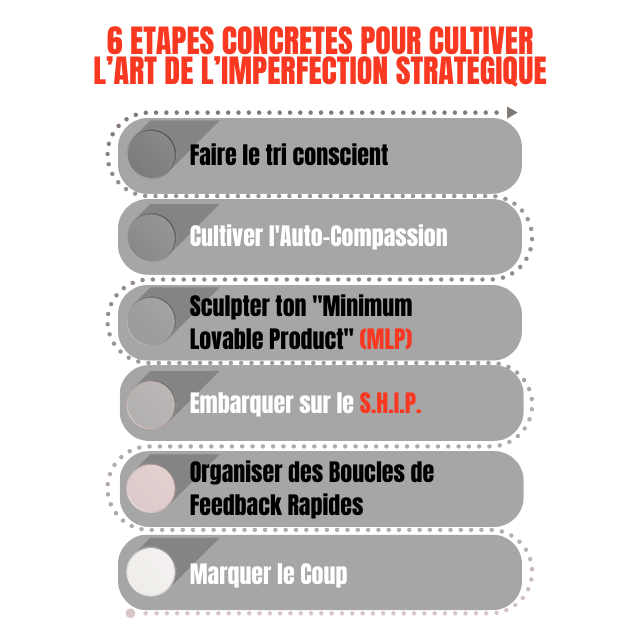
How do you find the right balance between imperfection and perfection? (Access the 6 concrete steps to cultivate the art of strategic imperfection)
Find out how to distinguish “good” from “bad” imperfections to finally move forward.
Let's be direct: what do we mean by "good imperfections" and "happy medium"? How can we stop chasing perfection and adopt a smarter approach, where imperfection becomes an asset?
The idea is the power of chosen imperfection. No question of botching up, but of understanding that certain imperfections, well measured, can help you move forward. This is where courage comes in: daring to launch an idea without it being perfect, testing it in the field even if it is not the ultimate version, and saying: “This is what I am proposing, it has value now, and it will evolve.”
Chasing perfection makes us forget that imperfection is inevitable and even essential. Accepting good imperfections can change our vision of success and boost our well-being, personally and professionally.
Distinguishing Useful Imperfections from Pitfalls to Avoid
All the finesse is there: not all imperfections are your friends. Some pull you down, signal a real problem. Others are chances to grow, proof that you are moving forward. Knowing how to tell the difference is the basis for making imperfection work for you.
“Bad” Imperfections: Those that sabotage your work and your reputation.
These are the errors that do not come from a simple mistake. They come from a real lack of rigor, a lack of interest in the basics, or a disguised I-don’t-care attitude.
And they cost you dearly: in credibility, perceived quality, and customer trust.Clear and clear negligence : When you botch tasks that require a minimum of seriousness.
It's not a simple error, it's a relaxation that we notice immediately.Basic standards not respected : You are not doing what is minimum expected in your job. It shows in customer relations, in follow-up, in the experience you offer.
Broken promise : When the heart of your offer, what customers pay for, is failing or does not correspond to what was announced.
Missing and ignored skill : Ignoring or refusing to see a lack of critical skills to deliver your service or product correctly.
These imperfections are not “learning opportunities” in the noble sense of the term; These are red flags indicating that there is a flaw in your processes, your commitment, or your skills on non-negotiable points. Tolerating them under the pretext of “accepting imperfection” would be a serious error of interpretation and would directly harm your credibility and the sustainability of your business. The “golden mean” is never found by accepting this type of failure.
Then, the “Good” Imperfections: Your allies to progress quickly and well.
Once you've gotten rid of the "bad" ones (those that are unacceptable), you can focus on the "good" ones. It is these “not yet perfect” aspects, these “errors” along the way, or these deliberately simplified elements which, instead of slowing you down, give you a boost. They are often the natural consequence of action, experimentation, and your decision not to get stuck.
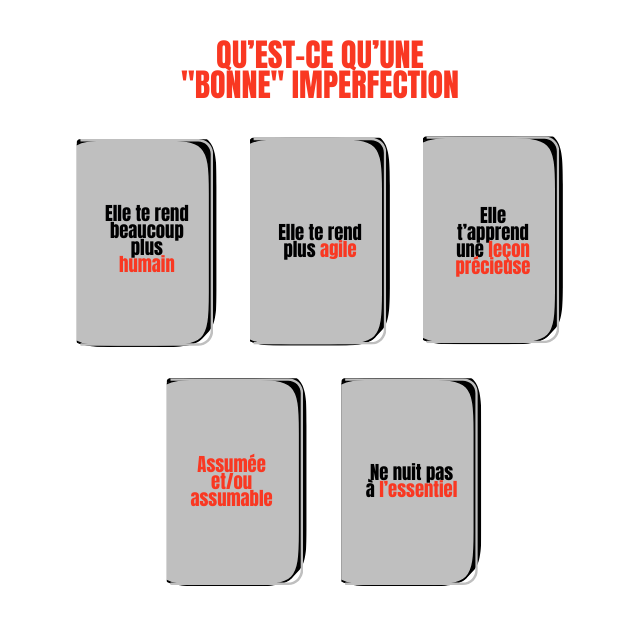
How to recognize a “good” imperfection?
It teaches you a valuable lesson: this marketing email which was not a success but gave you crucial information on what interests (or not) your audience. Launching a “test” offer that shows you what your customers really want.
It makes you more agile: Bring out that new idea quickly, even if the presentation isn't worthy of an art museum, just to see if it generates interest. Better an 80% solution that helps your customers now, than a 100% solution that will arrive very late.
It is often a step, not an end in itself: Your website, perhaps a little basic but clear and functional, which you will improve little by little. Your first video, with some hesitation, but a message that gets across.
It can even make you more human: Daring to talk about this challenge that you overcame, or this little blunder creates a bond. Your “um” in a podcast, if your expertise is there, shows that you are a real person, not a robot.
It doesn't touch the heart of your promise: Even if everything isn't perfect around it, what you deliver must provide real value, solve a real problem. The imperfection is in the finishes, not in the essentials.
Research into creativity is clear: environments that leave room for trial and error move faster and innovate harder.
If every attempt must be perfect from the start, audacity dies.
THE good imperfections prove that you take action, that you test, that you learn where it counts: on the ground.
This is exactly the spirit of Minimum Lovable Product (MLP) which I defend.
We are not talking about a botched product that disappoints. We are talking about a simple, refined version, but which already provides real value and an engaging experience.
Even without all the frills, it does the job. And above all, it allows you to throw, to have concrete feedback, to create an initial link.
The goal is not to do the job half-heartedly.
The goal is to choose consciously where you accept imperfection to keep your focus where it has impact.
That’s entrepreneurial discernment:
→ Put your energy where it creates value.
→ Accept that everything is not perfect as long as the essentials are solid.
→ Move quickly, adjust along the way, and progress with something concrete, not in your head.
It's not negligence. It's a strategy.
And that’s often what makes all the difference between getting stuck… or taking off.
The Urgency to Let Go of “Too Perfect” (and What It REALLY Changes for You).
The goal is NOT to “get rid of” perfection as if it were an enemy to be defeated. It is rather a question of redefining our relationship to perfection, of dethroning it from its position of supreme and paralyzing judge, to consider it as a horizon, an ideal which can guide continuous improvement, without blocking present action. It's about no longer being a slave to perfection, but learning to dance with it, and above all, knowing when an "imperfect but excellent" version is necessary to move forward. The “golden mean” is really the key.
But why is it so crucial to rebalance your relationship with this quest for perfection, concretely, for you and your business?
Because perfection is the best sleeping pill for your ideas
See that pile of “almost ready” projects on your virtual desktop? These “almost finalized” offers? This “almost perfect” content that you don’t dare publish? This is the work of perfectionism. He whispers in your ear that “it’s not the time yet”, “a little detail is missing”. Result: you stagnate. Visualize a dam that holds back a phenomenal amount of living water – your creative energy, your innovative ideas. Every time you give in to perfectionism, you strengthen this barrier.
Learning to tolerate imperfection is to dynamite this dam. It's letting the water flow, irrigating your projects, and finally, seeing the concrete results of your work.
Because imperfection is the breeding ground for accelerated learning (and resilience)
In the world of entrepreneurship, the one who learns the fastest and adapts the best wins. Point.
And how do we really learn? By doing. By confronting reality. By “failing” sometimes, but getting back up with one more lesson in his “bag”. If you wait until everything is perfect to act, you deprive yourself of these precious feedback loops. It's like an athlete who reads all the textbooks on running, but never sets foot on the track. Accepted imperfection is your entry ticket to the real playing field.
It means agreeing to deliver a V1 version, to test an approach, even if it is not "finished", to see what happens. Each “error”, each “customer feedback” becomes data, information to sharpen your strategy. You become more agile, more responsive, and much, much stronger in the face of inevitable setbacks. Your ability to absorb and bounce back increases tenfold.
Because seeking the “just imperfect” makes you more human, more agile and, paradoxically, more efficient
The idea is not to be lax or to deliver shoddy work. Absolutely not. It's about finding that balance point, that "sweet spot" where your work is good enough to be useful, to create value, to be tested, without exhausting yourself in a sterile quest for the ultimate detail.
When you accept that an offering can be "imperfectly brilliant" or that a service can be "effectively simple" rather than "perfectly complex", you open the door to another form of excellence: that of action, iteration, and authentic connection. Your clients don't ask you to be a flawless robot; they want solutions, help, connection. And this connection is often nourished more by an assumed imperfection and a desire for continuous improvement than by a facade of unattainable perfection.
It's this "happy medium" that allows you to be fast, adaptable and deeply aligned with the real needs of your market, without burning out along the way.
How do you find the right balance between imperfection and perfection? (Access the 6 concrete steps to cultivate the art of strategic imperfection)
Now that you understand the crucial distinction between the imperfections that pull you up and those that weigh you down, it's time to take action. Understanding is good. Applying is what changes the game.
The question is no longer whether you should tolerate some imperfection, but how you can strategically use it to free yourself from paralysis, accelerate your growth and, frankly, find more joy in your entrepreneurial adventure.
Here is your battle plan in 6 steps. It's not an instant formula, but a proven roadmap to reprogram your approach, hack your perfectionism and finally make imperfection an ally. Take note, each step is designed to be directly applicable.