How Your Own Thoughts Can Sabotage Your Business
And How to Break Free with Two Methods

Hello and welcome to this new edition of this Newsletter.
If you have just discovered me, I am Yann Gabioud, Life Designer, expert in performance psychology and deliberate practice.
I help entrepreneurs like you and leaders to unlock their full potential. I help you become the entrepreneur you need to be to have the company and the business that really suits you, to match your greatest ambitions. My vision is to enable you, as an entrepreneur, to reveal the unique genius within you.
When you enter the entrepreneurial world, you intend to think like entrepreneurs:
You want to seize opportunities,
you want to be on the lookout for the trend,
you want to generate new ideas,
you want to master other skills,
because you believe that this type of thinking is what differentiates those who succeed from those who fail. And at a certain level, you are not wrong: the way of thinking, of deciding, of perceiving obstacles and opportunities, has an enormous weight in this trajectory.
However, thinking like an entrepreneur is not just adopting a series of mental techniques or productive habits. It's more subtle than that.
What you are actually trying to do, without necessarily verbalizing it, is to reconfigure your way of seeing the world, others and yourself. You want to change your mental framework to be able to evolve in an environment where classic benchmarks such as security and the validation of others are absent or changing.
So you are not just learning to act differently. You come to confront this structure of thought that has accompanied you for years, often without you being aware of it. And this structure will not disappear simply because you have decided to "think like an entrepreneur".
It will resist. It will bring you back, subtly, to known reflexes: waiting for permission, wanting certainties, avoiding discomfort, rationalizing inaction. Not because you're weak. But because you are human.
Concretely, your approach is not just external learning (models, strategies, methods). It’s an internal exploration. And it's at that moment, when you start to see the discrepancies between what you want to think and how you really think, that the terrain of cognitive biases becomes relevant.
What is entrepreneurial cognitive bias?
The human brain is an incredible machine, designed to process a phenomenal amount of information and make decisions quickly. To achieve this, he uses mental shortcuts, a kind of automatic thought programs. These programs are the fruit of your development and experience. Most of the time, they are super useful and save you precious time.
However, in the very specific context of entrepreneurship (an environment full of uncertainty, pressure, strong emotions) these same shortcuts can lead you to systematic errors of judgment. These errors of judgment, these deviations from a purely logical and rational analysis, are called cognitive biases.
For you, solopreneur, they are particularly important, because they directly influence:
Your perception of opportunities and risks.
Your strategic decisions (product launch, investment, etc.).
Your ability to objectively assess your own strengths and weaknesses.
The way in which you interpret market returns or advice.
A cognitive bias is therefore a systematic distortion in the processing of information by your brain. This is not a lack of intelligence, but a natural response to cognitive overload.
Your brain, faced with uncertainty, strong emotions and quick decisions, uses mental shortcuts (heuristics) to simplify reality.
As Nobel Prize winner Herbert Simon explained, our rationality is "limited." We cannot process all information in a perfectly logical way. Simon showed that we seek "satisfactory" rather than optimal solutions, and for this, our brain relies on these famous shortcuts, which become biases in certain contexts.
Why are solopreneurs like you particularly exposed to these biases?
Several factors make the entrepreneurial terrain conducive to the activation of these biases:
Maximum Uncertainty: You often advances in uncertainty. Your brain hates a vacuum and will seek to create meaning, to fill gaps in information, sometimes based on erroneous assumptions or desires.
The Pressure of Time: In entrepreneurship, everything often happens very quickly. Sometimes you have to decide quickly. Faced with an emergency, your brain favors rapid and automatic responses, which are often biased.
As Daniel Kahneman demonstrated with his distinction between System 1 (fast, intuitive thinking) and System 2 (slow, analytical thinking), time pressure pushes us to rely heavily on System 1. His work highlights that if this system is effective for routine decisions, its use under constraint in complex situations significantly increases the risk errors linked to cognitive biases.
Intense Emotional Involvement: Your project is a part of you. Passion, enthusiasm, but also fear of failure, are powerful emotions that can easily cloud objective judgment.
The Fundamental Need for Optimism: To dare to undertake, you need a good dose of confidence and optimism. This is a necessary quality, but it can easily lead to an overestimation of your chances of success or an underestimation of the difficulties.
Information Overload (or Lack thereof): You are bombarded with various information, or on the contrary, you are cruelly lacking in reliable data at the start. In both cases, your brain will sort, filter, interpret... and biases get involved.
The Most Frequent Cognitive Bias Among Solopreneurs
Excessive Optimism Bias
Excessive optimism bias is based on a human tendency to overestimate the probabilities of success and underestimate the risks. This mechanism finds its roots in the need to maintain motivation in the face of adversity.
Your brain releases positive signals (via neurotransmitters like dopamine) when you envision favorable outcomes, which prompts you to focus on optimistic scenarios. As an entrepreneur, this bias is amplified by your role as a visionary: you must believe in your project to persevere. However, this distortion leads you to minimize real obstacles, because your mind filters negative information to preserve your confidence and energy.
This bias is particularly powerful in situations of uncertainty, where objective data is scarce. Your brain fills in the gaps with positive assumptions, giving you a distorted view of reality. Which can make you blind to warning signs, such as a drop in cash flow or mixed customer feedback.
You launch a new offer, convinced that it will appeal to your market. You received some encouraging feedback during an initial test, and your intuition tells you that now is the right time.
You plan for rapid growth and invest heavily in marketing. But you're overlooking crucial details: customer acquisition costs are higher than expected, and part of your target audience is not yet ready to adopt your product. This bias caused you to focus on positive signals (initial returns) while ignoring contrary indicators (market data), because your brain wanted to protect your motivation.
Confirmation bias
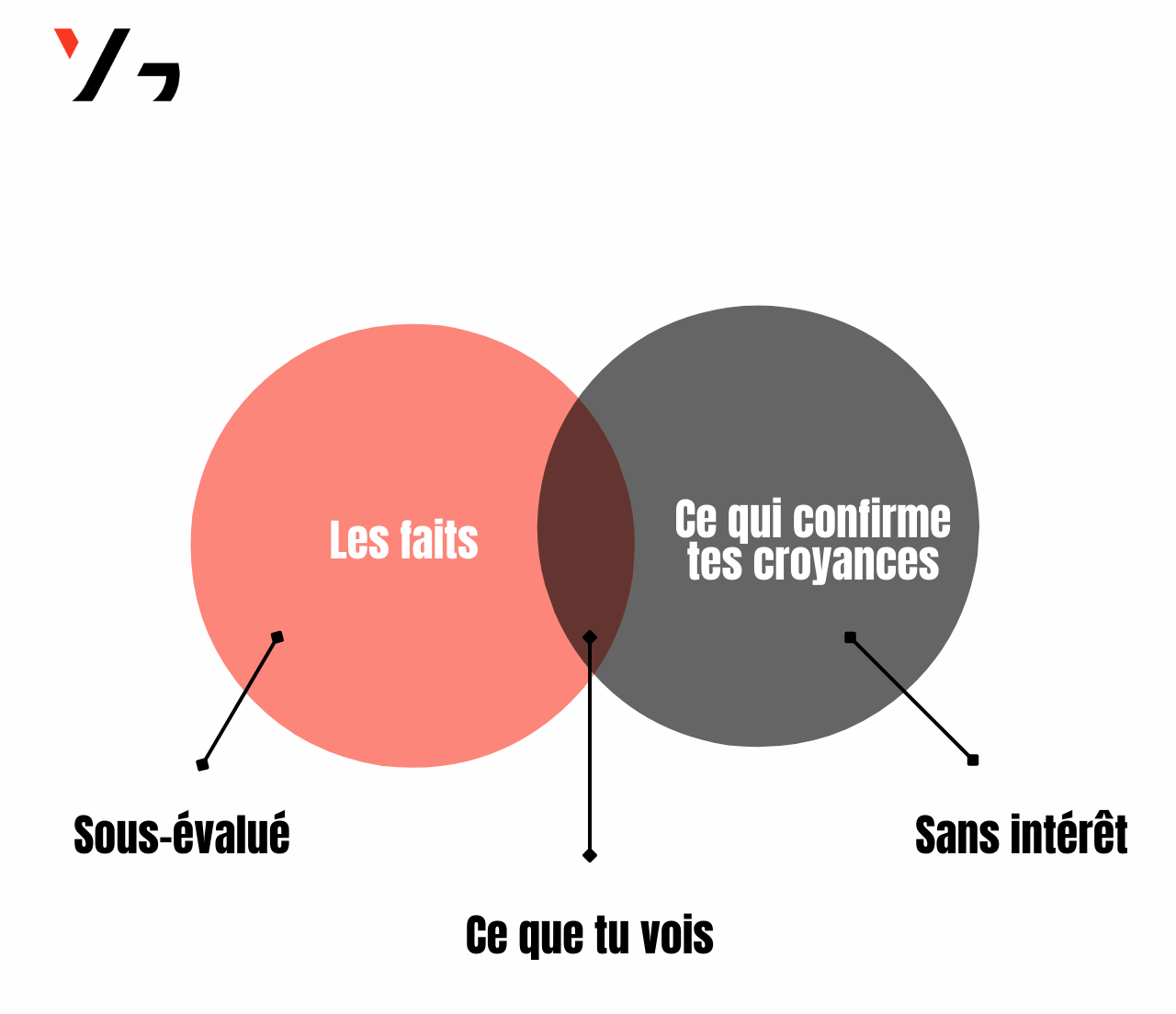
Confirmation bias is a mechanism by which your brain favors information that reinforces your existing beliefs, while ignoring or devaluing information that contradicts them.
Cognitive psychologist Peter Wason was one of the first to study and name this phenomenon in the 1960s. His classic experiments, such as the one where participants had to discover a rule hidden behind a sequence of numbers (e.g.: 2-4-6), clearly showed that individuals actively seek to confirm their initial hypotheses rather than test alternatives that could disprove them. This phenomenon is linked to cognitive dissonance
Anchoring bias
Anchoring bias occurs when your brain relies disproportionately on initial information (the anchor) to evaluate a situation, even if that information is arbitrary or irrelevant. This mechanism is linked to the way your mind processes references in a complex environment: it seeks a starting point to structure its judgments.
Once the anchor is set, it influences all your subsequent decisions, because your brain has difficulty detaching itself from it, even when faced with new data.In entrepreneurship, this bias is amplified by the pressure of time and the need for rapid decisions. Your brain, overwhelmed, clings to an initial reference to reduce cognitive effort, which can limit your ability to explore more advantageous options or to reassess a situation objectively.
Overconfidence bias
Overconfidence bias pushes you to overestimate your skills, your knowledge or your ability to predict the future. This mechanism is linked to the illusion of control: your brain gives you a feeling of mastery to reduce anxiety in the face of uncertainty.
As an entrepreneur, this bias is reinforced by your past successes, which make you believe that you can manage everything alone. It is also fueled by a social phenomenon: as a leader, you feel obligated to project confidence, which can convince yourself of your own infallibility.
Psychologically, this bias protects you from paralyzing doubt, but it makes you vulnerable to costly mistakes. It encourages you to underestimate the complexities of a new challenge or ignore the limits of your expertise, which can push you to take poorly calculated risks.
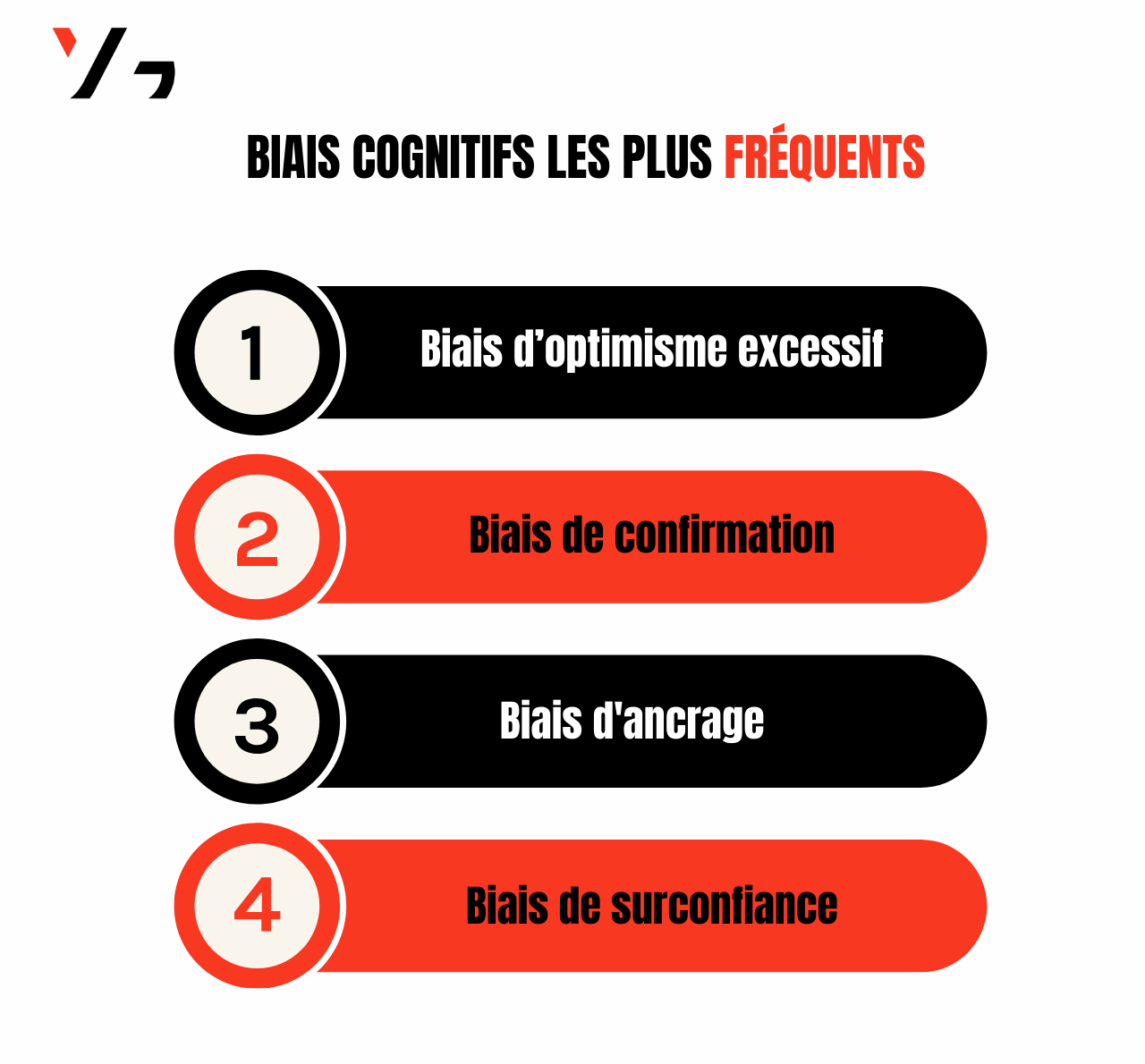
These biases (Excessive Optimism, Confirmation, Anchoring, Overconfidence...) are not bugs in your system, they are a part of the system. Inherited mechanisms, often useful in other contexts, but potentially devastating when you pilot your project amid uncertainty and entrepreneurial pressure.
The question is therefore not to eradicate these biases. But:
how do you build an internal structure strong enough to recognize them, mitigate their impact, and ensure that it is you, the conscious entrepreneur, who makes the final decisions?
How do you really embody 'Be Your Real Boss' in the face of your own mental automatisms?
We're talking here about strengthening the foundations of your mental architecture. And for that, we are going to use Vision and Grit.
VISION: Your Clarity to Decide Better, Less Subject to Bias It is your clear, personal and, even demanding definition of what you want to build. A direction aligned with who you really are (Be You, The Real You). It is this clarity that helps you resist the sirens of bias:
Counter Confirmation Bias: This bias makes you like what confirms your ideas. Your Vision forces you to change the question: not “Does this comfort me?”, but “Does this help me move towards where I have decided to go?” It forces you to consider the information for its real usefulness in relation to your goal, even if it upsets you.
Free yourself from the Past (Anchoring, Sunk Costs): These biases chain you to an old idea or a past investment. Your Vision is your chosen course for the future. It gives you the authority (Be Your Real Boss) to say stop: "Okay, I put time/money into this, but it no longer serves my Vision. I'm redirecting." It's deciding based on the future, not out of loyalty to the past.
Research on decision making, including work on escalation of commitment (Barry Staw), shows our tendency to persist on a path because of past investments (sunk cost bias). A clear Vision and a strong commitment to future goals (as outlined by Locke & Latham) provide the necessary counterbalance to unanchor the decision from the past and redirect it towards desired future outcomes.
Give a Solid Basis for your Optimism: Baseless optimism makes you blind. A clear Vision, which takes into account real challenges, anchors your optimism in reality. You know why you believe in it, even knowing the difficulties. It becomes a lucid trust, not a naive faith.
Putting Order into Uncertainty: Vagueness favors biased decisions. Your Vision gives you a main criterion to decide when everything is uncertain. It allows you to make intentional choices, based on your direction, rather than on automatic reactions.
In short: Your Vision, It is your active mental process, a reference structure that you build and consult to impose your strategic intention in the face of the automatisms of your brain..
2.The GRIT: The Energy to Persevere, But Cleverly The Grit. This strength which combines passion and perseverance. You know it is essential. But be careful: Grit alone, without lucidity, can make you rush headlong into problems, reinforced by your biases.
It's the passion to understand what really works, not just to defend your initial idea. It's the perseverance to learn and adapt, not just repeat. It's the energy to say: "Okay, this isn't going as planned. My determination is there. What am I changing to move forward?" This is the mentality of continuous learning.
The Strength to Face Internal Reality: Admitting a mistake, seeing a bias at work in you, accepting harsh criticism... It's difficult, it takes guts. Grit gives you this mental strength, this resistance to do this work of honesty with yourself, without breaking down. To learn from it and continue, stronger.
Exceeding your Internal Limits: “Be Your Own Limits.” Enlightened Grit helps you realize that your biggest obstacles are often these biases, these blind spots. It gives you the energy to question your own ways of thinking, to try something different, even when it takes you out of your comfort zone.
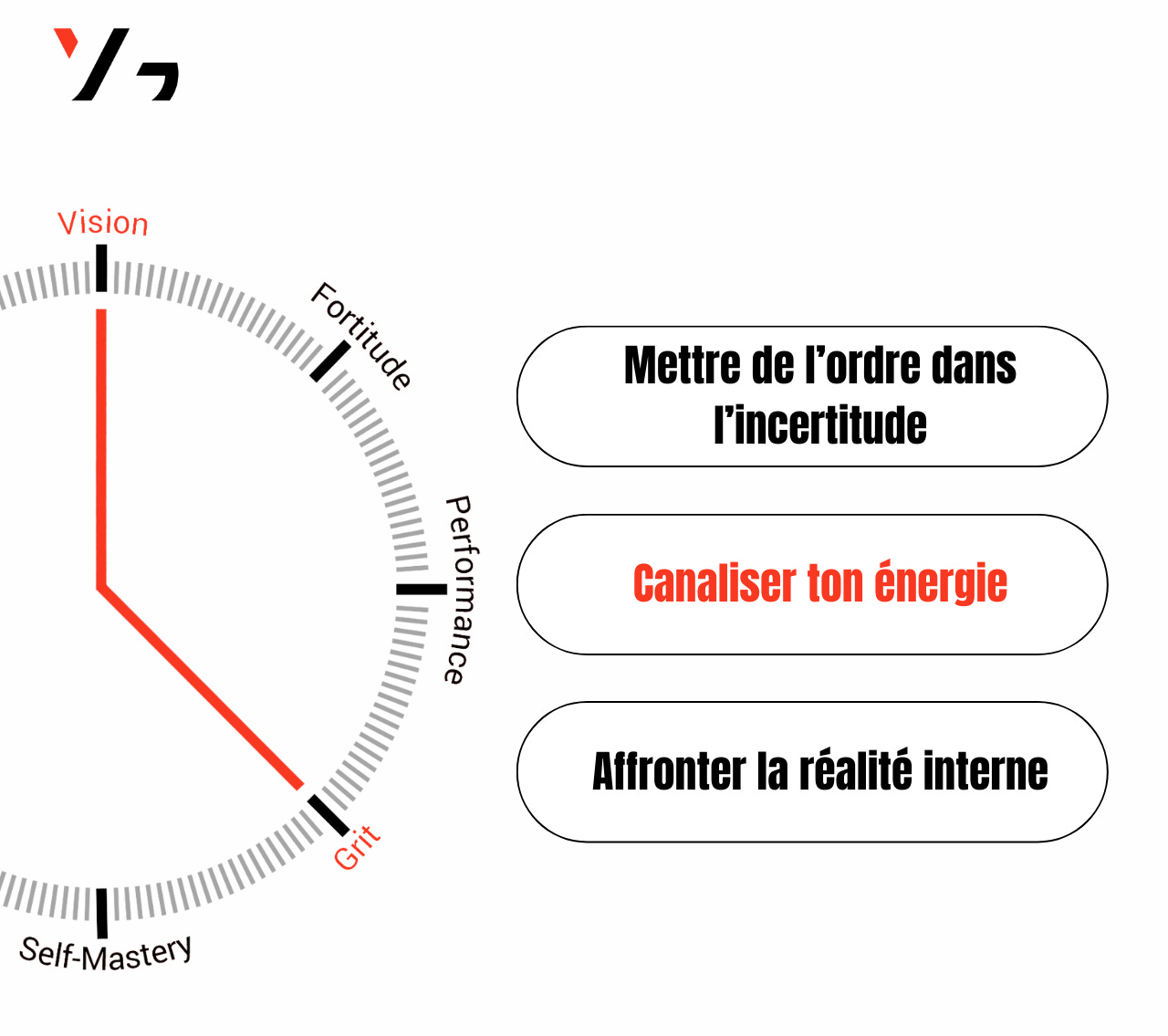
Real change comes from how these two forces work together within you:
Vision Gives Grit a Clear Course: It prevents your energy from being spent defending mistakes or pursuing goals that are no longer relevant, because of your biases. It channels your strength towards what really matters to you (Be You).
Grit (Reflective) Makes the Vision Robust: When doubts, difficulties or your own biases push you to give up or deviate from your Vision, Grit gives you the strength to hold on, resist short-term impulses and stay committed to your direction
True expertise lies not in claiming to be immune to these biases (no one is) but in recognizing their presence, understanding how they manifest specifically in your unique situation, and implementing, with discipline and humility, strategies to moderate their impact.
It is a demanding journey, which requires introspection and rigor, but it is undoubtedly one of the most profitable investments you can make for the sustainability and success of your solo entrepreneurial adventure.
I am preparing a program called the Morning Voice. It's a daily reset that will reprogram your brain every day so that you are more and more aligned in this Vision that makes your heart beat. It's still in progress, but I'll tell you the details here. In the meantime, leave me a big Like to help me give even more value to this News. Your support means a lot.