
How to Move Beyond Social Norms and Create Your Own Standards
The Two Steps That Worked for Me

Hello and welcome to this new edition of SoloBOOST News. I am Yann, I am a personal development coach, and also a Productivity Trainer.
I created SoloBOOST News to help you achieve this ambition that you have deep in your heart.
With SoloBOOST News, my goal is precisely to delve into these psychological mechanisms that slow us down or, on the contrary, propel us.
And today we are going to dissect this blockage that can directly or indirectly affect solopreneurs like you. You feel this potential within you, this ambition that makes your heart beat, but there are aspects that can hold you back. These are the words that can bother us from society:
"Here's what you need to do if you want to be like us,
How you should behave as a solopreneur,
What you're considering... it's not really the norm."
In other words, these are what which we call: social norms. However, you want to surpass yourself, you want to create your own standards because you want to be true, you want to stop feeling out of step with your Vision, you want to allow yourself to give yourself the freedom to explore, to innovate, to grow beyond the limits imposed by others.
In one sentence, you want to create your own standards to design a tailor-made system, optimized for your own functioning, your own objectives.
Understanding the Social Norms Matrix
Social norms, what are they really? They represent the implicit or explicit rules that govern behavior within a group or society. They tell us what to think, how to act, what is "normal", acceptable, desirable or, on the contrary, to avoid.
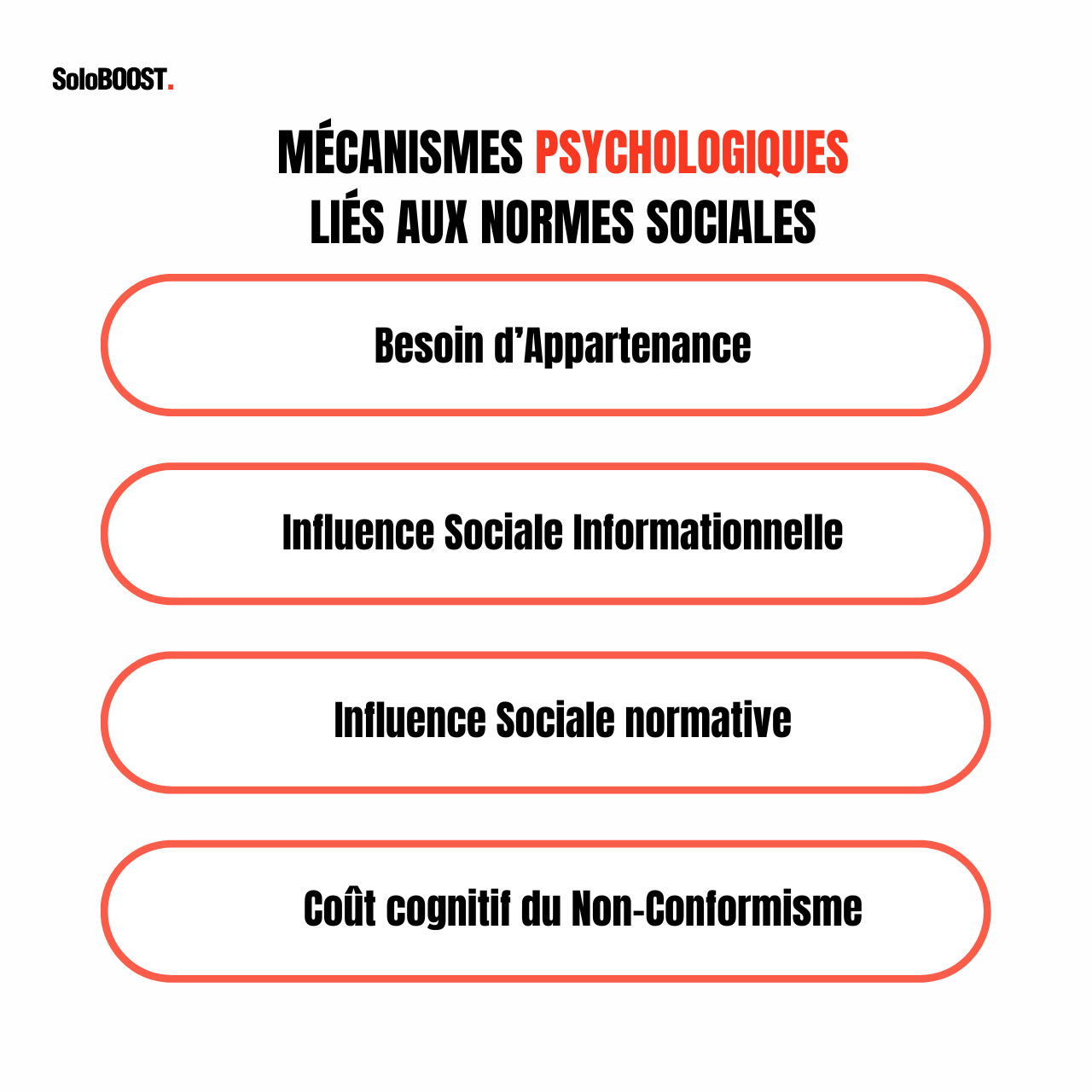
Before being able to consciously choose your own standards, it is fundamental to understand: why collective standards have an influence on us, and even without our knowledge. Several psychological mechanisms explain this:
The Fundamental Need to Belong: We are social beings. And from a psychological point of view, we want to be accepted. Our primitive brain associates belonging to a group with our survival. Going against the grain can activate this subtle fear of being judged, misunderstood or isolated by your peers, your potential clients, or even those around you.
This fear is not always conscious, but it can make you hesitate to make decisions that motivate you.
You may hesitate to adopt this very atypical work rhythm (such as: working intensely for 4 days then taking 3 full days off each week), even if you feel that it is optimal for your energy and your creativity, for fear that it will seem less "serious" or "professional" in the eyes of others.
Informational Social Influence: When we are uncertain about how to act or think (and entrepreneurship is fertile ground for uncertainty!), we tend to look at what others are doing, assuming that they have information that we do not have.
"If everyone communicates this way on LinkedIn, the method must work."
"If successful entrepreneurs all show this image, this is the way."
This is a mental shortcut, a cognitive bias to save energy. The problem lies in the fact that "everyone" is not you, and their apparent "success" does not necessarily correspond to the definition of your success.
Normative Social Influence: Here, we do not follow others because we think they are right, but because we want to be liked, accepted, or at least, not to be disapproved or ridiculed. Behind it is the fear of judgment, of how others will look at you.
You might avoid openly sharing your deep thoughts or your unconventional working methods (even if they are effective for you and your clients) for fear of being perceived as "weird", "amateur" or "not serious". You prefer to stay in a more conventional, less polarizing discourse, which can smooth out your singularity. Or, you could maintain prices "in line with the norm" in your sector, even if you know that the value you deliver would justify much more, for fear of the reaction or judgment of others.
This fear is particularly strong when you expose your work to the whole world.In my case, I do not excel in networking. This is partly my area of incompetence. I am quite easily content to be alone, to work in my corner. Socially, I'm not the guy who will organize meetings with friends to go and drink coffee, or who will go to sports in a group, who will pick up the phone, who will maintain relationships, or create grassroots exchanges. I tried to develop this ability in networking, but deep down, I don't really see any sense in it. When I don't really see any meaning in it, it's because I've decided not to see any meaning in it.
Once again, everything we do, we do it because we see a sufficiently strong meaning. However, I realize that it can help develop my activity, create variety in my life (perhaps coming from normative social influence), but I decided not to put too much effort into it.
The psychologist Solomon Asch demonstrated this in a striking way in the 1950s. He asked people a very simple task: to say which line among three had the same length as a model line. Easy, right? Except that the other participants (accomplices) gave the wrong answer on purpose. Result ? About 75% of real participants complied at least once with the group's wrong answer, going against the evidence of their own eyes! For what ? Either for fear of looking stupid (normative), or by ending up doubting their own judgment (informational)
The cognitive cost of Non-Conformism: Questioning norms, thinking about your own rules, and above all applying them requires considerable mental effort. It is simpler and less costly in energy to follow the marked path. Your brain is wired for efficiency. Thinking outside the box therefore amounts to accepting an additional mental load, at least at the beginning.
Leon Festinger, the psychologist who developed the theory of cognitive dissonance, explains that this dissonance is so uncomfortable that we are obliged to act to reduce it: either change our beliefs (convincing ourselves that the norm is ultimately ok), or change our behavior. If you don't change anything, this internal struggle will drain your energy and motivation.
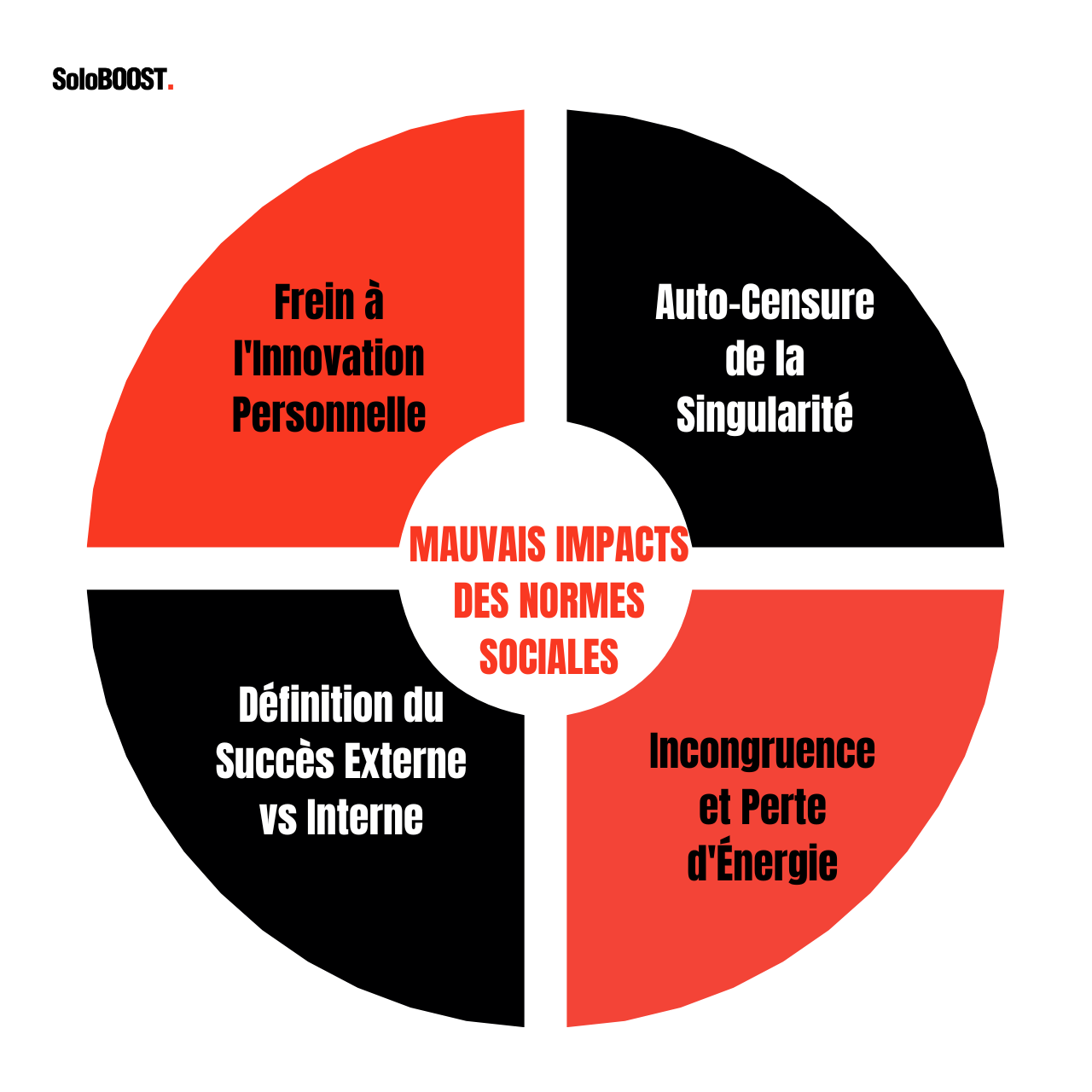
These mechanisms create subtle, but powerful internal and external frictions:
Incongruence and Loss of Energy: Acting out of step with your deep values or your natural functioning to conform to norms (even unconsciously) generates cognitive dissonance. This saps your energy, reduces your intrinsic motivation and can lead to a form of weariness or stagnation: you force your nature.
In Self-Determination Theory (SDT) by Deci and Ryan shows that when we are forced to act against our own choices and values (by conforming to a norm that offends us), our intrinsic motivation collapses and our psychological "vitality" decreases.
Self-Censorship of Singularity: For fear of judgment or by mimicry, you risk not fully expressing what makes you unique: your vision of the world, your atypical methods, your personality. Your offer, your communication, your way of being an entrepreneur become more generic, less magnetic.
Definition of External vs. Internal Success: You may find yourself pursuing objectives (notoriety, company size, type of clientele) dictated by the standards of "success" in your environment, rather than those which correspond to your own definition of a fulfilling life and business. Which can lead you to a form of success that leaves you empty or exhausted.
Hinders Personal Innovation: Standards can prevent you from exploring and experimenting with ways of working, creating, interacting that would perhaps be much more effective and joyful for you, simply because they are off the beaten track.
So how do you take back control and define the rules of the game that really suit you?How do you go beyond social norms and create your own standards?
It's about taking action to consciously choose your own rules. And to do this, you must note this essential point: thenorm is not a normality.
A norm is a rule, an expectation, a standard or a behavior established (explicitly or implicitly) by a social group. It is an external construction.
Normality refers to what is usual, natural, functional, or healthy, either statistically (which is most common) or biologically/psychologically (which corresponds to your state of balance or well-being). It is therefore an internal state.
This distinction is the logical key which justifies and guides the entire process. For what ? Because the need to change frequently comes from the friction between a social norm and your own normality. Recognizing that what is "the norm" is not necessarily "your normal" gives you permission and legitimacy to detach yourself and create a different framework.
This process is done in two steps, using your Vision and your Congruence as main tools:
Step 1: How to Detach Yourself from Social Norms (Identify and Let Go of What Hurt Your Normality)
It's not about throwing everything away, but about targeting and eliminating what specifically harms you. It is an active process, not passive.
Identify ta Pain with Congruence: Where does it hurt? Where do you feel this tension, this shift, this feeling of “playing a role”? It is your Congruence or your Incongruence that plays a crucial role in being more or less comfortable within these norms. Harmony between your thoughts, your words and your actions is your best guide. If a norm forces you to act against what you deeply think or feel, it creates dissonance. This lack of Congruence is the number one warning sign: this norm directly attacks your normality.
Confront the norm with Your vision: Take this norm that you have identified as problematic. Put it in front of your Vision, in front of this ambition deep in your heart.
This standard propels you towards your Vision, or slows you down?
Does it allow you to be more ''You'', more ''Boss'', more ''Without Limits'' or the opposite ?
Psychologically, your Vision acts as an extremely powerful higher purpose. As decades of research on goal setting have shown (e.g., the seminal works of Locke and Latham), a clear vision directs your attention and energy toward what really matters to you. Additionally, research on meaning and motivation highlights that having a strong "Why", embodied in your Vision, gives you the psychological strength to navigate challenges and make aligned choices, even when they go against the grain.
If the norm is an obstacle on the path to your Vision, then you can break away from it. Your Vision gives you the clarity and motivation to sort things out. Once sorted, make a clear decision to dare to break away from this norm.
As writer Rita Mae Brown said: "The reward for conformity is that everyone loves you, except yourself."
Step 2: Dare to create your own standards
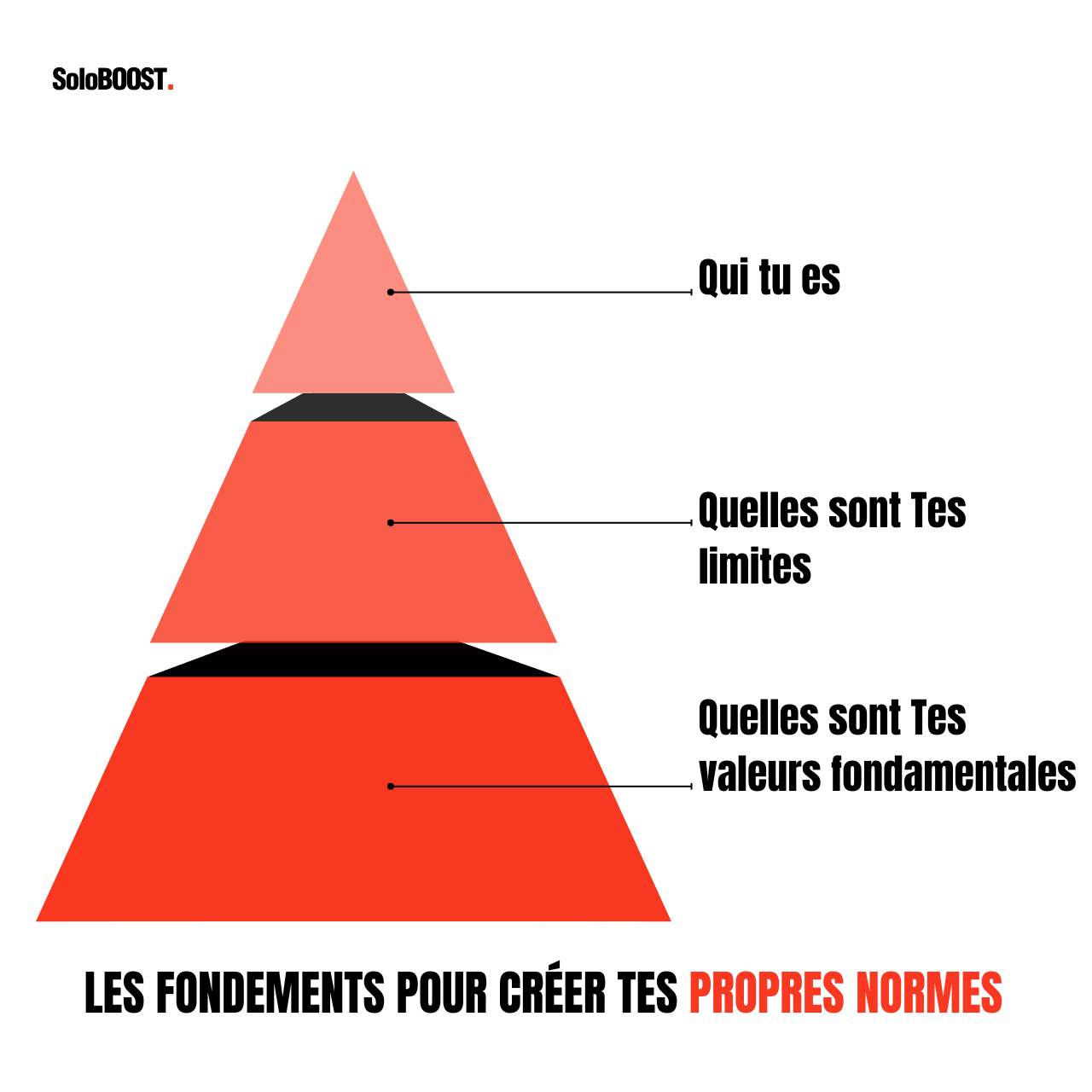
Imposing your own rules, creating your own standards, creating your own standards requires audacity, courage. You have to dare to do it. Your new rules must be built on deep knowledge of yourself.
What is your biological rhythm?
What are your non-negotiable values that must permeate your professional and personal decisions? It can be authenticity, depth, or even freedom, serenity,...
What are your needs to be creative and efficient?
It is this whole, your normality, which constitutes the foundation of your new system. You no longer copy, you create from your essence. You create your standard(s).
And when you create your own standards:
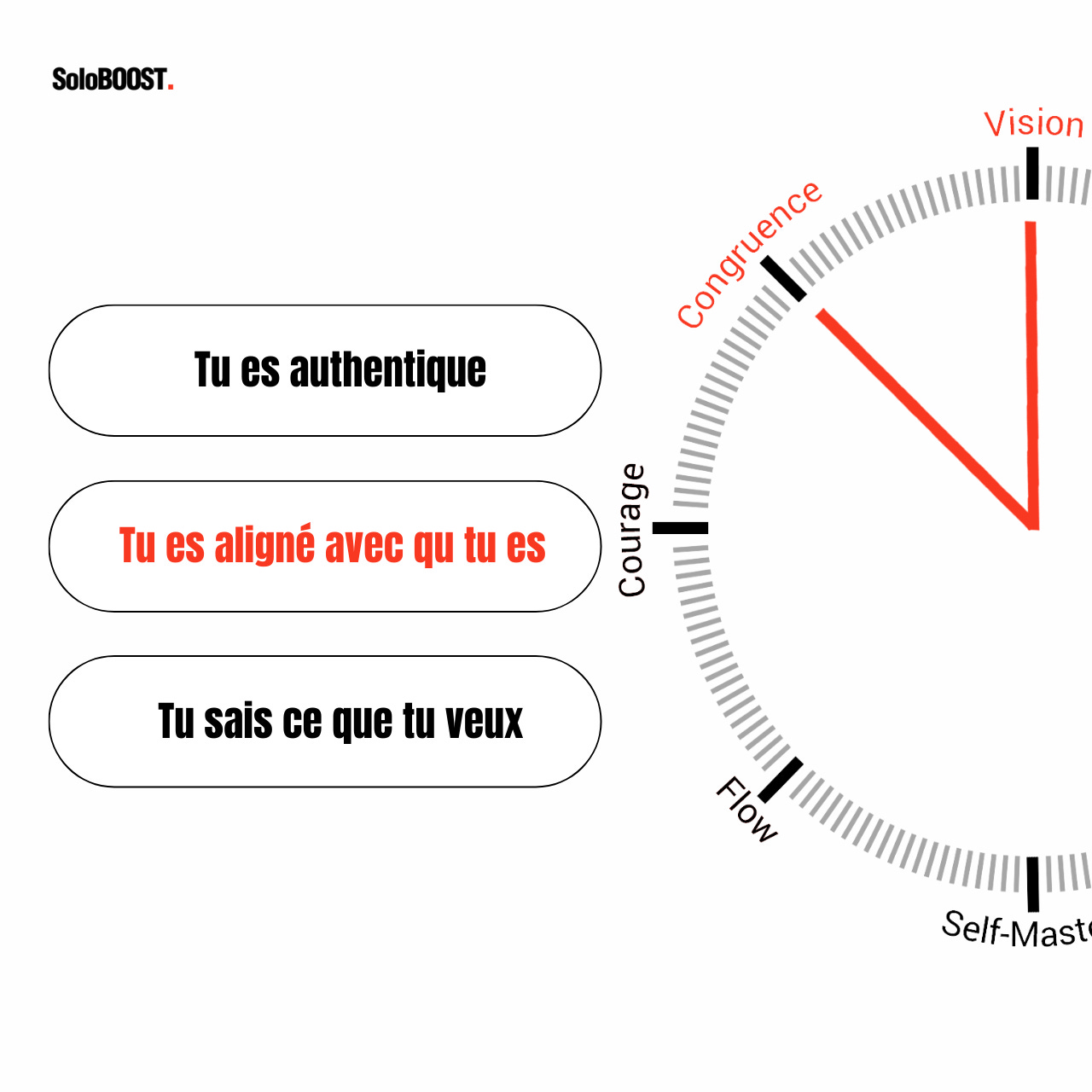
Congruence will help you check if the standards you create are truly in line with who you are, and not just a new form of "should" or a reaction to the old standard. This is the authenticity test. It allows you to feel intuitively and rationally whether a decision or a new rule “rings right” for you. It helps you avoid simply replacing one prison with another. A standard created in a state of Congruence will be easier to maintain and will bring you more energy.
The Vision, will act as your beacon. Without a clear vision, you risk rejecting external standards without knowing what to replace them with, or creating new standards that are not really aligned with your deep aspirations. The Vision gives you the “Why?” of your own rules. Your Vision will therefore remind you of your personal definition of success, of fulfillment, of your ideal business.
The stagnation, the frustration that you can sometimes feel is often the symptom of an internal struggle against rules that are not yours. By becoming the conscious author of your own standards, you not only change the trajectory of your business, you transform your relationship with yourself and your ambition.
You give yourself permission to be fully who you are, and that is where your greatest strength lies.Deviating from the norms can generate discomfort, fear of judgment, or even incomprehension from others.
Learn to tolerate these feelings. Tell yourself that you are forging your own path. The misunderstanding of others is not necessarily a sign of error. On the other hand, daring to create your own standards is often a sign of courage and affirmation.
Every time you make a choice, even a small one, that aligns with your internal standards rather than an external standard, take a moment to recognize it and appreciate the feeling of integrity and rightness. It will positively reinforce this new behavior and build your confidence in your ability to define your own rules.
In my program called The Morning Voice, you will learn to construct a deep message that will allow you to reconnect with your why, your ambition, your Vision. Not only will you gradually detach yourself from social norms that don't suit you, but you will also allow yourself to fully accept who you are and what your values are. It's being prepared, but I'll share the details with you when it's ready.
In the meantime, leave me a Big Like to help me develop the News. Your support means a lot.

Cette news est très pertinente